Label
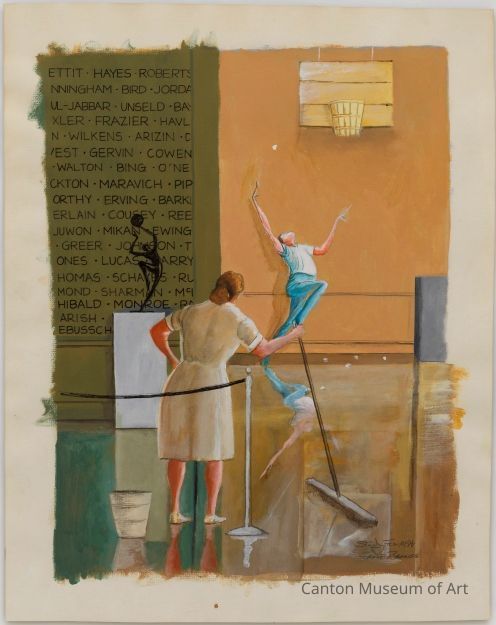
This work is one of three preparatory studies created by Ernie Barnes for "The Dream Unfolds," a major commission by the National Basketball Association commemorating the league’s 50th anniversary. The final painting was installed for many years at the Naismith Basketball Hall of Fame. Though a study, this work stands on its own due to the compelling story that Barnes conveys through it — a vision of basketball as both cultural history and collective aspiration.
In the background, a figure jumps up toward a basketball hoop in a gesture that feels both athletic and symbolic. Here Barnes uses motion, a signature of his work, to convey multiple meanings — the act of jumping and the act of reaching beyond one’s circumstances.
In contrast, a grounded female figure stands in the foreground watching the soaring motion of the player. This duality between active motion and still onlooker is a recurring theme in Barnes’ work, here as the woman (and us, as the viewer) bear witness to a dream unfolding. A wall in the background inscribed with the names of legendary basketball players suggest that the reaching figure is not just playing a game but stepping into a legacy. Barnes, himself a former professional football player, frequently drew on sports as a metaphor for discipline, struggle, and transcendence within Black American life. Through his work he documented black culture, a theme significantly absent in mainstream art history.