Label
"When I was pursuing long-wood-firing, I developed and built a kiln that had a firebox almost as big as the ware chamber. Because my rural subdivision property was not an appropriate place for an anagama, I set about to see if I could achieve anagama-style results by some different means.
Immediately I faced the one large factor that face all long-firing potters: who’s going to help in this endeavor? In an attempt to solve that issue, I designed this large-firebox kiln: it allowed me to fire it with no assistance for the first 12 days of a 15-day firing. I opened the damper of the kiln only ¾ of an inch, and then FILLED the large firebox 4-5 times each day. So, I stoked at breakfast time, lunch, supper, once before bed, and once during the night. This schedule allowed me to continue working full-time as a potter at my retail studio. I’d just run home for “lunch” to feed myself and the kiln.
In anticipation of long-fire, I needed to consider fuel. An act of nature helped to sort this one out: a big storm knocked down 6 large Chinese Elm trees on our property, blocking our driveway, and generally making a mess. I decided that before I hired someone to haul all this wood away, I would try to fire with it. I discovered that Chinese Elm is very high in Potassium release when it is used as a fuel. As a result, one makes Potassium Silicate glass….natural ash glaze…. on the pots. The high-potassium natural ash didn’t look all that nice on my normal woodfired clay bodies. So I set out to try to develop some clay bodies that “appreciated” the potassium-rich natural-ash-glazing.
I formulated 8 clay bodies that were potential choices. But of course, testing them all in long firings would take lots of time and many pots. So I negotiated with 5 woodfire potters, who all agreed to fire in their own fireboxes, one small pot of each of my 8 clay bodies. They did this in exchange for the recipes for each of those clays. This “outsourced-test-firing” yielded rich results, leading me to select 5 of the 8 bodies for heavy ash pots.
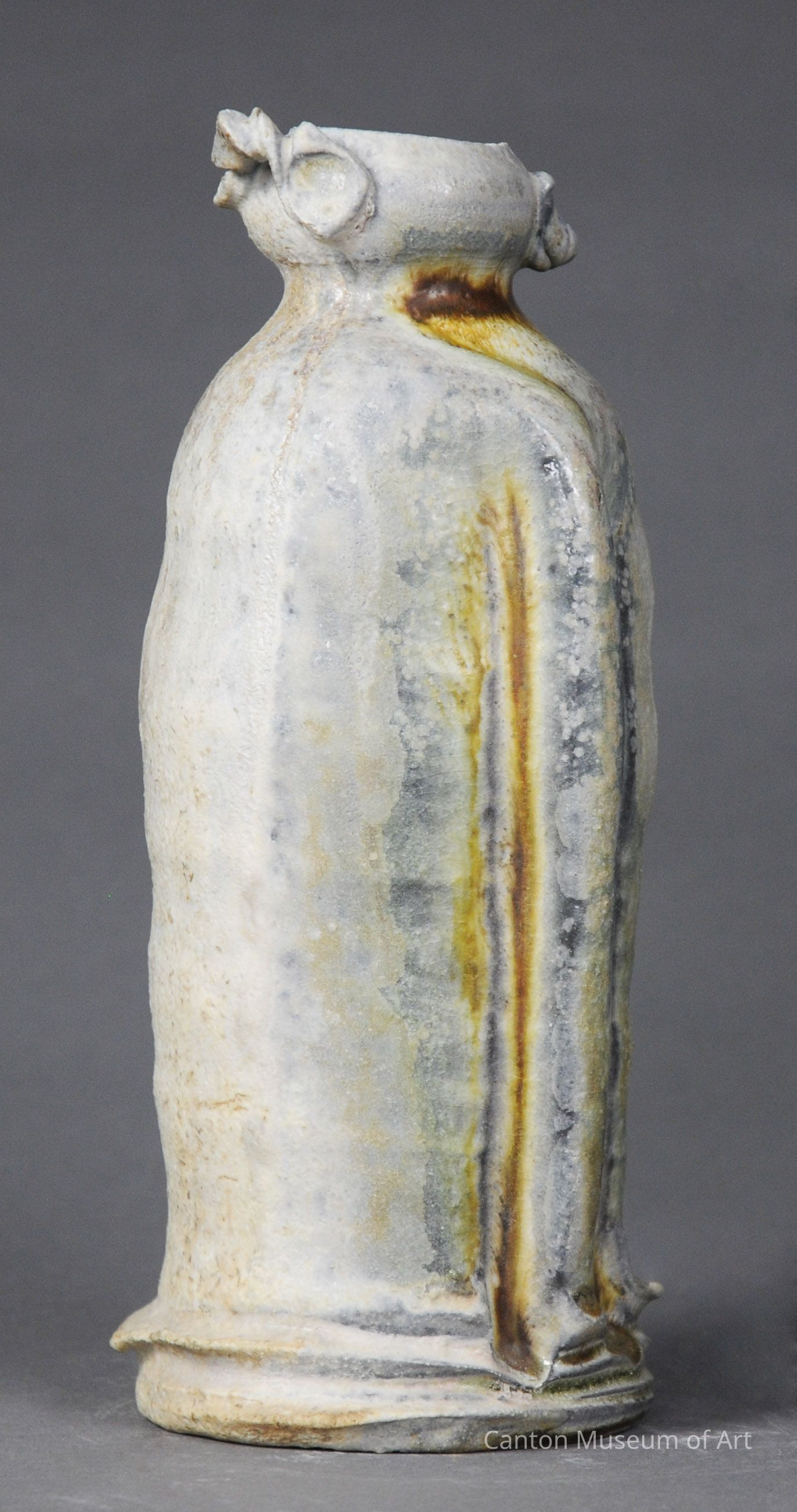
Of course, I still needed to test the 5 bodies in the potassium-rich atmosphere. But with the help of the other potters, I had been able to come to focus on 5 clays. It turned out that 4 of the clay bodies were particularly colorful in the potassium-rich environment. These I used exclusively for all the years of my long-wood-firing. The pot you will be showing uses one of those clay bodies…producing the icy white and steely gray hues, alongside the normal rich earth tones that wood firing so often produces.
My woodfire production routinely was fired for 15 days and utilized about 8 cords of Chinese Elm fuel. I fired for the first 12 days by myself - using the approach I mentioned earlier - and then spent the last three days firing in a way that is more normal for wood firers: teams of people firing the kiln in 6-hour shifts around the clock. When cone 10 melted in front, we set a clock for 50 hours, and continued firing, being careful to keep cone 13 from melting entirely. The rich results from these long firings were the best woodfired pots of my career.
The form that you have is the result of working with a Japanese shape that I quite disliked. (The Japanese ceramic shape was based on Japanese bamboo wall vases.) So visceral was my dislike of the Japanese shape that I’d quickly page past it when it appeared in books and texts. It occurred to me that I my dislike was that great, I owed it to the pot and the history of its use, to try to make it to see if I could understand it. As I worked on it over a period of years, the shape slowly began to morph into what you see here. It was the resolution of my dislike, and a form that I still like and use."