Label
My hand-built ceramic sculptures take the form of stylized figures and animals that reflect a problematic relationship between humans and the natural world. Like monsters, these clay figures often act as a warning, or show some sort of unfamiliar reality through their distortions and abstractions. My work references some visual language used in art historical periods like the 1960’s and 70’s Funk Ceramics movement, as well as some other familiar historical conventions. Frequently, an uncanny and strange sense of humor is used as a hook, inviting an audience to look at something more serious than initially implied by these playfully articulated works.
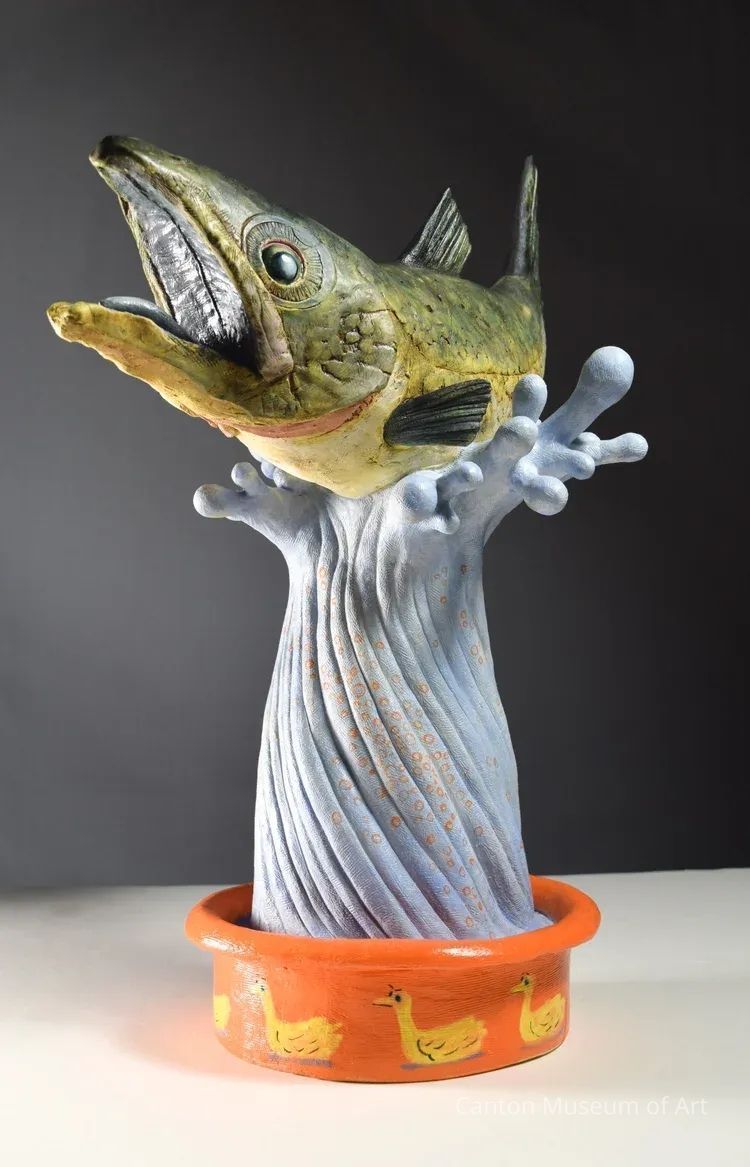
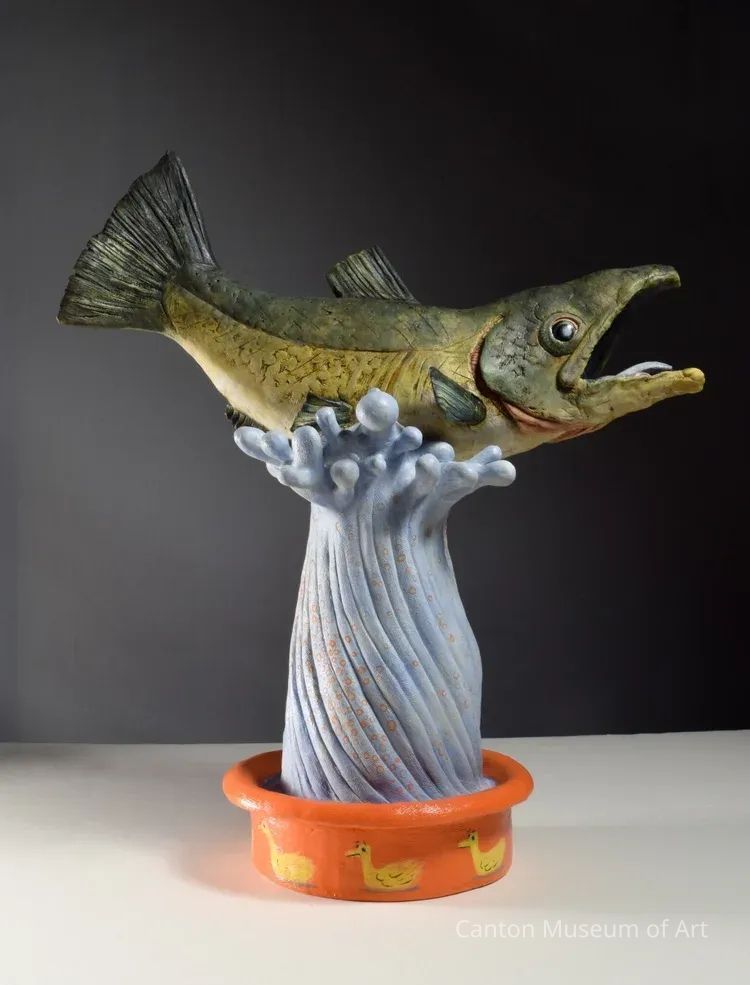
"Young King of Fountain Mountain" was the first piece I created after moving to Ohio in 2019.
The work emerged from my growing awareness of the contrast between idealized public imagery surrounding the environment and the more complicated ecological realities beneath it. Before relocating to the Cleveland area, I had been living in Alma, Michigan, near multiple Superfund sites and polluted watersheds, while the Flint Water Crisis continued to unfold nearby. Arriving in Northeast Ohio—another region deeply shaped by industrial pollution and environmental recovery—further sharpened my interest in how landscapes are marketed and perceived.
I found myself thinking about promotional imagery such as “Pure Michigan,” along with the ways parks, waterways, and natural resources are framed through tourism and recreation. These highly curated visions of nature often rely on extensive human intervention: fish stocking programs, engineered waterways, and environmental management designed to sustain particular experiences and expectations.
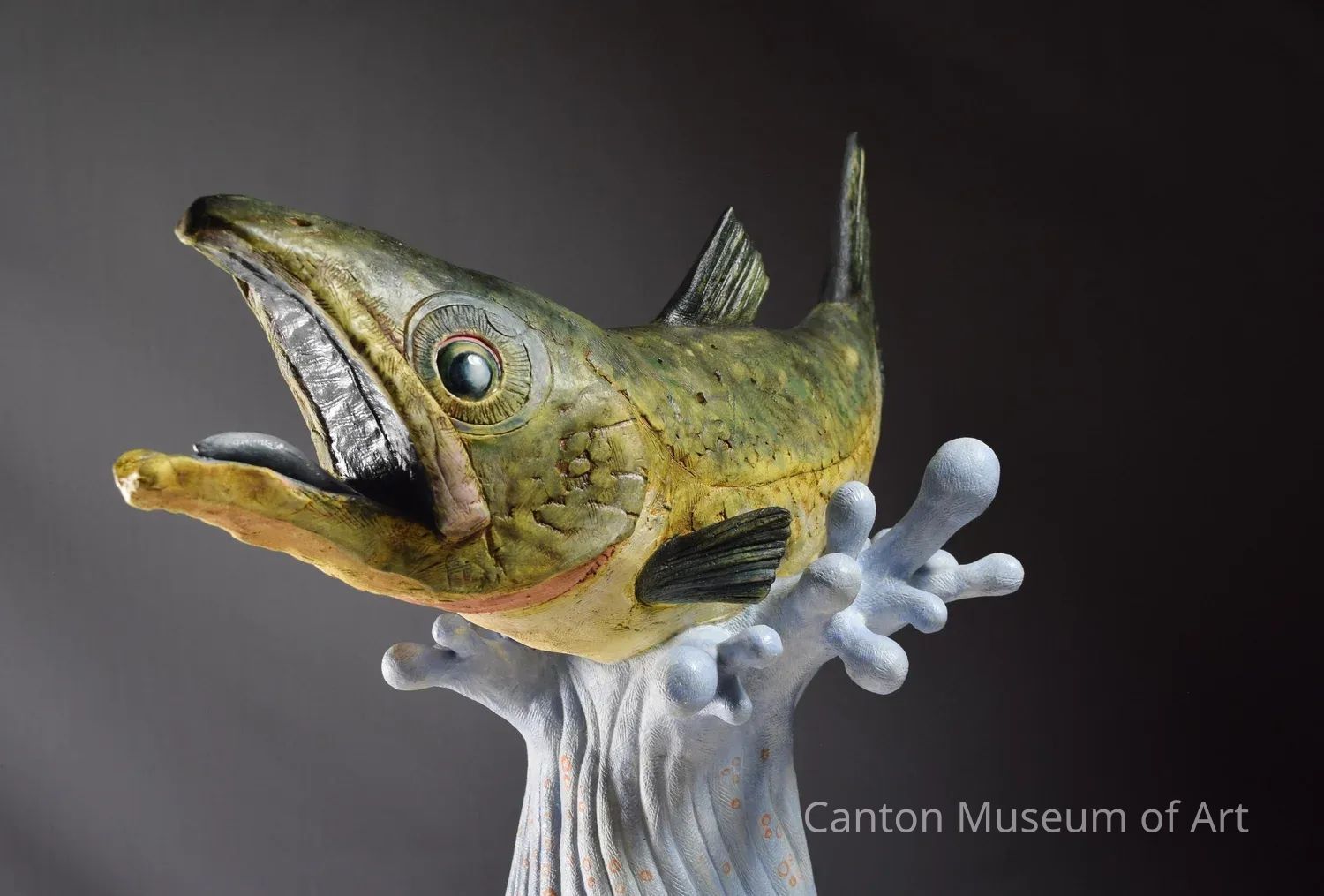
The sculpture explores the idea of a farm-raised fish introduced into an environment with the expectation of greatness—the “young king.” A small swimming pool supplies an exaggerated amount of water, while orange effervescent bubbles suggest both artificiality and instability. Together, these elements foreshadow an uncertain future for the fish, one in which it may struggle to survive in the same way as its wild counterparts.
This piece is made from stoneware, underglaze, and glaze.
The form is built primarily through the coiling process. Over the course of several weeks, I gradually bring the sculpture into focus. As the clay slowly dries, I paddle and compress the larger forms, model smaller anatomical features such as the eyes, fins, and gills, and carve sharper details to give the figure a greater sense of implied movement and vitality. My goal is to describe enough information that the animal appears as though it could move or breathe at any moment.
Before the piece undergoes its first kiln firing, I apply a layer of pastel underglaze as a kind of tinted primer. After the bisque firing, I sand the surface and build up many layers of underglaze—similar to watercolor washes—to develop depth and variation in color. Clear and tinted glazes are then applied before the sculpture returns to the kiln for its second and final firing.
- Benjamin Lambert