Scope and Content
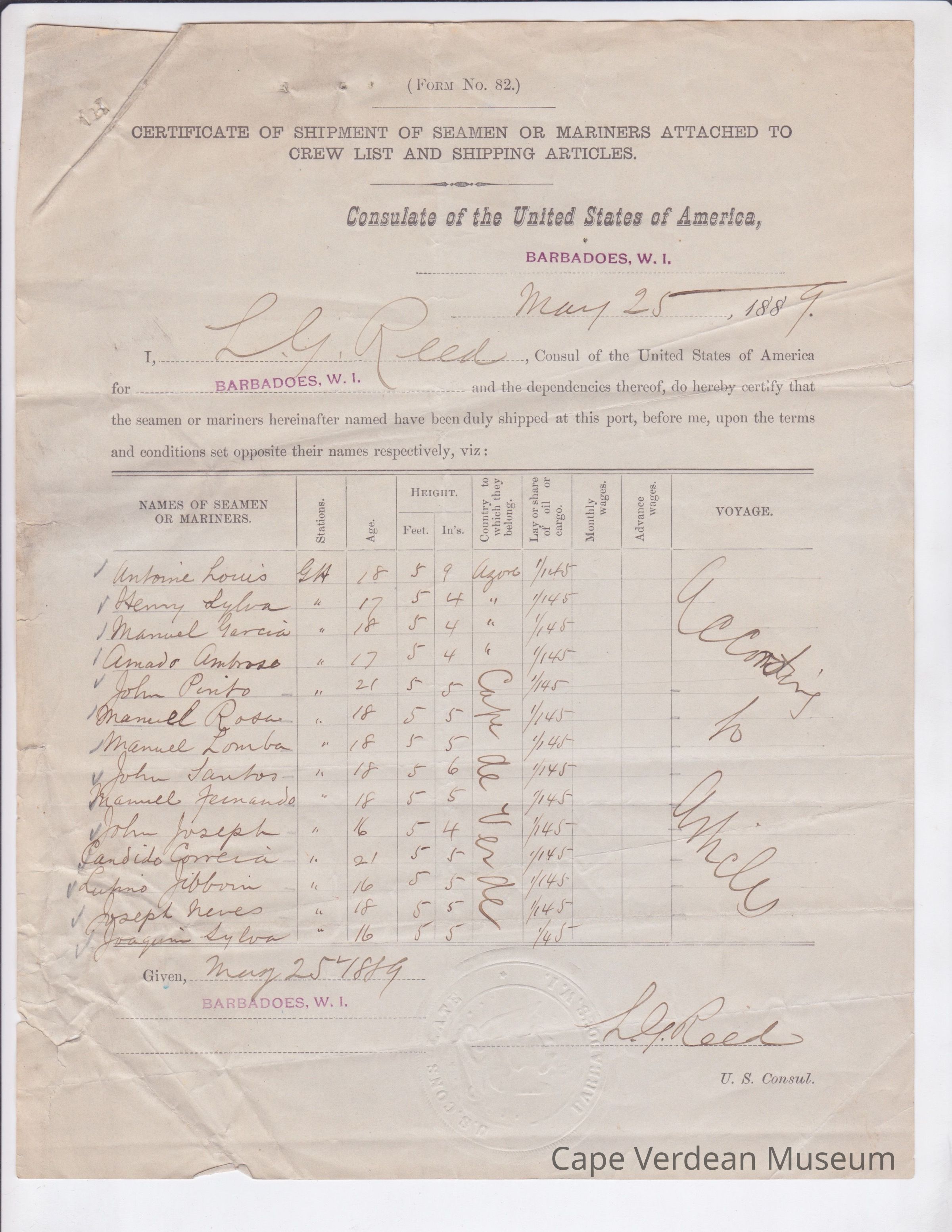
Single page crew list of young Cape Verdean sailors on a whaling voyage that reveals much about the story of 19th-century Cape Verdean migration in the Atlantic.Context
This crew list from 1889 presents a bit of a mystery. How did this group of young Cape Verdean and Azorean men end up in Barbados and what were they doing there?
To help us decipher this document, we turned to Michael Dyer, Curator of Maritime History at the Mystic Seaport Museum. He explained that the certificate refers to a group of inexperienced “greenhands” hired to work on a segment of a whaling voyage and speculated that the vessel in question might have been the schooner Carrie D. Knowles. The Knowles, under Captain Charles Marston, left Provincetown, Massachusetts, on May 8, 1889 and returned September 14, 1890 with 500 barrels of whale oil after a 15-month trip.
It was not uncommon for New England whaling captains to leave their home ports with only a skeleton crew so they could hire cheaper labor elsewhere, like Barbados or Cape Verde.
The Cape Verdeans named here were aged between 16 and 21. They were: John Pinto, 21, Manuel Rosa, 18, John Santos, 18, Manuel Fernando, 18, John Joseph, 16, Candido Correia, 21, Lupino Jibborn, 16, Joseph Neves, 18, and Joaquim Sylva, 16.
Each was to be paid only 1/145 (or less than 1%) of the profits from the total whale oil haul. This might not have been a lot of money for many months at sea, but it was certainly more than a 16-year-old could have earned back home.
Such a voyage would not be easy work, however.
“Whaling itself was a risky occupation,” Ray Almeida writes in his book, “Cape Verdeans in America: Our Story,” and states that, “An enraged eighty-five foot whale could smash a small whale boat to kindling, killing the crew instantly or dumping them into the sea to be drowned or to be eaten by sharks. Accidents were frequent aboard whaling ships, and the Cape Verdean ‘hands’ did not always escape injury.”
“Whaling was also monotonous work, in addition to being dirty and dangerous. For weeks, even months, no whales would be seen. The crew would repair the gear and carve scrimshaw to pass the time. During the periods of calm, food and water became foul and fights among the crew often broke out because of the heat… Captains were reluctant to enter major ports for fear that their crews would desert them.”
But why Barbados?
Barbados, along with the Azores and Cape Verde, was among the most important whaling grounds in the Atlantic Ocean in the 19th century, according to Dyer.
The droughts in Cape Verde of the 1880s and its difficult system of feudal land ownership might have driven these young men away. Barbados, at about 2,100 miles distant, happens to be the closest Caribbean island to Cape Verde.
And the capital of Barbados, Bridgetown, where these men boarded the whaling vessel, was a bustling port at the time.
“Bridgetown,” Dyer writes, “serviced many of the business needs of the whaling vessels that used the port including consular services, ship chandlery and brokerage services and specialized navigational hardware services like clock and watch repair. The famous restaurant and saloon the Ice House on the Westbury Road was a favorite with many visitors to the place. Commission houses, like that of W.P. Leacock, brokered the boarding of sailors ashore, the transshipping of oil, the sale of wood, coal, and bulk foodstuffs such as flour and sugar as well as lightering and cartage.”*
Curiously enough, the names of these young sailors do not appear in the databases of American whalemen so it seems likely that none of them made a career out of whaling in the United States.
Did these greenhands use this voyage as an opportunity to migrate to Provincetown or somewhere else in southern New England? We don’t know the answer as the records in Provincetown are limited, but for many young Cape Verdean men, whaling gave them an important opportunity to set down roots elsewhere in the world.
Several people with similar names and similar dates of birth identified as being of Cape Verdean descent do appear in later U.S. records, living in places like New Bedford, Providence, Harwich, Plymouth and Fall River. So it is possible, though more research would need to be done.
The story of these young men highlights the fact that migration for Cape Verdeans was often not simply a direct line from a hometown on the islands to one particular location in New England.
Many who came to America in the 19th and early 20th century first made several roundtrips as seasonal laborers or had stops along the way where they worked a variety of jobs and picked up a diverse set of skills. This was true of John Silvy Thomas, whose story we posted about last year. Thomas, who later called Boston his home, left São Nicolau at the age of 11, worked as a cabin boy on a ship trading off the coast of Africa and ended up coming to Connecticut by way of Rio de Janeiro in 1815 on a schooner carrying coffee.
Documents like this 1889 crew list remind us that because of the maritime nature of their island origins, Cape Verdeans ended up spread out across the world. Today, there are communities not just in New England, but in places as far flung as Honolulu, Sacramento, Rotterdam and Buenos Aires. Some have even tracked down relatives from the Arctic to Australia. When Cape Verdeans arrived in these new homelands, they brought with them personal histories and an exposure to a broader world that life on the high seas gave them, part of what makes the Cape Verdean identity so unique to this day.Created By
ChrisCreate Date
November 16, 2026Updated By
ChrisUpdate Date
November 17, 2026