Description
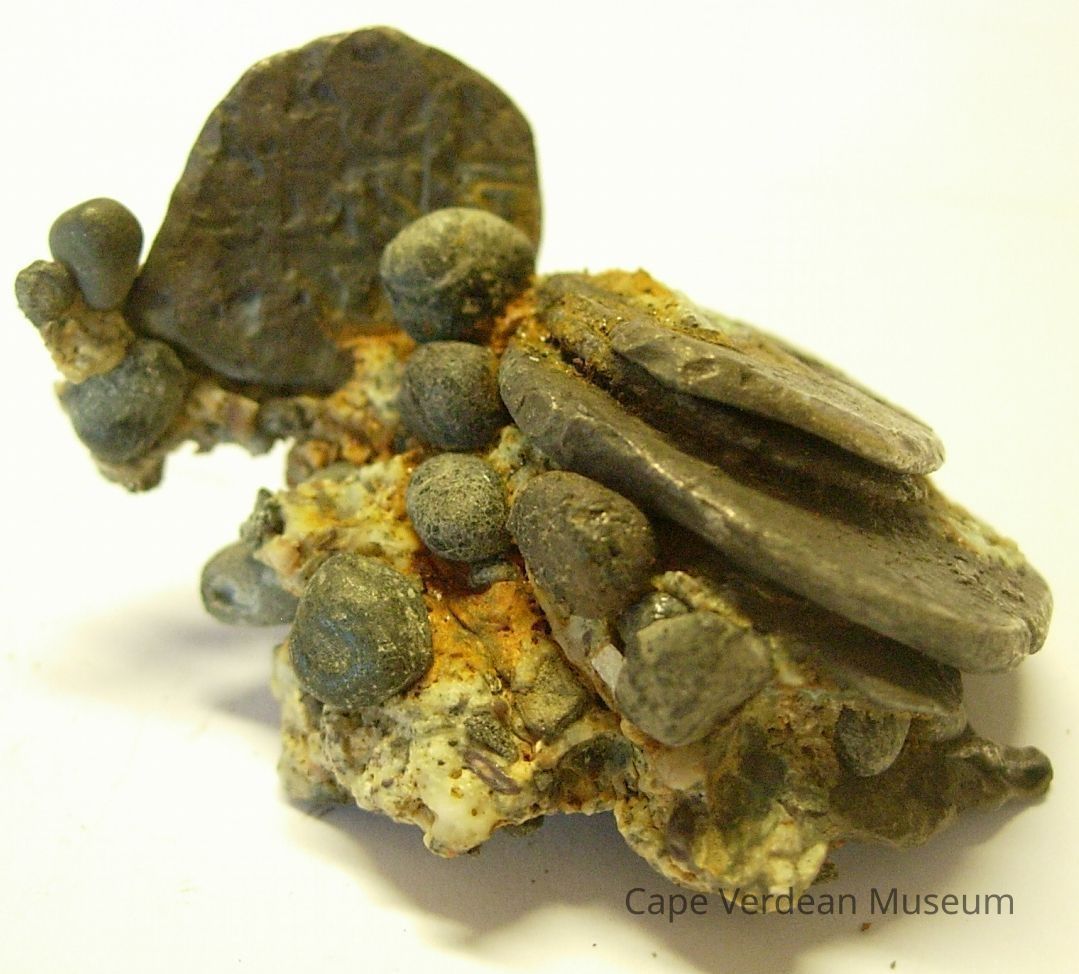
Coin Cluster of 11 Silver Cobs, from Princess Louisa, wrecked on a reef off Maio, 1743, with 20 chests of silver coins, weighing 4,300 lbs.Context
Coin cluster on display at the museum from Arqueonautas Worldwide expedition.
This information was provided by Arqueonautas Worldwide about the ship:
The Princess Louisa was built in 1733 at Deptford in south-east London by Bronsdon and Wells, a famous firm of shipbuilders who built ships for the Royal Navy as well as very fine merchantmen; she was designed for the service of the East India Company. She mounted 30 guns and was rated at 498 tons like all East Indiamen of this period, though this tonnage was an administrative fiction and the Princess Louisa would have been rather bigger, about 550 tons. Many of the ships built for the East India Company were named for royalty and the Princess Louisa was named in honour of the youngest daughter of King George II, an eight-years-old girl who was to become the Queen of Denmark in the same year that the ship met its tragic fate.
The Princess Louisa set sail from Portsmouth on her last voyage on 20 March 1743 in company with another East Indiaman, the Winchester commanded by Captain Gabriel Steward, 26 smaller merchantmen and, since this was a time when England was at war with Spain, a naval escort in the form of the 70-gun two-decker warship, H.M.S. Sterling Castle. She was chartered to sail to Bombay and Persia. The crew consisted of six mates, purser, surgeon, boatswain and 91 other officers and seamen, and she also carried 14 soldiers for the service of the Company in India, a total of 115 men. The Princess Louisa’s cargo is listed in the Commerce Journal of the East India Company and it was a typical cargo, woollen textiles for the Persia market and a mixed cargo for Bombay consisting of gunpowder, iron guns, sailcloth, cordage, iron, lead, and rather unusually ivory or “elephants’ teeth”, 822 tusks in all. However, the Company could never find sufficient goods with a market in Asia to pay for what they wanted to bring home and so much the most valuable part of the cargo was money, 20 chests of Spanish and Spanish American pieces of eight, a total of 69,760 ounces of silver. If this fourth voyage had been successfully completed, the return cargo would have been silk and cotton textiles, indigo, pepper and spices, saltpetre for gunpowder manufacture and a host of other things.
On 17 April, four weeks out of Portsmouth, Boa Vista in the Cape Verde Islands was sighted and the two ships set a course to pass through the islands. As night fell on the following day, both ships shortened sail as they entered dangerous waters, the Princess Louisa’s lights clearly visible about a mile ahead of the Winchester. By midnight, the island of Maio could just be seen to the south-west and about an hour later the Princess Louisa fired her guns as a signal of danger. Shortly afterwards, the Winchester saw her sister ship “in or very near the breakers” on a reef, just in time to tack and save herself from sharing the same fate. At daybreak, the stricken ship could be seen “among the rocks without ever a mast standing and the sea making a free passage over her.” The Winchester launched two boats to try and save the men from the Princess Louisa, but the sea was too high to get close and they had to pull away from the reef, while the men on the wreck despairingly “waved their hats and called to us, but we could not distinguish what they said.” A second attempt was equally unsuccessful and, by now, the upper works of the Princess Louisa had all been washed away and there was not a man to be seen. Reluctantly, the Winchester hoisted in her boats and set sail again, “there being no possibility of saving anything.”
Reports on the condition and location of the wreck convinced the East India Company that salvage was unlikely to be successful, though they were prepared to sign a contract on terms very favourable to the salvors with a private syndicate headed by the ship’s own husband, Thomas Hall. The syndicate fitted out a galley and a sloop, both well-armed, in an expedition designed to combine privateering with the salvage of the Princess Louisa. However, they were unsuccessful in both ventures and one of their vessels was captured by the French on the way home and taken into Bayonne, thus leaving the treasure of the Princess Louisa to be discovered by Arqueonautas two and a half centuries later.
The discovery
The Princess Louisa wreck is located in the Northeast end of the Baixo de Galeao on the North coast of Maio island, Cape Verde, two and a half miles from the coast.
The normal conditions of the sea in this area are exceptionally rough. Big waves are coming from the North and Northeast and breaking with all their strength on the reef. Also strong tidal currents are present running to the NE or SW.
The access to the site is rather dangerous and can be done only in small boats, taking great deal of precaution with the waves those raise suddenly and can capsize the boat.
The seabed in that place is made of volcanic rocks and mostly flat, almost until the reef.
The nucleus of the wreck is a pile of iron and lead bars surrounded by cannons and small guns and is the northern point of evidences in the place with the exception of an anchor that is 005º and 177m away. In total there are 20 big iron cannons (6 of them mixed with the iron and lead bars), 19 small cannon (approximately) and 2 anchors.
Few meters to the south (8m) of this pile is a gully that ends in a small wall that runs almost East-West. In this gully were found the majority of the silver coins clumps and lead shot. This “wall” made a very effective mechanical barrier that stopped most of the heavy objects and concentrated them inside the gully. Continuing to the south and over the “wall” is a shallow flat bottom that falls gently until 6m depth and continues like that for the next 100m. The elephant tusks area is 337m at 201º from the iron pick pile, but in between these two sites we can found the debris of a modern steel wreck.
As the Princess Louisa site is under very adverse meteorological conditions most of the time, with waves of 3-4m and very strong tide currents during summer and winter, we could confirm that most of the light objects of this wreck were washed away and destroyed during the last 200 years.
The first excavation in this wreck was done in 1998, when the majority of the coin clumps and the few visible artefacts were recovered.
In the season of 1999 was set a grid system in order to excavate as carefully as possible and avoid missing small artefacts or little areas. Each grid was 25m2 area (5m x 5m) and orientated according to the geographical coordinates. Were set two grids simultaneously and moved them only when the whole area inside the grid was already searched and excavated; the next emplacement was just besides the previous grid. The entire area of the wreck was covered with this system and special interest was made in the South of the gully were most of the objects were found in 1998.
Many single coins and lead shot were found under the rocks as well as fragments of glass and some glazed pottery. The excavation was done from the main iron pile to the South and going SE and SW (downwind) until the occurrence of artefacts was null even deep in the sediment. A systematic metal detection was performed in the main area of finds and in the edges of the scattering area without interesting readings. A wide survey was done to the North East and South West (1 Nm approximately from the pile) and no new evidences of the wreck were found.
Apart from the silver coins, not many artefacts were found in this wreck. The main area of coin clumps and lead shot was the gully in the South of the iron pile. In this gully the seabed was literally covered with coin clumps and lead shot (bird shot mainly) and in the west end of this place were found most of the bottles and fragments of glass of the wreck. The birdshot were scattered from the iron pile (and surrounding it) until the “wall” in the South and very few were found over the “plateau” after the wall. In the area of the anchor, where the sediment is deeper, were found the personal belongings (knife handles and pieces of jewellery) and the Seville coins (rounded pillar dollars very different from the cobs of the rest of the area). Is interesting to note that the Seville coins were not mixed with the cobs and this suggests that were stored in different place in the ship or at least in different boxes.
The elephant tusks were quite well concentrated in the area to the SW and very few were found in the cannons area. A wide scattering of elephant tusk is present going downwind (SW) and some tusks were found even in the coast (2.4 miles away), as fishermen information reads.
A total of approximately 45,000 silver coins and 181 elephant tusks were recovered from the Princess Louisa wreck site.
Writen by, Lic. Alejandro Mirabal
Marine Archaeologist / Operations Manager
Arqueonautas WorldwideCreated By
ChrisCreate Date
November 16, 2026Updated By
ChrisUpdate Date
November 16, 2026