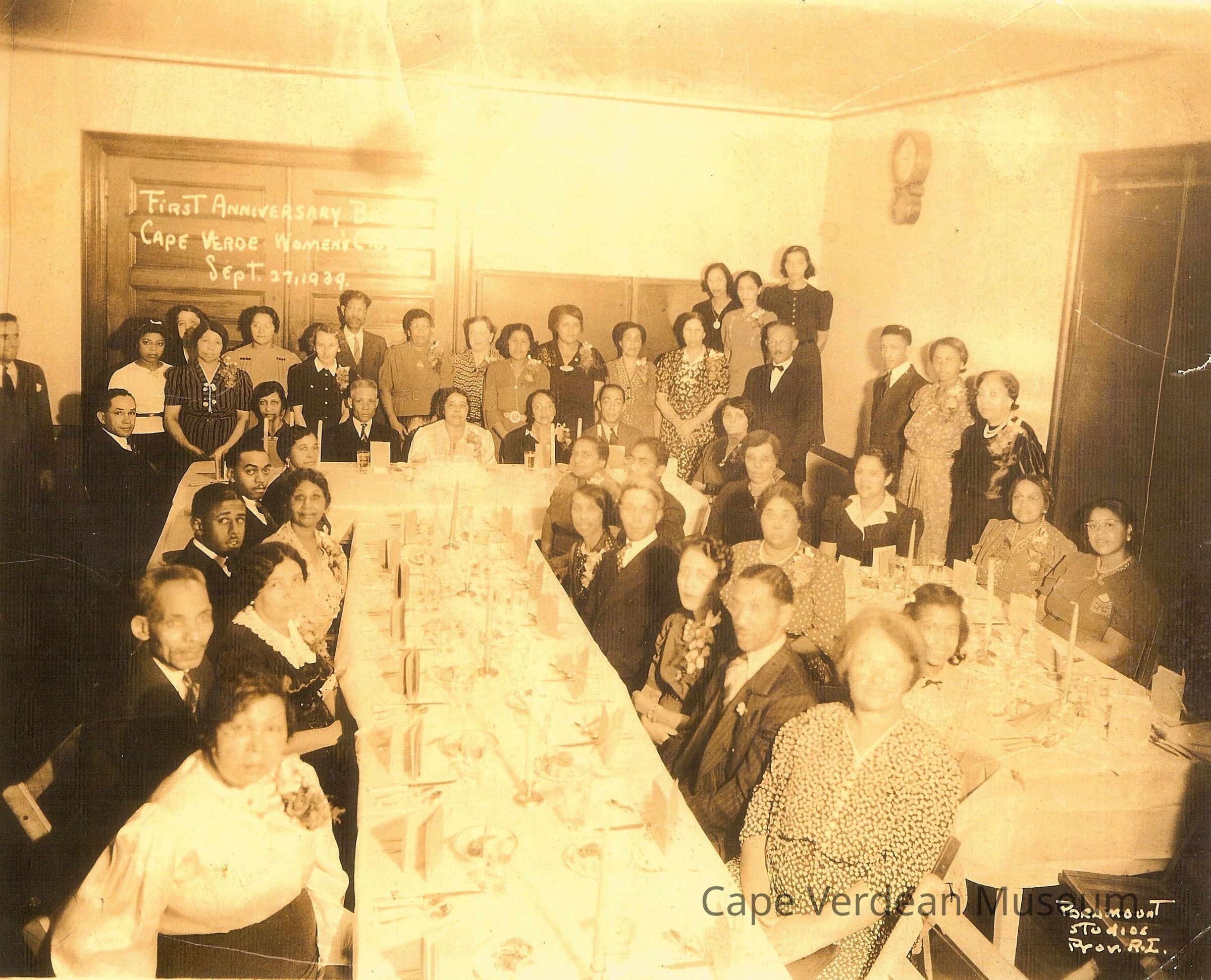
Description
1938, the year that Providence’s Cape Verdean Women’s Club was founded, was an ominous time in America. The Great Depression was taking its toll and world war was looming.
Unlike the “Cape Verdian Smart Set,” which had disbanded the year before, this new club was less focused on cultural activities and more geared towards vocational training and English literacy, helping prepare the workforce for a productive life in America.
Members included Mary Almeida, Mary Bento, Margaret Cabral, Louise Duarte, Mary Fontes, Mrs. Justa Gomes, Clara Lima, Joaquina Lima, Virginia Lima, Mrs. Antonio Lopes and Mary Madelein.
The Cape Verdean Women’s Club was created as part of a larger effort by the local chapter of an organization named the International Institute, itself a more politically-oriented offshoot of the YWCA. Its strategy during this time was to address the social issues of the day by forming separate clubs for the various nationalities of the immigrant population in Providence, so that training could be tailored for the different needs of the Polish, Italian, Armenian, Russian and Portuguese women of the city.
Between lectures on subjects like tuberculosis at Institute’s building on Arnold Street and English classes at the Wickenden Street Centre, the Cape Verdean group did have time for fun. They held a “Cotton Ball” in 1939 where a prize was awarded to the woman wearing the most attractive cotton gown. Members were also invited to teas at the International Institute building where they mingled with women from the other nationality groups.
With the start of World War II, the International Institute cut back funding for such activities and the Cape Verdean Women’s Club appears to have closed about 1940. Today, the International Institute is known as Dorcas International Institute.
Also in 1940, a completely separate group of women formed another organization named the Cape Verdean Women’s Club, which was incorporated in 1944 as the Cape Verdean Women’s American Progressive Club. That group became East Providence’s Cape Verdean Progressive Center in the 1950s and remains an important part of the community in Rhode Island to this day.Created By
ChrisCreate Date
November 16, 2026Updated By
ChrisUpdate Date
November 16, 2026