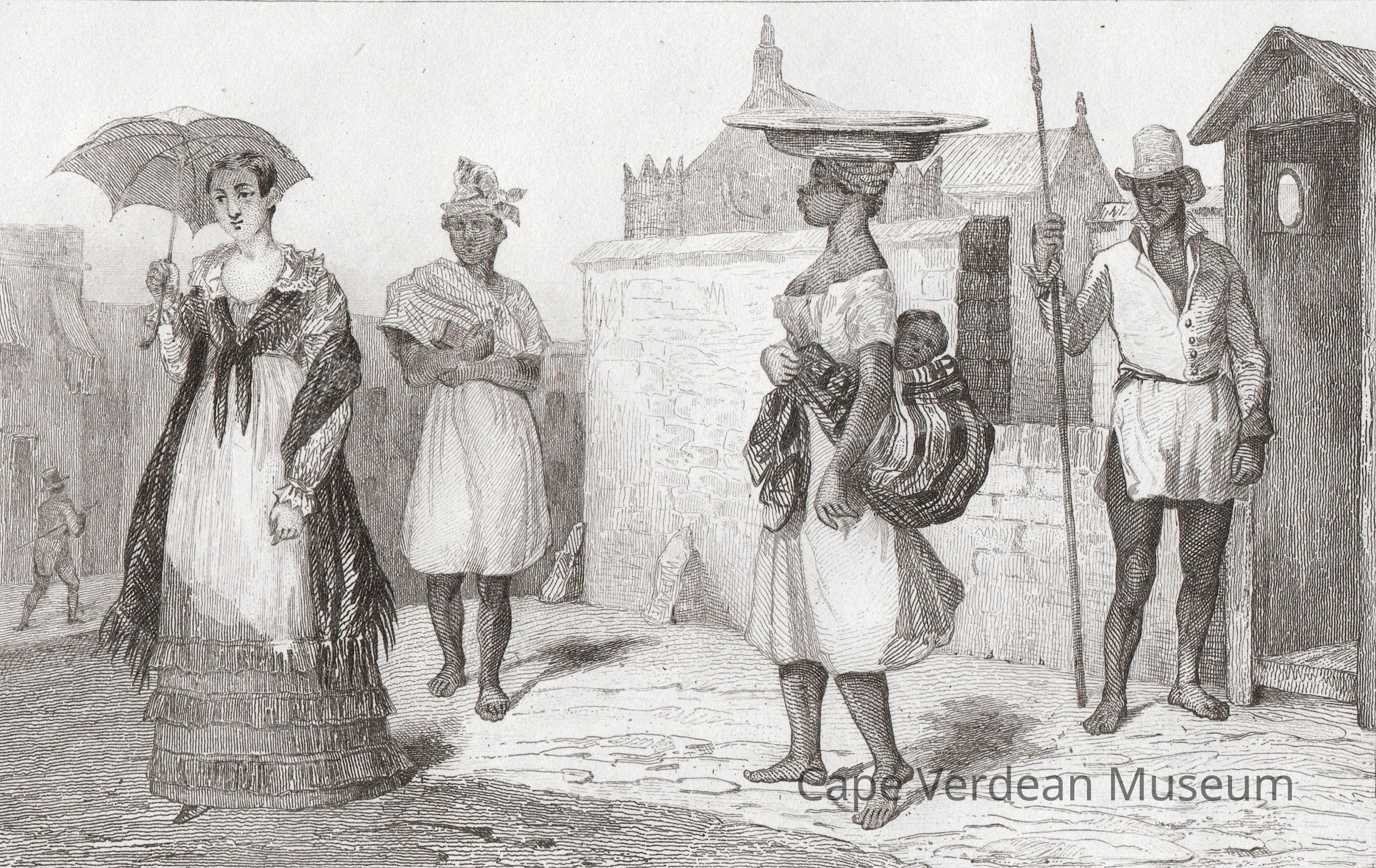
Michel, J. M. Ile du Cap Vert, "Habitans de San Jago" [Lithograph.] Circa 1830s.
Context
Used in the Cape Verdean Museum's 2025 exhibition on enslaved people and Cape Verde.
Artwork Details
Subject
The clothing styles of enslaved Cape Verdean women are depicted in this rare and early lithograph in the museum’s collection.
At the center right, a Cape Verdean woman carries a baby on her back wrapped tightly in a pano and called a bombu mininu. She wears her hair tied up and carries a bandexa on her head, a wooden bowl for fish or fruit, leaving her hands free. This enslaved woman follows her mistress, the woman in European clothing at left with an umbrella, and the composition suggests that they are heading to the markets to shop.
A second woman, in the background, wears a pano around her shoulder and a lenso tradisional around her head, typical of Cape Verdean women of this period.
To the right, a barefooted Cape Verdean man in an open-collared shirt with a tall hat stands at a sentry box. Enslaved people were not permitted to own shoes in this era. Behind him is what appears to be a church. Together, this was possibly meant to symbolize the military and religious aspects of the Portuguese colonial authority over slavery.
This detailed lithograph was made by J.M. Michel in the 1830s and is based on a work by a French artist and naval clerk named Louis-Auguste de Sainson. Saison worked as a draftsman aboard a ship named Astrolabe that traveled from France to the Pacific Ocean on a voyage of scientific discovery from 1826 to 1829.