Description
Letter discusses the responsibilities of his position, without once mentioning suppressing the slave trade.
Text:
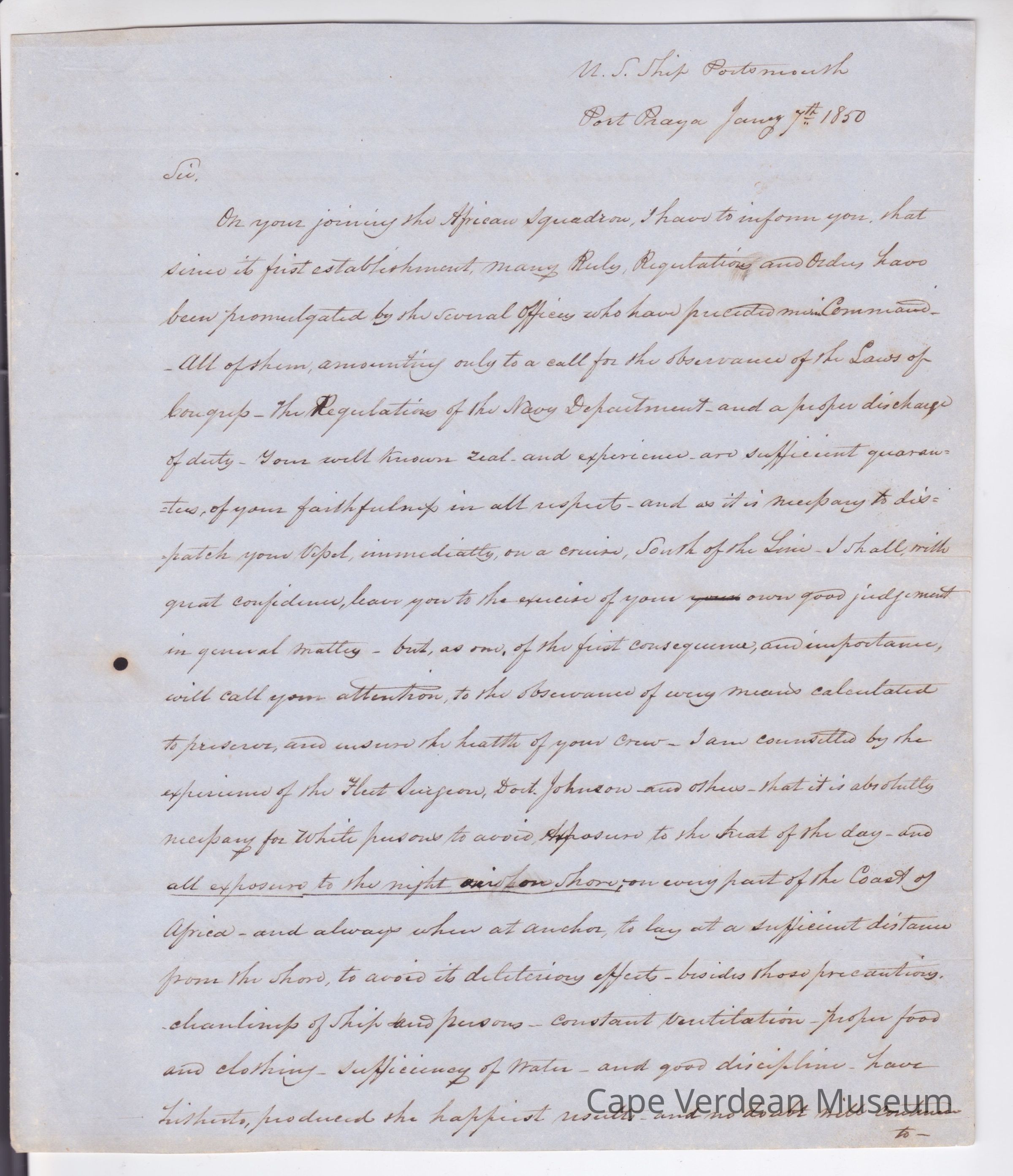
U.S. Ship Portsmouth
Port Praya Jany 7th 1850
Sir
On your joining the African Squadron, I have to inform you that since its first establishment many
Rules, Regulations and Orders have been promulgated by the several officers who have preceded my
command. All of them amounting only to a call for the observance of the Laws of Congress - the
Regulations of the Navy Department - and a proper discharge of duty. Your well known zeal and
experience are sufficient guarantee of your faithfulness in all respects and as it is necessary to dispatch
your vessel immediately, on a cruise, south of the line - I shall, with great confidence, leave you to the
exercise of your own good judgement in general matters - but, as one of the first consequence and
importance, will call your attention to the observance of any means calculated to preserve and ensure the
health of your crew. I am consulted by the experience of the Fleet Surgeon, Doct. Johnson - and others-
that it is absolutely necessary for white persons to avoid exposure to the heat of the day and all exposure to
the night on shore, on every part of the Coast of Africa and always when at anchor, to lay at a sufficient
distance from the shore, to avoid its deleterious effects. Besides those precautions, cleanliness of ship and
persons -- constant ventilation - proper food and clothing - sufficiency of water - and good discipline -
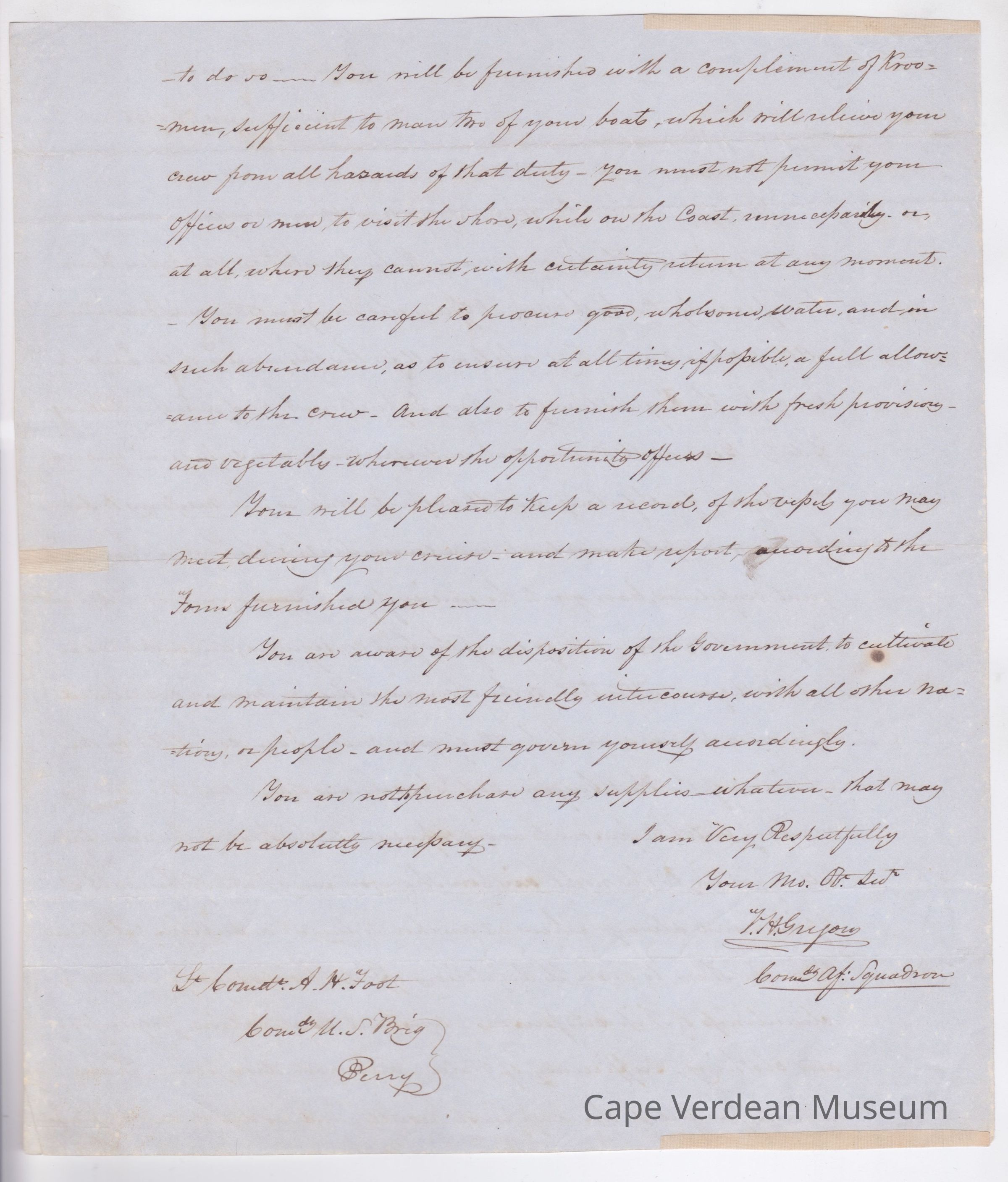
have hitherto produced the happiest results - and no doubt will continue to do so. You will be furnished
with a compliment of kroomen, sufficient to man two of your boats, which will relieve your crew from all
hazards of that duty. You must not permit your officers or men to visit the shore while on the coast
unnecessarily or at all where they cannot with certainty return at any moment. You must be careful to
procure good, wholesome water and in such abundance as to insure at all times, if possible, a full
allowance to the crew. And also to furnish them with fresh provisions and vegetables wherever the
opportunity offers.
You will be pleased to keep a record of the vessels you may meet during your cruise and make
report according to the form furnished you.
You are aware of the disposition of the Government to cultivate and maintain the most friendly
intercourse with all other nations or people and must govern yourself accordingly.
You are not to purchase any supplies, whatever, that may not be absolutely necessary.
I am Very Respectfully
Your Mo. Obt. Srvt
F. H. Gregory
Commg. Af. Squadron
Lt. Comdr. A. H. Foot
Comdg. U. S. Brig PerrySubject
Description:
Admiral F.rancis] Hoyt Gregory, Commander, US Africa Squadron. Autograph Letter Signed
U.S.Ship Portsmouth, Port Praya, Cape Verde Islands, Jan. 7, 1850. 2pp.
To Lt. Commander Andrew Hull Foote., who had just joined the African Squadron as commander of the U.S
Brig Perry. Gregory, a veteran officer of the Navy since the War of 1812, had no doubt of
Foote's "proper discharge of duty", given the younger officer's "well known zeal and
experience", but as the Perry had to sail immediately for the African coast, he stressed special
measures "to preserve and ensure the health of the crew". As it was "absolutely necessary for
white persons to avoid exposure to the heat of the day" and the "deleterious" night air along the
coast, the ship should anchor "at a sufficient distance from the shore", officers and sailors
should not be permitted to "visit the shore.unnecessarily", and "kroomen" - black Africans -
should man small boats to "relieve your crew from all hazards of that duty. Gregory had almost
nothing to say about Foote's duties in patrolling the coast to interdict slave traders, except that
foreign vessels should be treated diplomatically, as it was "the disposition of the Government to
cultivate and maintain the most friendly intercourse with all other nations or people..." Many
abolitionists in America believed the Navy made a "deliberate attempt" to avoid enforcing the
ban on slave trading, assigning too few ships to patrol work, and selecting Port Praya, 350 miles
from the coast, as the Squadron's only supply depot. The 44 year-old Commander Foote would
prove to be unusual among the captains of the Squadron for his anti-slavery "zeal", and after
four years at this onerous work, he returned to America to write a classic account of his service
in African waters and to become a frequent speaker for the anti-slavery movement. During the
CivIl War, Foote was promoted to Admiral and valiantly aided General Grant in battling
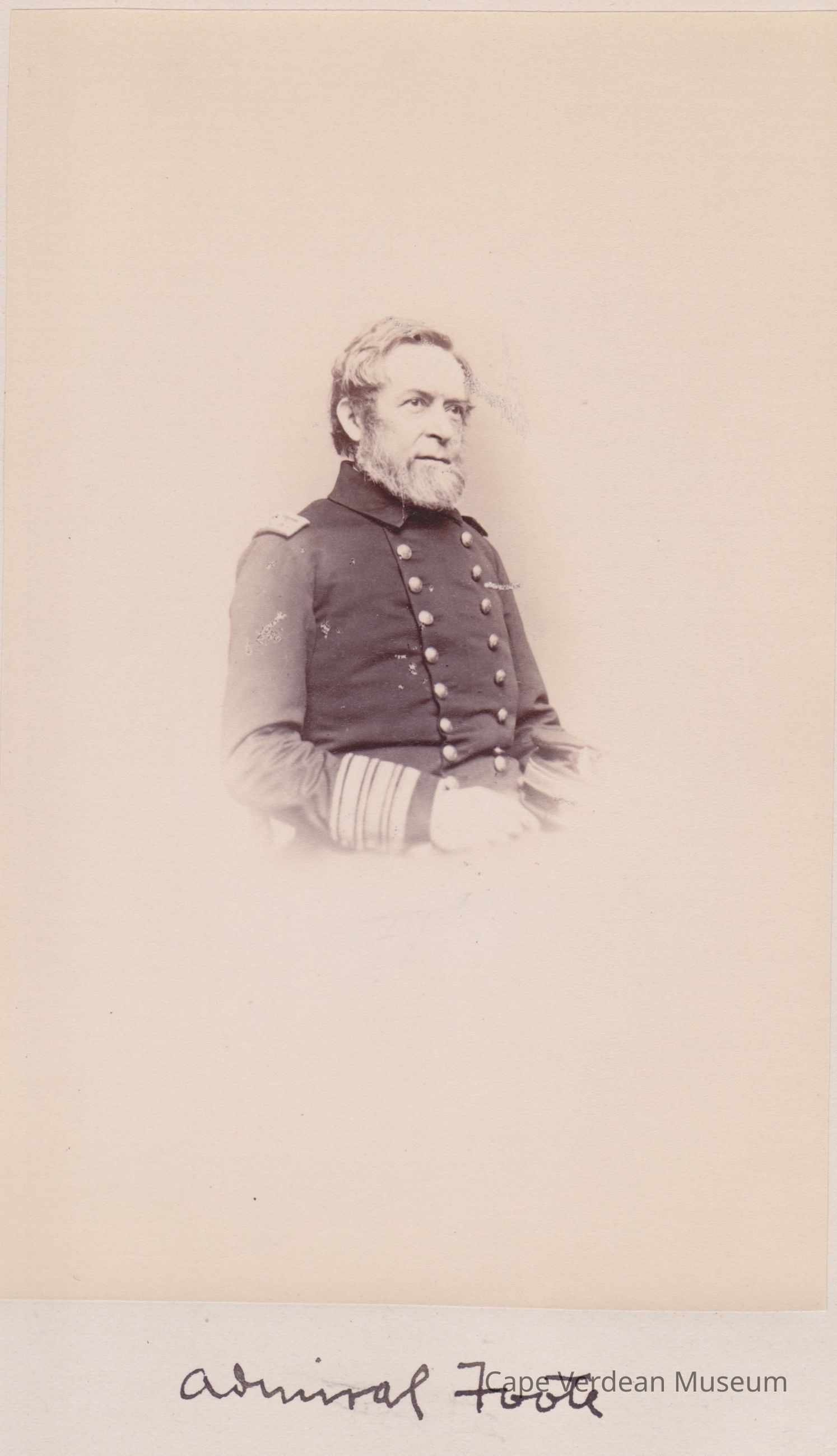
Confederate waships until his premature death in mid-War. Included with his letter is a Cabinet-
size photograph of Admiral Foote cut from a vintage Civil War history.Context
Used in the Cape Verdean Museum's 2025 exhibition on enslaved people and Cape Verde.Created By
ChrisCreate Date
November 17, 2026Updated By
ChrisUpdate Date
November 17, 2026