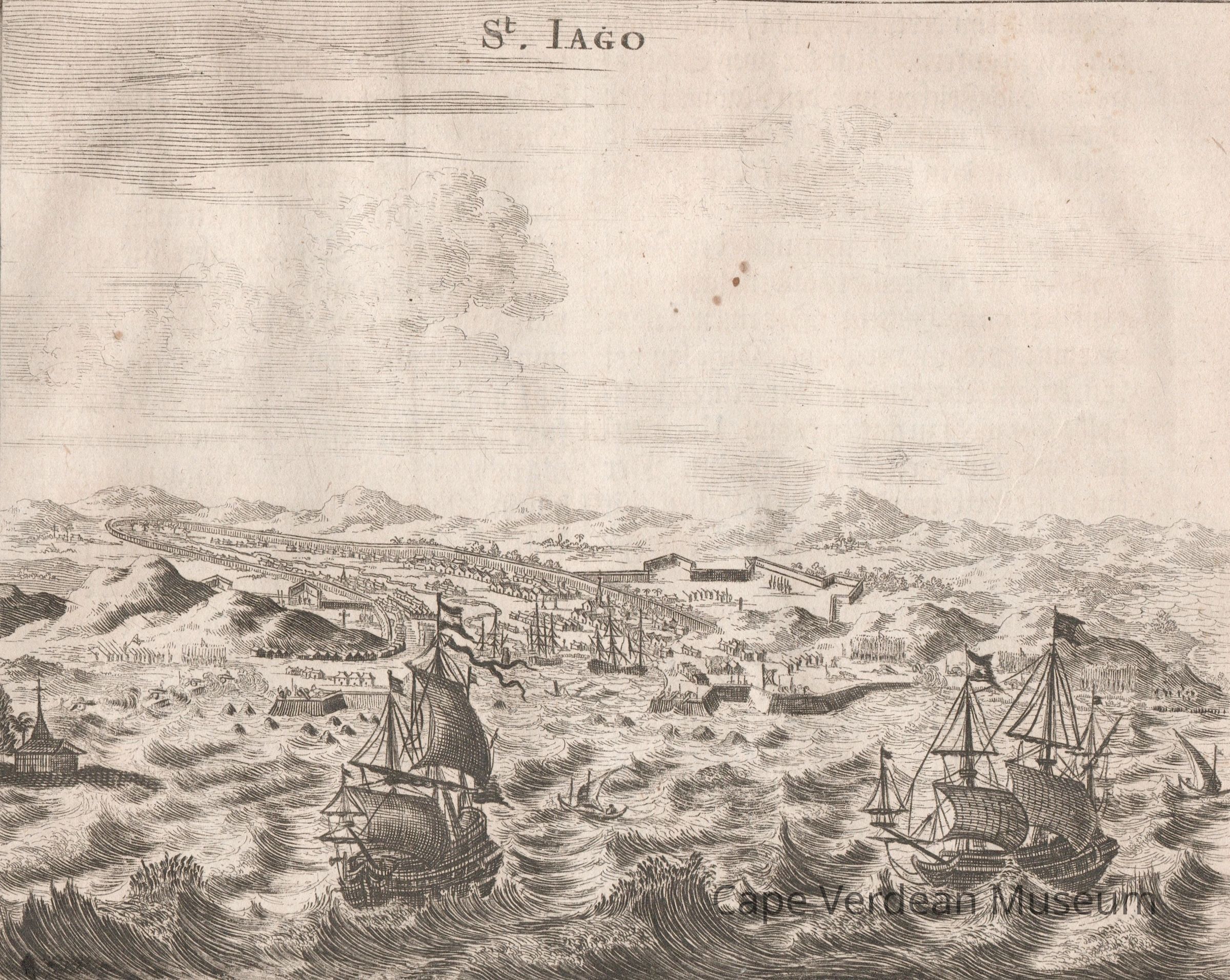
Montanus, Arnoldus. St. Iago. [Engraving.] From: "Die Unbekante Neue welt, oder Beschruebung des Welt-teils Amerika." 1673.
Antique copper engraved print from the German edition of Arnoldus Montanus' "De nieuwe en onbekende weereld..." This is from his seminal work, "The new and strange world..." Shows galleons off coast of Cidade Velha, Santiago. The long, fortified valley that stretches to the left is where enslaved people were held before being shipped off to the Americas
This image accompanied a chapter on the voyage of Dutch explorers Jacques Mahu and Simon de Cordes from Rotterdam in 1598.
Montanus was a Jesuit priest, based in Amsterdam, who published a series of books based mainly on the reports from his fellow Jesuits in their travels around the world. Another engraving by Montanus entitled, "Al de Koningen van Kaep de Verde zyn Burdomel genaenit," is also in the museum's collection.
Context
Used in the Cape Verdean Museum's 2025 exhibition on enslaved people and Cape Verde.
Artwork Details
Subject
An early image showing Ribeira Grande, Cape Verde. This outpost of slavery was protected by fortifications, cannons and numerous soldiers. As can be seen here with the church at the far left and crosses elsewhere, religion also played an important role in this colony.
The Portuguese believed that African slaves had to be baptized before they were sent on to work in the Americas. In groups of up to 700 at a time, captive peoples were baptized at Ribeira Grande by having water sprinkled on them and having salt put in their mouths. They were then given Christian names, which were recorded on baptismal certificates and in the registers of the slave ships.
Panos created in Cape Verde were regularly traded for slaves from mainland Africa during this time, and large numbers of those slaves were sent on from Ribeira Grande to places like Brazil, Mexico, the Caribbean and Cartagena (then a Spanish colony, now part of Colombia).
Today, Cidade Velha is a UNESCO World Heritage Site.