Secondary Title
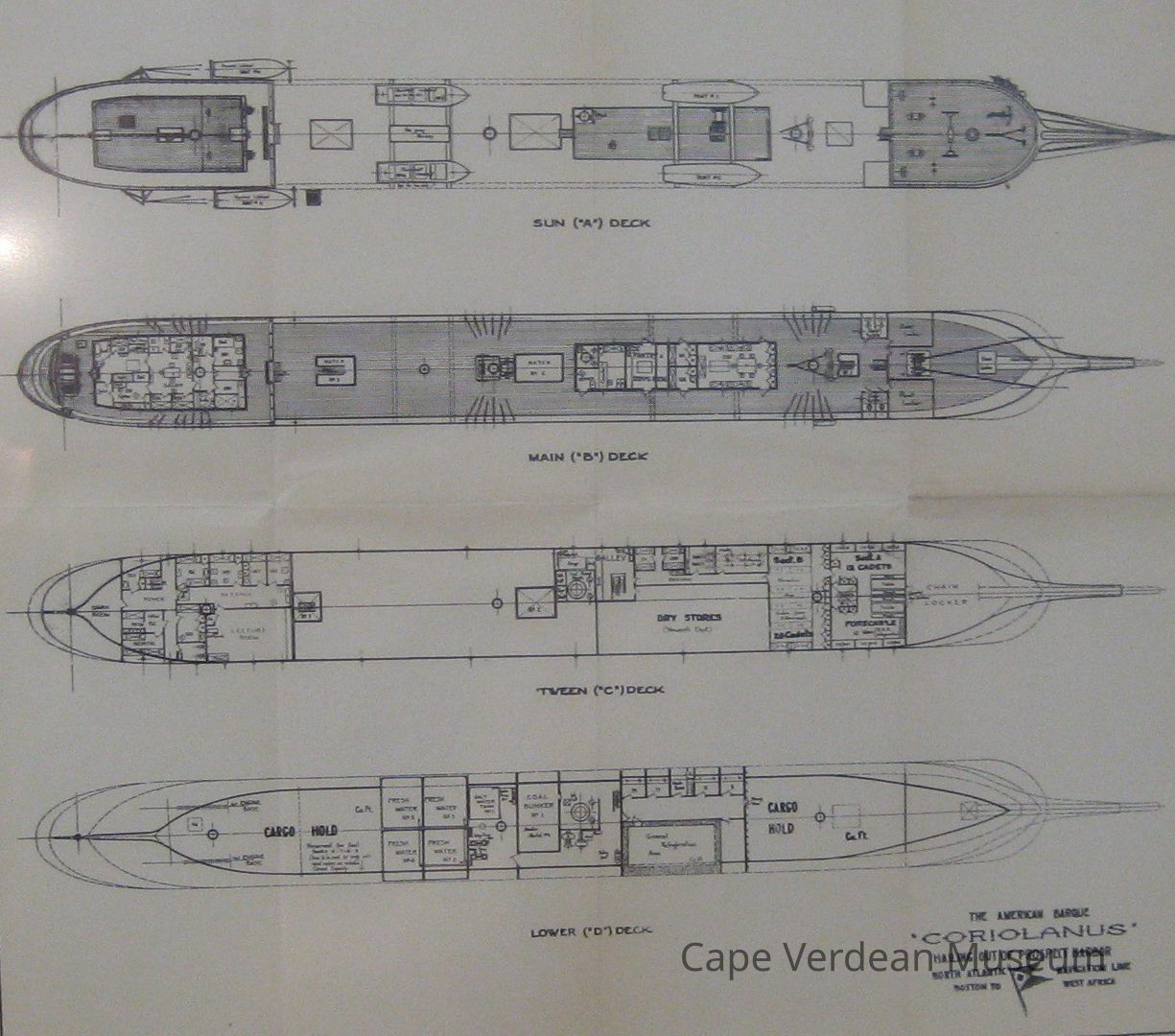
Hailing Out of Prospect Harbor, North Atlantic Navigation Line, Boston to West Africa 4.28.31, Revised Aug. 15, 1932. West African Trading Company.Description
Built in Scotland in 1876, the Coriolanus was a 105 gross ton, 217 foot-long full-rigged schooner. Said to be one of the loveliest iron ships ever built and known as "The Queen of the Jute Clippers," its model was awarded the Gold Medal at the Shipwright's Exhibition in London 1877.
In her long life, the Coriolanus sank a steamer, lost her mast passing under the Brooklyn Bridge, was seized for smuggling alcohol during Prohibition, was renamed six times, sailed under six flags and survived a fire, numerous storms and World War I.
In 1921, she was bought by Louis d'Oliviera and entered the Brava Packet trade, making many trips between New Bedford and Cape Verde. In one passage, she sailed from New Bedford to Santo Antão in a record 17 1/2 days (normally the trip could take 35-45 days). Provincetown author Norman Matson wrote about his voyage to Cape Verde aboard the ship in his 1930 book, The Log Of The Coriolanus. Later, she was bought by Praia's mayor, Abilio Monteior de Macedo, for $1,000.
In 1931, damaged by a black squall and mired in insurance disputes, the Coriolanus was sold for a mere $250 to Clarence Nelson Rogers of Boston. He dreamed of returning her to service and organized the West African Trading Company for this purpose. But Rogers had financial problems and the ship moldered. She met her end in 1936, when the great ship was towed to Fall River and broken up for scrap at the General Iron Smelting Company.Created By
ChrisCreate Date
November 16, 2026Updated By
ChrisUpdate Date
November 16, 2026