Description
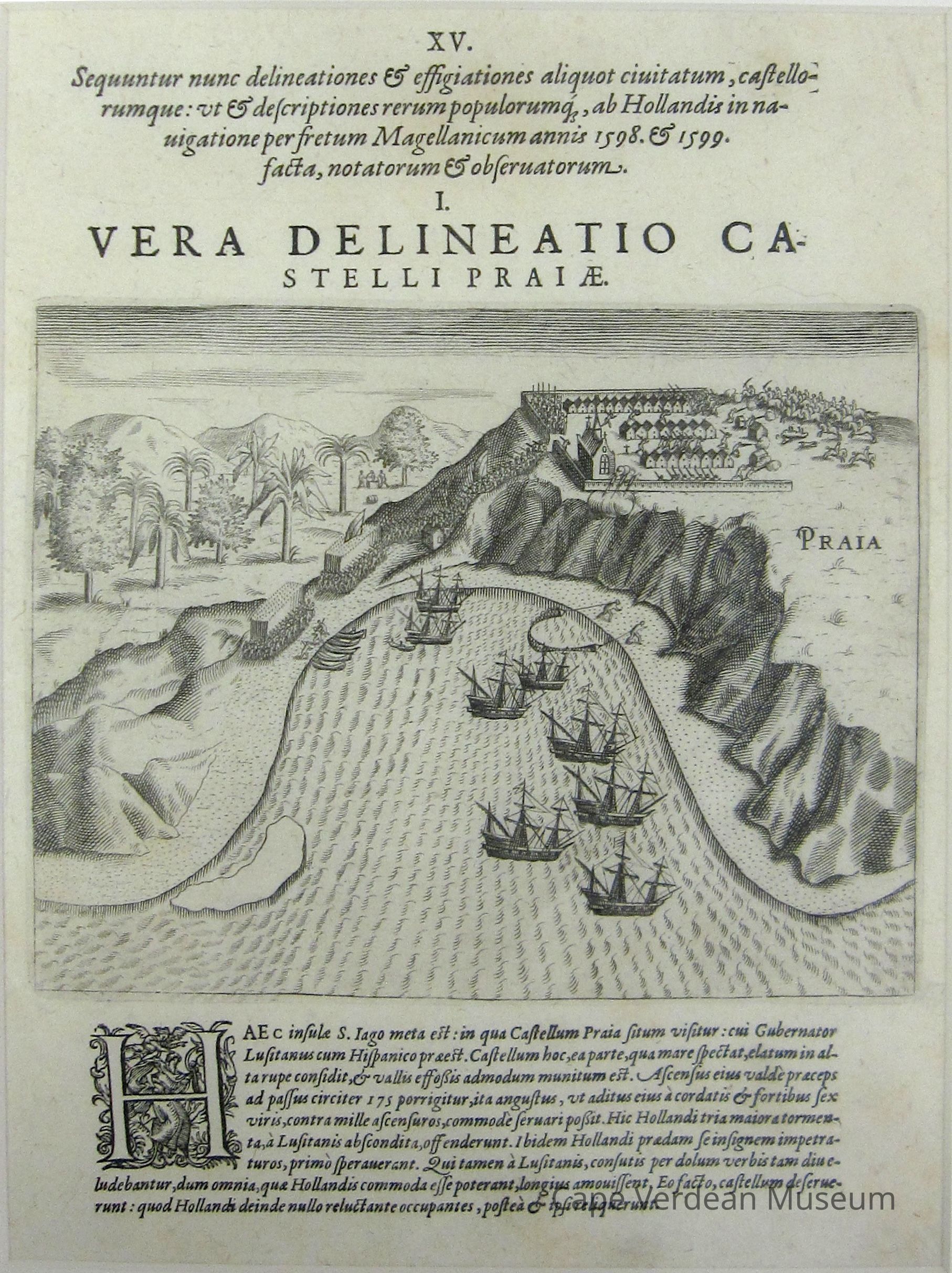
Description: The Dutch attack the fortress at Praia, Cape Verde.
Translation of text: "On reaching Santiago, the fleet decided to loot the fortress at Praia. This stood on top of a high rock, whose only approach was by a narrow stairway with 175 steps. At the time the fortress was occupied by the Portuguese under a Spanish commander. On landing, however, the Dutch were entertained by some of the Portuguese on the beach, while the others hid all the valuables. Later, when the Dutch took over the fortress, they found nothing of value."
Full title: Americae nona & postrema pars. Qva de ratione elementorvm: de Novi Orbis natvra: de hvivs incolarvm svperstitiosis cultibus: déq; forma politiae ac reipubl. ipsorum ... pertractatur ... His accessit designatio illivs navigationis, qvam 5 naues Hollandicae anno 1598, per Fretum Magellanum ... tentarunt: quomodo ... capitaneus Sebalt de Weert ... postquam plurimis mensibus in Freto ... miserè iactatus fuisset ... an. 1600 domum reuersus sit [per Bernhardvm Jansz.] Addita est tertio navigatio recens, qvam 4 navivm praefectus Olevier à Noort ... suscepit ... Omnia è Germanico Latinitate donata, & figuris aeneis coornata editaq́; sumptibus T. de Bry viduae & binorum filiorum [i.e. J.T. and J.I. de Bry]
---
In 15th and 16th century Europe, sea voyages were the main source of information about the world at large. Early book manufacturers were both engravers and printers. They would gather the stories of famous explorers and important naval battles, engrave text, maps and illustrations on copper plates and print them as folio page-sized, multi-volume works. The copper plates would wear down after 200 prints, so only a small number of copies were made at a time. These were less guidebooks and more tales of military power and encounters with faraway places. They often had political and religious motives as well. This was the case with Theodore de Bry (1528 - 1598), a Dutch engraver living in Frankfurt, Germany. His publications are important documents because they represent some of the earliest illustrations of European voyages. Incensed by the spread of Catholicism, he used his books to encourage the claim of Protestants to territories around the world.
This is one of three copperplate engravings on display at the Cape Verdean Museum that appeared in volume IX, Americae Nova & Postrema Pars..., of de Bry's most famous work, Grands Voyages. While he died before this section's publication, his work was carried on by his widow, sons, and grandsons-in-law until 1634. They tell the story of five ships commanded by Jacques Mahu and Simon de Cordes sent out from Rotterdam in 1598. The fleet ultimately traveled around the tip of South America and to Japan. This voyage has been described by some as a pioneering expedition by the Dutch, and by others as a raiding mission on enemy colonies where most of the crew died of hunger or were killed in battle. The descriptions below are told from de Bry's perspective, favorable to the Dutch.Created By
ChrisCreate Date
November 15, 2026Updated By
ChrisUpdate Date
November 16, 2026