Transcription
{partial uncorrected OCR]
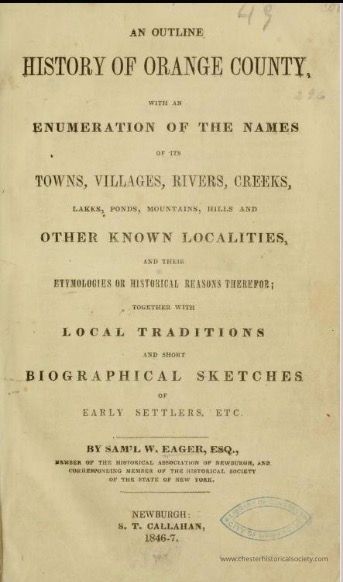
AN OUTLINE
HISTORY OF ORANGE COUNTY,
WITH AN ENUMERATION OF THE NAMES OF ITS TOWNS, VILLAGES, RIVERS, CREEKS, LAKES, PONDS, MOUNTAINS, HILLS AND OTHER KNOWN LOCALITIES, AND THEIR ETYMOLOGIES OR HISTORICAL REASONS THEREFOR; TOGETHER WITH LOCAL TRADITIONS AND SHORT BIOGRAPHICAL SKETCHES OF EARLY SETTLERS, ETC.
BY SAM'L W. EAGER, ESQ.,
MEMBER OF THE HISTORICAL ASSOCIATION OF NEWBURGH, AND CORRESPONDING MEMBER OF THE HISTORICAL SOCIETY of THE STATE OF NEW YORK,
NEWBURGH:
S. T. CALLAHAN,
1846-7.
INDEX.
Preface, Page 3
Introduction, 5
General View of the County, 18
Indians, 30
Settlement of Orange County, 42
Roads and Turnpikes, 52
Agricultural Society, 58
Mastodon, 71
Newburgh, 81
Montgomery, 230
Crawford, 332
Walkill, 345
Deerpark and Mount Hope,. 361
Mount Hope, 399
Minisink, 406
Warwick, 421
Goshen, Hamptonburgh and Chester, 443
Goshen, 502
Hamptonburgh. 511
Chester, 516
Bloominggrove, Cornwall and Monroe, 523
Bloom inggrove, 535
Monroe, 550
Cornwall, 571
New-Windsor, 608
To the Reader, 643
Appendix, 645
Errata. 652
PREFACE.
The following Paper was in part prepared to be read before the Historical Association of Newburgh, and a small portion of it was actually read before that body last spring ; since which the residue has been written, and, at request, permitted publication. The nature and general scope of the Paper will more particularly appear from the Introduction. It was undertaken partly out of curiosity, and partly for amusement, to learn what things, interesting of the kind, could be found located in the County, worth recording. Since began, it has increased in size on our hands, and we now find it, both
in contents and magnitude, a very different article from what it was origin-
ally intended to be, and so disposed to grow up and expand — perhaps not in
real interest, yet in other ways — that we hasten to get rid of it, and give it
another paternity, lest it become too varied in contents and too cumbersome
in detail, to manage with convenience to ourselves or justice to the subjects
treated of. We confess the subject, has failed in fruitfulness and disappoint-
ed our expectations, especially in local tradition. There are, perhaps, many
in the county worthy of rescue from oblivion ; but we cannot afford to spend
the time and money necessary to visit the individuals in possession of them,
scattered as they are in every town. We take to ourselves no special cred-
it for the hasty and fugitive contents, prepared at leisure moments in our
office, in the course of a few months, costing no great expenditure of time
or talent. That it is defective, barren, and devoid of interest to the old and
well-informed citizen, and could have been far better executed by hundreds
in our County, had they deemed the same worthy of their leisure moments,
we are fully assured. Such, we trust, may hereafter adventure upon the
enquiry, and if the present Paper shall lay a foundation in any way, for a
future effort, on an enlarged plan, we shall be gratified and receive our re-
ward. At present we are contented to commit our bantling to the public
alms-house of the people, where, if it be not cherished with greater indul-
gence than it has received from its author, its destiny is already determined.
What the judgment may be, we will not anticipate farther than to state that
many great and capacious minds may say the contents are worthless, and
our time misspent. If this be all we ate prepared for it, and may survive
the shock, under the mental satisfaction that we have done something, small
indeed, connected with the objects of the Association, added ten fold to our
stock of information, respecting the numerous localities of the county, and
saved time for the purpose, redeemed from idle gossip along street, about
the News, Texas, Oregon, James K. Polk, the Mexican and Tariff wars. —
To all disposed to find fault, (their name is legion,) we say, be not so intent
on our errors and defective execution, as to be forgetful of your own. We
claim the most lenient judgment, for it is one hundred to one, we may never
a°;ain be guilty of perpetrating an act like this.
INTRODUCTION.
Every work, from Sinbad the Sailor to a British Classic,
has, or ought to have, an Introduction — establishing its pro-
priety and necessity, and explaining in some good degree its
nature and design, particular and general. It is a point a-
bout which there is a kind of joyous public expectation, neces-
sary to gratify and indulge, dangerous to disappoint, lest the
omission materially injure the work itself. Generally
speaking, the world is not over friendly to any one in par-
ticular, and we may safely mark it down, in deep black
lines, as hostile to and careless of our acquaintance. When
we address it, therefore, for our own or the benefit of others,
common courtesy would seem to demand that we speak to it
in the kindest terms, pat it on the head as we would a vicious
and untamed animal, tell who we are, what we want and
are in quest of, and what favors we expect of it. The pub-
lic, like a private gentleman, expects a letter of introduction,
before it will make our acquaintance and regard us kindly.
Indeed, you might as soon expect to see a man during a clear
day without his shadow, or Don Quixotte appear publicly in
the streets without being preceded by his Esquire Sancho, as
to see a grave and learned work on Etymology, and the his-
torical reasons for names, thrown carelessly upon the public-
notice without a well digested and befitting Introduction. —
The omission would prove a careless disregard of popular fa-
vor, sentiment, and expectation. To this all important de-
partment, as it concerns the future welfare of our Paper, we
now proceed ; and when manipulated to our satisfaction,
will adventure upon the more laborious and difficult task of
executing the work itself. It is said that ivestigation begets
a thirst for investigation, and that we aie happily so constitu-
ted that labor makes labor more pleasant and agreeable. The
truth of this principle we will endeavor to establish, or prove
its antiquated fallacy, by a reasonable devotion of our time
and labor.
We have heard the sentiment advanced and advocated,
that it requires more tact and mental effort to write an Intro-
duction, than the work. Not knowing its truth by acinnl
experience, we neither affirm nor deny it. We know that
nothing is more common in the literary world, into which
b INTRODUCTION.
we now seek admission, than for one individual to write the
book, and another greater man, and more favorably known
to the reading public, to write the Introduction. Unquestion-
ably there are some advantages in this : the work is the joint
production of two authors, whose aggregate knowledge is
greater than that of either, and the Introduction precedes the
main body of the matter discussed, like a well-trained band
of music, at the head of an army of reserve. No doubt an
Introduction, if executed with skill and judgment, and not
too lavish in promises, furnishes not only a pleasant foretaste
of the contents, but helps most marvelously to get up a sharp
appetite to relish and devour the delicious food, so confident-
ly assured and temptingly set forth. We speak in general
terms, without allusion to any particular case, much less to
the contents of our present paper ; for we intend to write
both the introduction and the work, and to execute them
equally well. In this our first effort for public favor, we are
too verdant in literary imposition to hook our work on to
another man's introduction, as a boy ties a tail on his kite to
balance it, and gain temporary influence ; and therefore in
due time, here publicly protest and insist, not for the purpose
of influencing the judgment of any reader, or winning one
golden opinion, that the whole work will be so identical and
unique, as to preclude the idea of a possible joint authorship.
The learning and discoveries of other men are but common
pebbles which thickly strew the path of every investigation,
many of which are worn smooth by the frequent manipula-
tions and re-settings of inferior authors ; but that which is
made or discovered by ourselves is the true diamond — the
priceless jewel of literary fame — to find and secure which
ought to be the aim of every one. Borne, then, upward and
onward, by the difficulties and exciting nature of the subject,
and cheered by the free and gracious approval of co-laborers
around us, we leave these general topics of remark, and call
attention to those particular subjects, in which more immedi-
ately lie the interest and vitality of our paper.
Every person is under high obligation to regard and care
for his own character and reputation, and be ready at all
times to justify and defend them. Accordingly, lest any un-
warrantable inference be drawn from the contents of this pa-
per, injurious to the character of the writer, we protest in ad-
vance that heretofore we have not been in the habit of slan-
dering any one, nor calling things out of their proper names,
nor even of speculating too freely upon them, whether good
or bad, pleasant or disagreeable, common or peculiar. Yet,
INTRODUCTION. 7
as every new position in society places us in a crisis of some
kind, and brings with it new duties, offices and responsibili-
ties, which not unfrequently educe, and by necessity rather
than election, exhibit new capabilities and traits of character,
we are compelled to-night, at the hazard of being deemed
mendacious, intrusive, impertinent, perhaps personal, to call
all kinds of hard, soft and queer names, whether they be
Saxon, Dutch, Irish, English, French, Indian or American,
single or compound. In some cases, where names do not
rest on such broad and legitimate basis, and are drawn from
less approved and warrantable sources, perhaps creatures
only of fancy, of the most lively and luxuriant character, we
may be compelled from the nature of the case, and our pre-
sent undertaking, to challenge them and question their pro-
priety. On the other hand, when found natural, easy and
appropriate, we shall not withhold the meed of approbation.
Our motto is — give praise where it is due, and set down
nothing with a malicious motive.
All this we should never have thought of doing, especially
we should not have been compelled to do, nor even submitted
to such a dangerous task of doubtful character, if we had not
been elected a member of this hunting, fishing, Paul Pry
Association of busy bodies, who deem nothing too sanctified
by time or popular approbation to escape their inquisitive and
intermeddling judgment. But such is the danger and res-
ponsibility of station, and we assume to discharge it in its
most personal character.
This exercise, therefore, being based upon the requirements
of the Association, if not executed by its direct authority, we
cherish the consolation that we shall be most manfully backed
up by the members, inividually and collectively. They
share the honors of the achievement, if there be any, and
justice and equity demand of them to divide the odium and
ill will incurred by the effort. Not only so, but in cases of
doubtful interpretation or authority, they are expected to vol-
unteer their own cultivated inquisatorial powers, and freely
discuss names of every import and character, though it may
subject them to actions for defamation or scandalum magna-
tum, in favor of the time honored localities and moss-covered
names of the county. With this understanding, to be ful-
filled in good faith, we enter upon the work of doubt and
uncertainty, consoled and cheered as we proceed, by the re-
flection that the great and controlling influence and authority
of this Historical Association will confirm all that is found
doubtful in the public mind, and of the least questionable
S INTRODUCTION.
import, while it brings to light, and developes many new
and interesting etymologies and historical reminiscences —
real tit-bits to the learned in this department.
It is remarkable, as a general rule, how long an original
name will be preserved and kept alive. Circumstances may
change, improvements may be made, new business may be
established and conducted, covering up and wholly oblitera-
ting the original reason for the appellation, rendering it in-
appropriate and unmeaning — still it never changes. It clings
to the locality, and haunts it by a daily and yearly renova-
tion, till the place can no more get rid of it, than it can re-
treat from storm or sunshine. This will be so, irrespective of
the fact whether it is good or bad, appropriate or improper,
pleasant or disagreeable. This fact is an admonition to all,
of having a bad name at any time ; for one hundred to one,
it will follow us through the remainder of life, and only die,
if it ever dies, when we go down to the grave. Its odor so
impinges itself upon the owner, and upon the sensitive and
predisposed popular mind, that we can no more escape its
deadly influence than we can the effects of original sin.
We will give an example of this, and which, at the same
time, will show what a trifling circumstance will bestow a
permanent name. One of the colleges at Oxford is called
" the Brazen Nose College," and has been known as such
since its foundation in 1509 — 337 years since. The following
was the origin of this ludicrous and whimsical name : this
college was built upon the foundation of two halls or inns,
and on the gate leading to one of them was an iron ring in
a nose of brass on the knocker. For a little while before the
erection of the college, some of the students had their quar-
ters in the old buildings, and in sport called it the Brazen Nose
College, which name attached to the newedificewhenereeted.
If the future historian of Orange County is expected to in-
form our descendents, the future public — more anxious than
we, we trust, on the subject — of the true meaning of the names
of places, rivers, mountains, etc., within her boundaries, or
the accidental reason of them, it is full time that some one
was busily and astutely engaged in the desired work. For
if they are not soon placed upon some durable record, and
before the knowledge of the present inhabitants shall slumber
with them in the grave, and be lost forever ; or before un-
certain tradition shall changs and mar their meaning by an
ever varying and fanciful glossary, the most interesting por-
tion will have passed from our memories, where now alone it
is found treasured up and useless.
INTRODUCTION. 9
By this paper — for the purpose effectual as the marble
slab or brazen tablet — safely deposited in your archives, we
begin the work ; and intend as far as gleaning - and dragging
the county will accomplish it, to garner up our county names
from the corroding power of time, and rescue them from ob-
livion. We intend thus to keep and cherish them, for the
pleasure and edification of those who shall come after us, in
these fair regions of descending day, this land of milk and
honey, of waving corn and lowing herds, of babbling brook
and majestic river, of valley, hill and towering mountain. —
In general, we are well pleased with the names by which the
several features and various localities of om county are known
at present, and in the spirit of pure patriotism, for old acquain-
tance sake, we ardently desire to preserve them, in all their
pristine verdure of appropriate and express meaning.
With stealthy steps and maiden weakness, civilization and
false refinement may seek to fritter away their strength, or
corrupt their meaning, and we wish in time to transfer them
to an undying tablet before such event shall come. Already
Ave have Mount Basha corrupted into Mombasha, Duck Cedar
into Truxedo, Grey Coat into Grey Court, Carr Pond into
Garr Pond, Peakadasank into Pekonasink, Pallapel into Pol-
lopel — with many others. These corruptions slowly and
artfully made, will finally change and alter the original
meaning, as certainly as moral corruption changes and ruins
men, states, and kingdoms.
In some instances, they remind us of the calculating and
hardy adventures of our ancestors in leaving the fat lands of
Holland, the Emerald fields of Erin, and the still richer glades
of Albion, to risk their lives and little all upon a deceitful
and trackless ocean, and establish themselves and live upon
the borders of a dense and unbroken wilderness, and sleep
with wife and children beside the scalping knife and gleam-
ing tomahawk. In other instances, they read us a lesson of
rude justice, or of bitter injustice, as the case may be, as we
ponder sadly and mournfully on the name of some red war-
rior of his forest home, now gone to his great spirit ; or upon
some mighty and terrible aboriginal nation, once owners of
these lands we celebrate, love and call our own, now swept
from the face of the earth ; but before departing, baptised us
with their own enduring and euphonious names as a portion
of their own and our history. What changes are brought
about in human affairs in the brief period of a single century !
Less than that time has been sufficient to depopulate this
county of its Indian inhabitants, where many thousands not
10 INTRODUCTION.
long since dwelt and wandered lords of the soil we now ten-
ant ; and there is not to-day one living specimen of their race
to rehearse the short story of their eventful lives. Nation
tramples down nation, as one individual crushes another to
the earth, apparently regardless of national rights, and the
ever enduring principles of justice and humanity. In the
case before us, we wait the unerring judgment of the muse
of history, who now, seated aloft beyond the excitements and
prejudices of the day, is preparing her deathless record of
national injustice and Indian wrong.
As before remarked, a durable and explanatory record of
the names of places, &c, such as we propose and now at-
tempt to make, may save our descendents from groping their
way in a kind of uncertain twilight, if not in many cases
from a fanciful guess-work. Its propriety and literary ben-
efit, as far as entitled to that character, may be rendered
somewhat apparent by citing a case from English history. —
We name the city of York; — this is said to have been a town
before the Roman invasion, if a collection of huts in a spot
cleared out of the forest may be called so. It is thought by
some, that the place derived its name from the river on the
banks of which it stood. This river is now called the Ouse
or Oose, anciently called the Oure or Oore, and the sound
of York is thought to be present in the Latinised form of the
word, Eb-or-acum. The Orac of Eb-or-acum is, therefore,
according to English etymology, the origin of the name of
modern York!
This process of arriving at the result wished for, is certain-
ly quite ingenious. It hacks out the middle of the word, by
no rule of the literary shambles we are acquainted with, and
throws the two ends away, as offal. It is the best perhaps
the case at this day admits of. By way of argument in favor
of our present timely effort, we cannot resist the temptation
of giving another example. We name the city of Rochester,
England. This is also said to have been a town before the
Roman conquest of that Island. It was originally called
Dourbryf, which, in the Saxon, signifies swift river, in allu-
sion to the rapid current of the Medivay, on the banks of
which it stood. The Romans, not content with the rough-
ness of the sound, smoothed down the prominent angles and
called it Durobrovis and Durobrovum. The Saxons, in turn,
not content with the length, shortened it into Hroffe — this,
with the addition of C easier, the Saxon word for city or castle,
the same as the Latin castrum for camp, together made
Hroffe-ceaster , the immediate parent of Rochester. The ad-
INTRODUCTION. 11
dition of the Saxon word ceaster, meaning castle, city or camp,
to those places which had been Roman military stations, was
very common. Thus it is, you have the English names of
Leicester, Doncaster, Winchester, and others ending in Chester,
all of them having beem Roman stations or camps while
they held the country. The name of a place thus formed,
as far as we know, is first mentioned in Hume's England, at
page 15, vol. 1, chap. 1, speaking of the war between the
Britons and Saxons under iElla, their chief, he is said to have
laid seige to Andrea-ceaster . This was in the beginning of
the fifth century. The Romans abandoned England in 408
of the Christian era, after holding military possession of the
Island 400 years.
The Saxon word Hroffe was afterwards Latinised into Roffa,
whence the Bishop of Rochester takes his signature, Roffen-
sis. Though all this may appear very natural and satisfac-
tory to the learned in these matters, yet its truth and proba-
bility have been questioned ; for Bede, who was as deeply
steeped in such antiquarian lore as any other Englishman,
says Rochester came from Rof or Rhof, tbe name of a man
who was once lord of the city. To which if you'add the Sax-
on ceaster, you have Rofceaster — in our opinion the most
probable derivation.
In our review it will be found that some places, without
any known reason therefor, have had as many names as any
convicted scamp in Sing Sing. What our ancestors knew as
Mouse Pond, Machem's Pond, Big Pond, Bennin Water, we
know in its more beautiful and ample dimensions as Orange
Lake. Even towns are not free from suspicion, as far as the
same may be inferred from a plurality of names. Smith's
Clove, Cheesecock's, Soutbfield and Monroe, each in their
turn have designated a large and respectable portion of the
county. Moral principle, also, which truly and extensively
prevailed among the early settlers, has not unfrequently
stamped its reprobation upon a locality for the violation of
her laws. But as men, from generation to generation, im-
prove and elevate themselves to a higher moral standard, and
better condition of things, it is but justice to change Jockey
Hollow to the more pleasant but less descriptive New Milford.
It would seem strange, indeed, in so large a county as Or-
ange, with its numerous localities, and settled by emigrants
from all parts of Europe, intelligent, witty, strong-minded,
full of fun and frolick more or less, if we did not find, as we
do in other counties, some odd and unaccountably queer
names. Accordingly, Joge and Brimstone Hills, Skunk's
12 INTRODUCTION.
Misery, Honey Pot, Goosetown, Dans Kamraer, Purgatory,
and a few more of the like, equally strong, hot, savory, odor-
iferous and expressive names, save us from all reproach, and
bring old Orange within the operation of the general rule. —
In the antiquity and classic beauty of names the western
counties of the State have eminently the advantage by travel-
ing further up the stream of time ; for looking over them we
would conclude they were settled by Greek and Roman colo-
nies, or, as some funny wag has said, they must have been
bestowed by a crazy pedagogue, from a catalogue carefully
prepared beforehand for the purpose. A good name is cer-
tainly without price, but we would not give a bit for a bushel
of Greek and Roman ones in particular, for in this, as in other
things, we prefer the domestic manufacture.
The uncertainty which covers up with an impenetrable
cloud the meaning of many English names, by which they
are now so difficult to explain, is the combined result of the
operation of time, conquest, and change of language. The
first of these causes we are now endeavoring to anticipate,
while we trust and desire to be saved harmless from the con-
sequences of the other two ; and that, as long as we have the
privilege to do so, when grown up to vigorous manhood, and
become dissatisfied with our present infantile names, and
wish to change them for those more beneficial, pleasant or
appropriate, we will appeal directly to the voice of the peo-
ple or legislative enactment.
In our present etymological paper upon the names of places,
etc., we shall not be able from pure domestic manufacture to
produce any thing equal to, or that will compare with, the
cases cited ; unless, as in those cases, we go abroad for them,
which we may be compelled to do, as we have been liberal
to prodigality in appropriating to our own localities the pro-
per names of foreign places ; and that, too, in many cases,
without either rhyme or reason for it. The truth is, we have
drawn them without stint or measure from the vocabularies
of ihe four quarters of the earth.
Other States in the Union are equally guilty, for a writer
on the vast multiplication of European and classic names for
towns in the United States, remarks, that in all Europe there
is but one London, whilst in this country we have five Londons,
one New London, and seven Londonderrys. We have six
towns called Paris, twenty-one Richmonds, sixteen Bedfords,
nine Brightons, nine Chathams, eleven Burlingtons, sixteen
Delawares, fourteen Oxfords, fourteen Somersets, nine Cam-
bridges, twenty-five Yorks, and other English names in pro-
INTRODUCTION. 13
portion. We have three Dresdens, fourteen Berlins, twenty
Hanovers, and four Viennas. All the cities of the East are
multiplied a great many times, with the exception of Con-
stantinople, in place of which we have Constantine. There
are one hundred and eighteen towns called Washington ;
there are ninety-one Jacksons, sixty-nine Jeffersons, fifty-
eight Monroes, fifty Madisons, thirty-two Harrisons, nine-
teen Adamses, sixteen Van Burens, twenty-one Clays, three
Websters, and but one Tyler. Of Bentons, there are fourteen,
Franklins, eighty-three, and Lafayettes, thirty-four. The
popularity of an individual can hardly be inferred from the
number of times his name occurs on the map. Clinton is
multiplied twenty-seven times, Decatur nine times, and Perry
one. The national habit of imitation is very strongly shown
in our names. There are very few' that occur but once, and
these are very peculiar. Small Pox, for instance, a town in
Joe Davies county, Illinois, stands alone yet, or did when
the census was taken ; so does the town of Jim Henry, Mil-
ler county, Missouri ; but they will doubtless be multiplied
before long.
The practice of Latinizing names is sometimes truly ridi-
culous, and is not to be encouraged, as it savors of learned
pedantry. Take an example : the island of Jersey was call-
ed Ccesarea by the Romans, in honor of Julius Ccesar, The
State of New Jersey was named after the island of Jersey and
never called Ccesarea, — yet the diplomas granted to the stu-
dents — graduates at Nassau Hall — by the authority of col-
lege, say they are granted to them by the Prceceptor et cura-
tores in collegio Neo Ccesariensis — that is, in the college of
New Jersey. What learned nonsense at this day, as far as
New Jersey is concerned — for the island of Jersey had lost its
name of Ccesarea centuries before New Jersey was known,
or the continent discovered by Columbus. The same applies
to New York. We admit that in a contract made by the
Duke of York, 23rd June, 1664, with Lord Berkley and Sir
George Cartoul, by which he sold to them a large part of
New Jersey, declared the name to be Nova Ccesarea, or New
Jersey ; yet we mean to say, this name was never generally
applied in a popular form to the country, but remained dead
upon the contract.
We have said thus much partly by way of amusement,
and partly for the purpose of impressing the truth strongly
upon the attention of the Society, that our names, with their
origin and meaning, ought to be firmly fixed and clearly es-
tablished, before the lapse of time 6hall, in a hundred ways,
14 INTRODUCTION-
obscure and cover them by the mists of uncertainty, and the
deeper clouds of learned fictions. The names cited are cases
in point.
We might here remark, that the great source of corrup-
tions in the etymologies of names, both of places and men,
consists in the natural propensity of mankind to substitute in
the place of that which is obscure or difficult, a more common
and notorious appellation, suggested and warranted by affin-
ity of sound.
The term Etymology includes the tracing of the different
significations of a word, and shows how one proceeds from
another, which is of great extent and difficulty; and though
not well adapted for the amusement or instruction of all
classes of readers, is curious and interesting. The history of
some words would be more amusing than the lives of half
the people found in our common biographies.
In executing this paper, we will endeavor, as far as our
knowledge oflocalities enables us, to enumerate,
1st, The names of all places, Tillages, streams of water,
mountains, hills, &c, in the county, under the head of the
town in which they are located.
2nd, The historical reasons, if any, why so named.
3rd, The etymology of the name, and the tradition, if any,
connected with the name or place.
4th, Short biographical sketches of early settlers, &c.
We shall be brief as possible, and not run out much into
historical detail, as that might be an infringement upon some
other department. In an historical point of view, we shall
aim to state those things only which are of a domestic and
local character, not found in print, resting wholly, or nearly
so, in the memory of the present generation ; and thus chron-
icle events somewhat below the dignity of history ; and
which the historic muse in her most careless stroll along the
track of time — richly strewed with flowers of every color,... [truncated due to length]