Note
Book
Leslie Smith
05/13/2016
pdf ppi 24 bit scan Fujitsu ScanSnap SV600 Contactless Scanner, 116 pages, 12.06 × 9.57 inchesNote Type
TranscriptionNote
[Under Copyright - Do not publish]
Edition 1st ed.
Charles B. Knight, 1941
---
[uncorrected ocr]
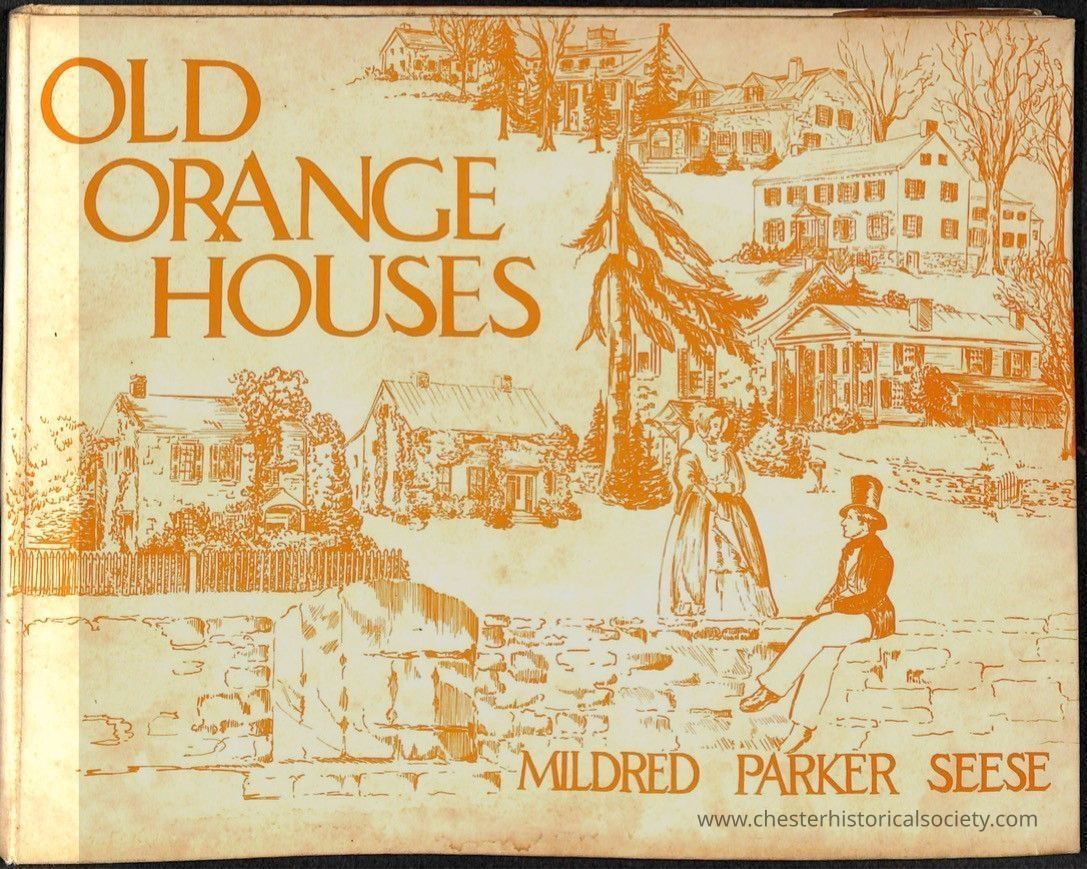
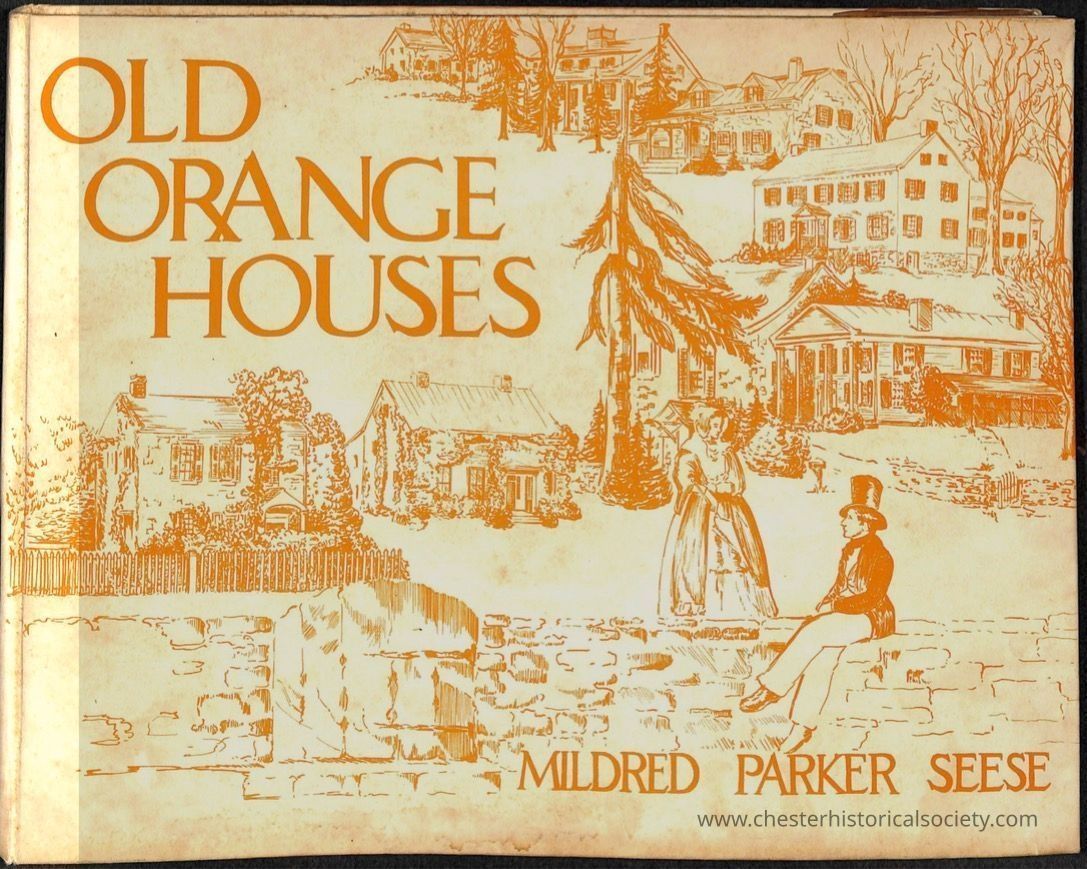
Old Orange Houses
MILDRED PARKER SEESE
Reproductions of any page in this book are available in multiplee of 150 copies,without page numbers or book title.Prices will be quoted and orders accepted by the author. Mildred P.Seese,15 W.Jackson averiue,
Middletown, N. Y.
This is County History from a new angle of approach; history in the intimate terms of the families who founded a great community, and
bequeathed to descendants and successors a fine tradition of independence and self-reliance,with
a spirit as stout as the houses they built to survive the vicissitudes of the Centuries.
VOL UM. E ONE of 3 Projected Volumes Of Which This is a First Edition Copy
Cover Design By Esther English Teacher of Art in Goshen Central High School
Front ls piece By Schell Lewis A Drawing of the old Southerland Place
On Angola Road, near Cornwall.
OLD ORANGE HOUSES
OLD ORANGE HOUSES
With One Hundred Photographs
By Mildred Parker Seese
ACKNOWLEDGEMENTS
}i'OR THE FACTS, records, reminiscences and genealogical matter that form the basis and substance of these sketches the author is in- debted to many persons in Orange County and all the way across the country.Their conversations, letters and notes have recreated for us the Orange County that was,and populated it with those who were.Of course,all previously published historical matter of the region has been invaluable;but the unpublished matter,existing only in the minds and desks of old families,has been equally so.To name all who have contributed to the making of this volume would be to list virtually
George L.Seese
Editor of The Times Herald,and A Cornwall Friend whose talent Mrs.Grace Pelton Holbert husband of the author.who made as a writer of letters.and Pa- Member of a Pioneer Warwick all the photo?raphs not other- tience in the answerinr of many family whose clarity and des-
wise credited,and has assisted queries,entitle him to be con- patch rank her as a correspon-
inallPhases ofthework.
Miss Elizabeth Ilorton
Viddletown Genealorist,whose
sidered afriend indeed. dentwithHr.CocksandHr.Barck. Mrs.May Milliken Tucker A Newbu r?h resident who promPt-
0.T.Barck lysupplied informationavail- Another writer of letters and Robert D.Thompson able from nobody else. answerer of quest ions in a man- A resident of East Rochester,
answers
to queries.
Miss Grace Lee
A member of the County Clerk's staff Possessed of extraordin- ary skill in the recovery of interestinf information from forfotten archives.
Miss Anna Walling
Middletown art is t whose sugse.s- tion that a rroup of Old House pictures be exhibited at the County Fair inspired prepara- tion of this book.
Rev. A. Elwood Corning
Newburohhistorian whoserecords and wide knowledre have been
in frequent request.
searchinr time and arain in
attic and storeroom for notes Miss Pauline Angell
has never
history of Warwick,who was un- sparinr; of time and effort to make the data rerardinr that re?ion complete and correct.
Mrs. Grace I. Winslow
Former librarian of Thrall.who continued helpful as a volunteer researcher in metropolitan libraries after she had left .'f1ddletown.
Mrs.George JI.Strong
Of Warwzck,whoseenthusiasm for the newspaper series was an inspiration.
Mrs.Gertrude Mentley
quarian, whose map of Oranre County,by Anne O.Peet,has been
a source of both inspiration and information.
Mrs.Edna Smith Seaman
Friendly interest sent her
Gilbert T.Cocks
zestful interest and varied
data have repeatedly illumin- ner that left nothinr to be N.Y.,who was ?enerous with his Miss Katherine Beakes
ated obscure facts.
William J.Coulter
Of N1ddletown,who
been too busy to offer SU?- ?estions,to consult his ow11 historical or ?enealo?ical files or look elsewhere for
desired. data about the Southerlands.
Mrs.Elizabeth Van Duzer Roscoe W. Smith
Recornzzed authority on the Vonroe business man and anti-
A Hiddletown resident who never refused a request for aid.
Miss Helen Scott
Member of the Library staff at
Port Jervis.who aided Mrs.Ter- will ieer in the search for facts.
Miss Sarah Corwin
libran anat Neioourgh who found much useful material.
every one with whom we have come into association for more than three years.Literally countless are those who have cudgelled their memories, ransacked their attics, travelled miles to open safe deposit boxes, left dinner to burn or grow cold,let cows go unmilked while they tried to recall for us perhaps the story that Great Uncle Nat, who died fifty years ago,used to tell about the building of his grandfather's stone house on the old home farm. Others have had both the opportunity and the generosity to render more frequent and varied assistance.Thanks and acknowledgements are especially due to:
on which the Smith map was based.
Miss MiJdred Deyo
A New York writer whose work as an Oranre County historian andarchivist hasmadethePort Jervis library unique.
Curator of Washinrton's Head-
quarters Nuseum in Newbureh,
whose helpfulness rendered the Staff of Thrall Library work less arduous.
Percy V-D.Gott
remarkably familiar with the Whose contributions were of The Times Herald Staff
Another Middletown resident lore of the rerion.
Mrs.Eva IV.Terwilliger
Of Port Jervis,whn left no source unexplored to serve the purpose of accuracy.
both fact and flavor from the records of his family.
llarry F,Johnston
Of Buffalo.another satisfactory correspondent.
£specially includinr three of the local Correspondents.Hrs. Bertha Baildon of Warwick,Hrs. EmmaKinneofBloominsburgand
OLn ORANGE
HOUSES
eminently
frs.Hary Dusenberry inftonville,friends newspaper associates.
of Wash- as well as
Elwood Roberts
Goshen Title Searcher,f(enerous with his time and records.
Arnone whom there always has been a cordial interest.
To Charles E. Koons
fl:BLISH£R of The Middletown Times Herald,
to use material the paper made
whose cordial oririnally
it possible to
Permission prepared for
produce
this book.
This book is exclusively a product of the typewriter combined with photog- raphy in an attempt at making the titles and captions simulate the handcut type of colonial times.
Text and Captions Done on The Vari-Typer
Ollset Printing and Book Binding by
The Whitlock Press ~liddletown,Orange County,N.Y.
Processing of the Photographs by
Walt Graham and Harold Strong
of The Times llerald Technical Staff
First Printing ]uly,1941
.DPY~I~~T 1011
~ll Rights Reserved
by Mildred Parker Seese
Foreword
WHAT MAKES HISTORY? Marching armies, great statesmen, clever diplomats,courageousandimaginativepioneers--industrial,spiritual, intellectual as well as territorial pioneers--men and women,venturesome ortimid,independentorinventive.Itisofthemarchingarmies,the diplomaticcoups,thestatesmen'sgestures,thespectacularpioneering thatconventionalhistoryismade.Itmustbeso.Thehistorianofa nation,or even of a region or state of this vast country,cannot possi- bly go into details of the lives and exploits of the average man and woman.Butarmieswouldhavenooccasiontomarch,diplomatsaLdstates- mennoreasontonegotiate,pioneersnoinspirationwereitnotforthe average man and woman,and their home-making instinct.
Thoseaveragemenandwomenwereourancestors.Likewise,themen who marched, the diplomats, statesmen, pioneers were Uncle Jonathan, Grandfat~erSmithorNeighborHilltotheircontemporaries.Youmaybe surprised;as we have been,to find how many of them were uncle,grand- father or neighbor to your own ancestors or your neighbor's.You may be
interested,as we have been,to see the broad patterns of history por- trayed in the migration of the Burts, the Peltons, Warrens, Binghams and others from New England to Orange County. You, too, may find it fascinating to contemplate the change or abandonment of travel routes and population centers as industry and transportation developed.You probably have heard many times that the milk-shipping industry began at Chester. Butw~ wereshockedtolearnthatnobodyhadtheslightest
idea what present farm ~roduced that historic first shipment of milk. History says that raiding Indians were as great a menace as Eritish Redcoats during the Revolution,and the stories of the Cuddebacks,the Oupuys and Colonel Hathorn confirm the cold historic fact.
Indeed,some part of almost every phase of American history is represented in the stories of people and places that make the past and presentofOrangeCounty.Thesearchofindet:endent-mindedScotsmen for the freedom of thought and action they had enjoyed for a few genera-
tions in Ireland is exemplified in the Burnets of Little Britain.The later flight of Orangemen from that same Green Isle when the Emmet Rebellion collapsed becomes a matter of personal interest to those familiar with Salisbury Mills or the Orange County Fair.The escape of bothProtestantandJewfromContinentalEurope duringtheInquisition
and after revocation of the Edict of Nantes is vivid in the background oftheGomezandCaudebechouses.Thebeginningsofchurches,schools, individual businesses and great industries,the tragedies,hardships andcourageoftheRevolutionandthevictoryandbenefitsthatfinally accrued--allcomesharplyintofocusasoneviewstbesolidwallsofan olddwelling.Itssurvivalshouldbeatalismanofhopeforthefuture.
This does not pretend to be a history of Orange County.It might be regarded as a footnote to what has been written by recognized his- torians,withsomesuggestivematter,perhaps,forthoseofthefuture.
Itsbasis,infact,lieslargelyintheworkofpasthistorians.Herein the endeavor has been chieflyto relate the Past to tbe Present,to show theconnectionsbetweenfamiliarpersonsandplacesandthosegeneral trends or momentous events commonly regarded as history.For pride in theheritageofanation,reverenceforthepeopleandthingsofits past are among the strongest incentives to patriotism.
Add to the glory of unsurpassed beauty of landscape and abundance of Nature the records and legends that give significance and interest to every hill you top and the valley beyond,to almost every farmstead from the stony acres of Greenville to the well-tilled slopes and mountain crags of Cornwall.Is there in all the worlC: a grander patch of earth?
We have tried to be accurate historically,particularly in the matter of names and dates.We give you,though,not only historic facts but something of the folklore,the traditions,homely stories and fami-
ly reminiscences that interuret and illumine records.
The houses presented here are only a very few of the old,historic or otherwise interesting dwellings in Orange County.Some of the best known are not even mentioned. On the other hand, some that are of con- siderable significance gain recognition for the first time.Others are here that would not be considered historic in the ordinary sense of the
word.But they do depict changes and progress in the county.Admittedly the whole does not make a well-integrated picture or story.But the aim has been to r enresent every section and every era.And withal the strange tourist er the Orange resident out for an evening's airing,wherever in
the county be happens to be,should find it possible to view within a
fe ·
w minutes one or several of the old and interesting houses of an
historic county.
OLD ORANGE HOUSES
CONTENTS
The Gomez House
A Fur Trader's Station
Jacob Caudebec's
Survivor of Peenpack Raids
Later Cuddeback Iiouse
Built in 1822 The Murray House
Goshen's First bank
Stony Ford
Famed for Hospitality
The Hulse House
An Architectural Gem
Wheat's at New Vernon
For a Blacksmith's Bride
The Hill Stone House
Home of Oranre County Apple
The Hill Brick House
.4 Colonial Manor Alexander Milliken's
A Hanover Pioneer's home
The Bulls:House Builders
A Unique Group
The Roe House
On the Grey Court Tract
The Stone House
Will;am and Sarah's
Capt.Jackson House
By the Second Generation
A Venture in Brick
Bartow Bull's House
Daniel Bu11's
By the Third Generation
Home of Samuel Bull
Founder of Circleville
Steel .in Construction
Rails used by a later Bull
John Bull's Mansion
On the Old Clinton Farm
In Old Conklingtown
A Place of Prorress
A Mapes Home
Twice Enlarsed
The Blake House
Still 1n the Family
Colonel Nicholson's
Before Naybrook was named
The Seybolt Homestead
Early Seat of Justice
An F.arly Brookfield llorne Hrs.Horton's at Slate Hill
1 Sotobed in Cornwall
Where Van Duzers settled
2 The Prize Farm
A Van Duzer Daufhter's Home
3 Burnet's in Little Britain A Post-Revolutionary House
4 An Early Reproduction
Rensselaer Howell's Idea
5 Home of the Free
The Caldwell Homestead
6 John Caldwell's
First President of Fair
7 In the Caldwell Group Built for a Daufhter
8 In New Windsor Town
19th Century Stone House
9 The Mills Manor
By a Continental Cordwainer
10 Guest House
Once the Mills Tannery
11 Where Milk Shipping Began Once the Greeory Farm
12 Home of First Onion Grower
Another Important Venture
13 Early Booth House
Isolated by Loyalty
14 Another Booth Home
26 The Knight Home
A Hiller's New House
27 Waterloo Mills
Once a Villaee
28 The Phillips House
Where Wisner made Gunpowder
5 1 For the Captain's Son 77 Built in 1796
52 On an Old Warwick Farm 78 Pelton Built in 1810
5 3 General Hathorn's House 79 Lady Nartha Stopped There
54 By a Fort Stanwix Veteran 80
The Horton House of 1766
55 On the Wisner Farm 81
A Symbol of Security
56 The Dolson Homestead 82 On the Old Ridfe Road
57 Isaac Dolson's House 83 Rejuvenated by the Gibsons
58 In the Johnson Neighborhood 84
The House Down the Lane
59 Where Farming was Exciting 85 Infalls Home was Finlay's
60 The Jervis Headquarters 86 On the Decker Fort Site
61 When Peace Had Come 87
Dupuy Rebuilt after Raids
62 On Samuel Wickham' s Tract 88
Middletown's Oldest House
63 Capt.Patrick Southerland's 89
In Old Canterbury
64 Another Southerland House 90
Now Cromwell Lodfe
65 Cromwell Manor 91
In the Grand Style
66 At the Balmville Tree 92
Chanted with the Times
67 The Thayer Mansion 93
Where Development Started
68 Elmwood Cottage 94
A Gentleman Farmer's Home
69 Ironmaster Turned Farmer 95
Old Bush House at Arden
70 Where Jacob Walden Lived 96
Home of Early Erwins
71 The Van Keuren House 97
A Guard for Goodwill
72 Quality Row 98
Neioburst. 's Quaint Block
73 19th Century Magnificence 99
David Crawford 1s House
74 Uniquely Styled 100
On Bloominfb«rf Turnpike
75 Surprisingly Large 101
Cherry Hill Stone House
76 On Springstead Plantation 102
The Cohalan Farmhouse
15
Built in Wartime
Lincolndale Stone House
Once the Otterkill School
31 32 33 34 35 36
37 38 39 40
41 42 43
44 45
46 47 48 49
The Gardnerville House Center of Gardnertown
With an Attic Smokehouse
Bloomineburf Miller's home
Mount Joy: Started in 1776
Recallinf Staeecoach days
From Tanning to Lanterns
The Dietzes of Burlineham
A Later Stone House
Built for William Elder
The Silk Farm
A 10th Century Experiment
The Ileart of Howells
An Erie Railroad Result
William Lain's House
A Lesson in Bui ldi ng On the Limekiln Farm
Where Ludlum Experimented
Philip Fink's Fine House
lone the Chamberlain Home
At Johnson's Corner
The Carpenter Homestead
Changed in the Eighties
Lindsay's in Nonteomery
At The End of an Era
The Hurd Stone House
Marv.in' s Brick House
Camp Superintendent's Home
Grandeur in Stone
The Woodhull House
Where Feathers Served
Home nf Quaker Reynolds
Phineas Rumsey's•Home
Where Silver Sprint Flows
Rowlee' s Stone House
A P'ioneer Farmer's Home Buttermilk Paint Durable
A Reminder of Goshen Butter
Tradition Says 1739
A Forrotten Pioneer's Home
Oldest House .in Warwick Bui lt for Danie l Burt:,Jr.
16HouseontheRidge
Hulse Home of Unknown Date
17 Stairway to Heaven
Farmhouse near Berea
18 Brought Fame to Florida
S.S.Seward Institute
19 The Cleland House
Where a Hiller found a Wife
20 The Schultz House
An Edi t or Turned Farmer 21 Without a History
Stone Cot tage nearRidfebury 22 The Millers:First Citizens
ExPlaininf their Prominence
23 Miller of Dolsontown
Built by the littles
24 Baird's Mill
A Currier & Ives Scene
25 At Smith's Clove
An Early Nonroe House
50 Captain Benedict's Stone Clotned lv1th Ivy
OLD ORANGE HOUSES
On an Old Sampler
29
30 Silas Gardner's House
DIRECTIO!IS:Make sharp eastward turn down windinf hill from Route9-Wnear Ulsterlin e.
A Fur Trader's
Post in the Danskammer
~VENTO THEtaxcollectorthemanwhoestablishedthishandsome residence was all but nameless,although colonial New York City held him and in fact all the men of his family in high regard.Therein lies a measure of the isolation of 0Fange County,even at the river's edge,in the first half of the Eighteenth Century.Gomez the Jew was the way he was listed on the tax roll of 1724-;and the little stream that tumbles past the house still is sometimes called Jew's Creek.The fact is that Lewis Moses Gomez,son of a Spanish nobleman and himself named for the French King Louis XIV, bought hundreds of acres of the Harrison and Kennedy Patents lying on both sides of the present Orange-Ulster County border in his own and bis sons' names soon after the patents had been issuedin1714and 15.Daniel,whosenameattachestothisparcel,isbe- lieved to have built almost at once a long low stone structure for a trading post where Indian trails from North,West and South merged at
the approach to the ceremonial ground on a promontory still called the
Danskammer,
OLD ORANGE HOUSES
Page One
short for the Dutch name, the Devil's Dance Chamber.The Gomez fireplaces,oneineach end of the house,are eight feet across and six feet deep.The iron pegs on which he hung furs are still in ceiling beams of what was his storage room.
By virtue of its perfectly preserved first story the house not
only ranks as probably the oldest in Orange County but it is the oldest
known dwelling of a Jew on the North American Continent.It represents
the beginnings of European trade and settlement in the region and also
the growing independence in politics and manufacturing of the Revolu-
tionary period.WolfertAcker, who bought itin1772,built the brickupper
stories, became a pioneer brickyard operator, had a ferry and a sloop line
to New York,and was a miller.That gave the place its title as the Old
MillHouse.Acker's counsel was a factorinthe move for inde-pendence,his
voice a prop to wavering spirits,his house a focus of whig sentiment.
The Armstrongs,post-Civil War owners,added the kitchen wing.
See Appendix Notes I
THE BRANT raids on the Peenpack Neighborhood, continuing for nearly a year in 1778-79, destroyed almost everything from the present Cuddebackville to the Delaware. Virtually the only habitable buildings
in the entire area when the terror finally abated were the fortified home of the DeWitts beside the Neversink on the present Marcus Stamp property, the stockaded stone house of Ezekiel Gumaer, torn down in 1823, and this small stone house of Jacob Caudebec. Why the Caudebec house was spared no one knows, especially since a grandson of the patriarch was in command of Fort Gumaer at that very time.
Jacob Caudebec,whohadfled France about 1686 withhisfriend,Peter Guimar, to escape the persecution that was then the lot of Huguenots in WesternEurope,builtthelittlehouseonthehillwithinsignalling distance of Fort Gumaer as a home for his old age. The date was 1755, and Jacob was then all of seventy.He lived to be about a hundred;lived to see the wilderness that had almost proved too much for hands and bodies unaccustomed to physical toil pushed back so far that a son complained because his elders had lacked the foresight to include in their patent sufficient woodland to provide fuel for their immediate
One House
the Peenpack Raiders Missed
posterity. Details of obtaining that patent had been attended to by Jacob Caudebec himself when, after several years on the ground, he and Guima.r, in conjunction with three others, decided to seek ownership rights.That wasin1697.The nearest accessible settlement was more than thirty miles away toward Kingston. The Peenpack pioneers probably were not even aware of the little group equally far away on the banks of
the Hudson at New Windsor.
Jacob,great grand daddy of probably all American Cuddebacks,was
a progressive n~n. He gave the Peenpack region its first gristmill. A man named Tietsoort had a mill farther down the Neversink some years earlier.but the Caudebec group seemstohave known nothing of that.They carried their grain nearly sixty miles to the Esopus mills or pounded it to coarse meal in the laborious Indian manner.Strangely,the Caudebec house has been in recent years the home of a descendant of another re- fugee from the same persecution that sent Caudebec here f rom his native Caudebec,capitalofCaux.Adolf Capel.l.e+s ancestors fled the Flemish Low Country,found safety in Hanover and many of them were still there when the present war in Europe broke out,
Page Two
See Appendix Noles T OLD ORANGE HOUSES
DIRECTIONS:Route 209.just to the southward of Godeffroy on the West side.
DIRECTIONS:On Route 211,just east of Route 200 int ersec-- tI on at Cuddebacevi lle,
An Old Hoμse With Distinctive Charm
THIS HOUSE is one that countless passersby have taken to their hearts and loved without ever knowing who lived there.although anyone familiar with the history of Orange County might have guessed it was
a Cuddeback home.It has the faculty of attracting interest and admira- tion, like the fresh charms of a dainty lady unexpectedly encountered; but as in a well groomed woman, there is something just a bit deceptive about that general impression.II'ith a womanasecond look sometimes will revealthestrong,heart-warminglinesofacapablematron;andwiththis house a second look reveals strength and breadth not noticed at first glance.For all its delicacy,william Cuddeback's house.now the home of threegrandchildren,George,Herbert andMissMaryCuddeback,hasthe sturdiness of a dwelling built for service and comfort rather than for show. That is because William,great grandson of Jacob Caudebec,the Huguenot refugee from Seventeenth Century France,had not only the need for a large house but an eye for architectural niceties and the where-
with to indulge in them when he built in 1822.
Actually,the exterior decorations are few but effective. A bit of
scroll work to relieve the severity of porch angles.even on the seem- ingly snaLt but really ample kitchen wing. and embellished dorn.ers inserted during a general repair period in the Eighties const i t ute its
chief distinction.Fanlight windows highinthebroadgable of the parlor
end are a further combination of usefulness and beauty.The nicely ran- elled main doorway with decorated lintel suggests the trim of interior woodwork.The fireplace mantel in the front parlor and staircase orna- mentation are testimonials to the pleasure of the bllilders in their work.They called it their fancy work and did it at night,according to family stories.A brick utility kitchen attached by a roof but at re- spectful distance from the main house gives the establishment almost asouthernatmosphere.
For years the house was headquarters for a large milk business in New York City operated by four sons of the late A.11'.Cuddeback while their two brothers and two sisters superintended the farm and thedairy
that supplied the trade.But probably the most exciting days under its roof were when it was 1uite new and William.bis brother Abraham and their father,Colonel William A.Cuddeback,undertook construction of a mile of the Delaware & Hudson Canal. Cuddebackville itself is one of the canal-born communities of the region. It thrived and declined with thatwaterway.ItwasnamedasmuchfortheColonel 3.S forhisancestor Jacob,for the Colonel once owned virtLJally the entire site of the ham- let and much surrounding territory. There are a number of Cuddeback homes in the neighborhood. Several.like this, are on farms he gave to each of his boys.
OLD ORANGE HOUSES
Pafi;e Three
WHEN THE county and country were young,when business,banking and inventions were in comparative infancy,many a bank president or cashier lived with the money entrusted to his institution.Thus did the Hurrays of Goshen.Lackingburglaralarms,burglar-prooflocksandpolicepro- tection,Ambrose S.Murray,clerk for many years,cashier from 1834 to '45
andpresidentofTheBankofOrangeCounty·from1~5 untilhisdeathin 1885, lived in the banking house in the early days. There he gave the funds not only the protectionof his presencebut the security of office walls lined with metal plates and a basement vault entered by a tr~p door in the office floor.
Murrays still are prominent in the bank, and the reinforced walls
andvaultremaintodayintheMurrayhouseat276Mainstreet,though
thebusiness,nowtheNationalBankofOrangeCounty,wasmovedtoits
present location at :'i<l West Main street in 1852. Set up temporarily in
the parlor of the house at 242 Main street when it was organized in
1812, the bank was moved to the new and stronger Murray house about
1815. Its second and last move, to its present address,was made ten
years after advent of the Erie railroad had started the westward drift
ofGoshen'sbusinesssectionfromitsoriginalplacebetweentheCourt House and Johnson's Corner.
Where Goshen' s First Bank Flourished
Virgin gold shipped from California by Orange and Sussex men caught in the Gold Rush of '49,and the golden notes which were known as Butter Money,and which rivalled Goshen butter in reputation,crossed its counters when the bank had quarters in the Murray house.The Butter Money was the issue of that bank under the old State law.Some say it
was called Butter Money because the pale yellow banknotes were just the
shadeofgoodGoshenbutter.Somesayitwasbecausethesaleofbutter
often brought about an exchange of money that gave Goshen notes cir-
culation in places where knowledge of Goshen was confined entirely to
its butter.Others say that in a day when money was only as good as
thebankwhichissuedit,ButterMoneywasatermthatatoncegave
assuranceofbothsourceandvalue.Itwas,infact,anotherwayof saying "As good as gold".
Its lawns patterned by the shadows of trees that have grown old with the house, the Murray homestead is mellowed but untarnished by age,and it is virtually unchanged from the time when it was a banking house as well as a home. Yellow brick constitutes the entire structure, andtherightwing,inwhichthebankhadquarters,isbalancedbya slightly different addition at the other side of the main house.The family of the late Russell Murray now occuoy it.
Page Four
OLD ORANGE HOUSES
DIRECTIONS: On the East side of Haln street ln Goshen.
DIRECTIONS:Turn westward from Route 207 at LoGrang e between Goshen and Campbell Ilall.
Noted for
Hos pit al i t y and Horses
HISTORY inthedevelopmentofbloodedbovineandequinestock has been made on Stony Ford Stock Farm for nearly a hundred years,but suchwerethehospitalityandrriendshipsofitsownerduringthelast third of the Nineteenth Century that its renown rests more generally onthefameofitsguestsofthatperiodthanonthefactsthatbrought them there. For Charles Backman, who came to Orange County and estab-
lished Stony Ford as a breeding farm about 1862, was as noted for his hospitality as he was for his horses.
A drawing by W.R.Leightoillustrate The Evolution of The. Trottrne Horse, which Hamilton Busby wrote many years ago for Scr1bner 's. gives substance to the legend of Stony Ford. The picture, long cherished by Joseph Daly of Goshen, shows two Cabinet members, Benjamin F.Tracy and William C.Whitney, the creator of the Navy's White Squadron; Robert Bonner, who spent $600,000 on fast horses, including Maud S. and Jonas Hawkins's Dexter which gambolled as a colt on meadows now occupied by the Maybrook railroad yards, and General U.S.Grant with Mr.Backman at ease in the Stony Ford smoking room. Senator Leland Stanford, August Belmont, Jay Gould and Sheppard Knapp were equally familiar with the Backman hospitality. And in the comfort and cheer of that same smoki ng room former President Grant is said to have enjoyed his last :igar.
Hehadoeenagreatsmokeruntildiseaseinterfered.Hislastvisitto Stony Ford was just before he retired in 188R to a friend's cottage on MountMcGregortocompletehismemoirsandifpossibleprolonghislife.
Whatever their business or political affiliations, the men who partookofBackmanhospitalitywereloversoffinehorses,especially harness horses; and Stony Eord,under the Backman aegis,was a pl.ace of fine horses in great number. Breeding from the strains of American Star and Harry Clay,both Orange County horses.the Backman stables pro- duced not only notable racers but fine road horses, and in addition provided the basis for many another good stable by the excellence of sires and brood mares developed there. Among the horses that went from Stony Ford into more notable ownership was Electioneer, bought by the ~tanford interests. Stony Ford's vast acreage, lying on both sides of the Wallkill between Goshen and Montgomery,andits buildings and equip- uient weresaidtoconstituteabreedingestablishmentunexcelledinthe Backman era. Under the Silas Thomas ownership of recent years it has gained recognitio3 as a dairy farm.
The house has been improved lately by the razing of a wing which, though unobtrusive from most angles, was not entirely in keeping with the gracious architecture of the Backman manor.
OLD ORANGE HOUSES
Page Five
AS RICHLY ornamented as the gem-crowned mechanical pencils and fine watch cases turned out in his jeweler's shop across the lane for early Victorian ladies and gentlemen, the house Charles Hulse built a hundred years ago is still a gem among Orange farm houses. His shop, one of the first watchcase factories in the United States, was burned some years ago. The business, however, had been discontinued before
Palmer Hinckley.grandfather of Miss Bertha Crist,present owner,bought theplaceintheFifties. Heoperatedacidermillanddistillery.
Unchanged during the century,this is a typical Orange County hill- side house, with a high front porch giving into a hall whose back door is at ground level. Butincornice,moulding and supporting woodwork.in- side and out there is a beauty and detail that could have been ccnceived only inamindsaturatedwiththeartoftheancients,andexe... [truncated due to length]