Name/Title
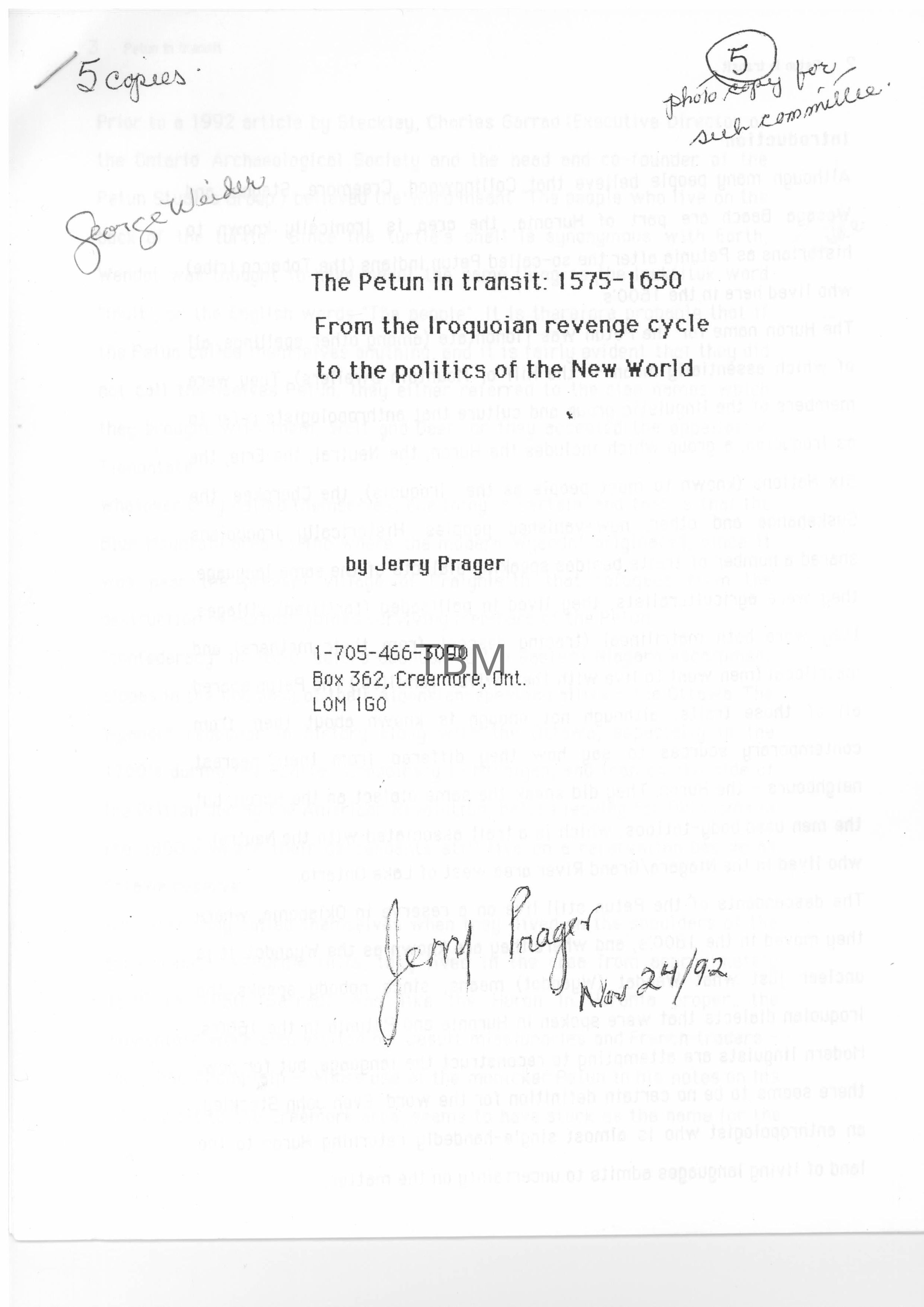
The Petun in Transit: 1575 - 1650. From Iroquoian revenge cycle to the Politics of the New WorldEntry/Object ID
2007-002-006Description
The history of the Petun people during the 1575 to 1650. This paper briefly introduces the Petun people. Then it discusses the researchers who studied the Petun. Finally it briefly discusses the way the natives, including the Petun, lived: such as food staples, hunter and gather society, matrilineal heritage, revenge fighting and more.
Information inside the paper:
People: Petunia, Petun, Tionontate, Hill or Mountain Dwellers, Linguistic group Iroquoian includes (the Huron, the Neutral, the Erie, the Six Nations, the Cherokee, the Suskenhann, and the other now-vanished peoples), Wyandot or Wendat, Steckley, Charles Garrad, Ontario Archaeological Society, "The people who lived on the back of the turtle," The Ottawa, Jesuit missionaries, French Traders, Champlain, Seneca, local Huron Institute, W.J Wintemberg, National Museum of Canada, Andrew Hunter, Rev A.E Jones, David Boyle, Jay Blair, Father Garnier, Wilfred, E. M Jury, Petun Studies Group, Mesoamerica, Mayan, the Kawarthas, European.
Places: Niagara/ Grand River, The Town of The Blue Mountains, Oklahoma, Lake Ontario, Craigleith, eastern Niagara escarpment slopes, Ottawa Reserve, Blue Mountains/Purple Hills, Nottawasaga Bay, Collingwood Township, Simcoe County, Southampton on Lake Huron, Duntroon, Etharita, Quebec, Upper New York State, Gulf of Mexico to the Great Lakes, Central American.
Dates: after the 1600s, Before 1992, confederacy in 1650, 1700s, 1800s, 1575 to 1650, 1616, mid-1980s, 1909 to 1923, early 1896 to 1901, 1900s, 1932, 1640s, 1960's, 900 AD, 1000AD, 1500's
Main points: Agriculturalists, palisaded villages, matrilineal and matrilocal, language, where the Petun name came from, clan names Wolf and Deer, Pontiac Conspiracy in Michigan siding with the British during American Revolution, Champlain visit to Creemore area 1616 use of monicker Petun, tobacco, 200 village sites of archaeological significance, local Huron Institute in 1909 to 1923 started studying sites, W.J Wintemberg with National Museum of Canada did site visits, Wintemberg arrive in 1923 marked the beginning of modern archaeology in area, Five periods of Petun studies (The first is the historical period with Champlain's and other's visit, The second is the early period dominated by David Boyle, The third period called the modern new institutions being made, the fourth period is Post- contemporary marked by fluctuations of intellectual bravado, followed by long cautious silences, the fifth is Christianity and society.)
Physical Description: A booklet is made of eight sheets of white, standard letter sized paper with black, printed text. A staple at the top left corner holds the booklet together. The first seven pages have printing on both the front and the back sides. The front page (cover page) has the title, author and an address all printed in the centre, but there is also handwritten notes in the top corners and at the bottom of the page.
Dimensions: 28 cm x 21.6 cm x 0.1 cmPublication Details
Author
Prager, JerryDate Published
1992Publication Language
EnglishNotes
Location of Obj. ID: Back page, top left corner of booklet
Reference/Artifact: Both
Numbered Pages: 15Dimensions
Dimension Notes
Length (cm): 2.8
Width (cm): 21.6
Thickness (cm): 0.1