Untitled

Work on Paper

-

DePaul Art Museum

Name/Title

Untitled

Entry/Object ID

2018.07

Description

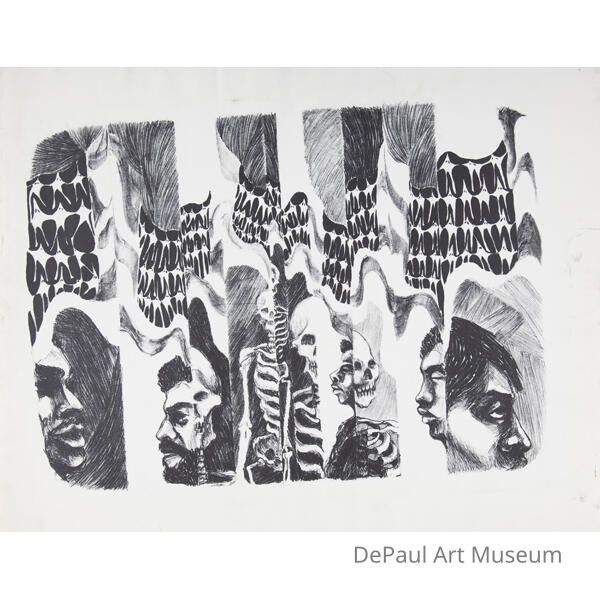
Skeletons & heads in distorted U.S flag (b&w)

Artwork Details

Medium

Lithograph on paper

Context

Racial strife and oppression of Black people in the United States were a central focus in Jones-Hogu's early prints. In this black and white lithograph, she presents a riff on the American flag. By substituting stars with the recognizable silhouettes of hooded Klu Klux Klan members, Jones-Hogu visually asserts that white supremacy is woven into the fabric of American ideology, as symbolized by the flag. In these images, the impact of racism is evident through interchanging pattern of skeletons and Black men in profile, alluding to centuries of racial violence.

Acquisition

Accession

2018.07-09

Source or Donor

Lusenhop Fine Art

Acquisition Method

Purchase

Credit Line

Courtesy of Lusenhop Fine Art

Made/Created

Artist

Hogu, Barbara Jones

Date made

1968

Ethnography

Notes

US Chicago

Edition

Edition Size

Less than 10

Lexicon

Getty AAT

Concept

civil rights, political concepts, social science concepts, pride, human behavior, psychological concepts, flags, identifying artifacts, information artifacts, information forms (objects), race (group of people), culture-related concepts

Hierarchy Name

Associated Concepts (hierarchy name), Information Forms (hierarchy name), Visual and Verbal Communication (hierarchy name)

Facet

Associated Concepts Facet, Objects Facet
LOC Thesaurus for Graphic Materials

Lithographs

Dimensions

Dimension Description

overall; sheet

Width

25-3/4 in

Length

20-1/4 in

Exhibition

Barbara Jones-Hogu: Resist, Relate, Unite, 1968-1975

Interpretative Labels

Label Type

Cultural/Historical Context

Label

The African Commune of Bad Relevant Artists (AfriCOBRA) was founded in 1968 by Jeff Donaldson, Barbara Jones-Hogu, Wadsworth Jarrell and Gerald Williams on the South Side of Chicago as a group of Black artists. The group aimed to create art that celebrated and brought together members of the African diaspora. They strove to create images that expressed the depth of black culture and Pan-Africanism, embracing a family tree with branches stretching beyond the United States, reaching the Caribbean and African ancestral homes.