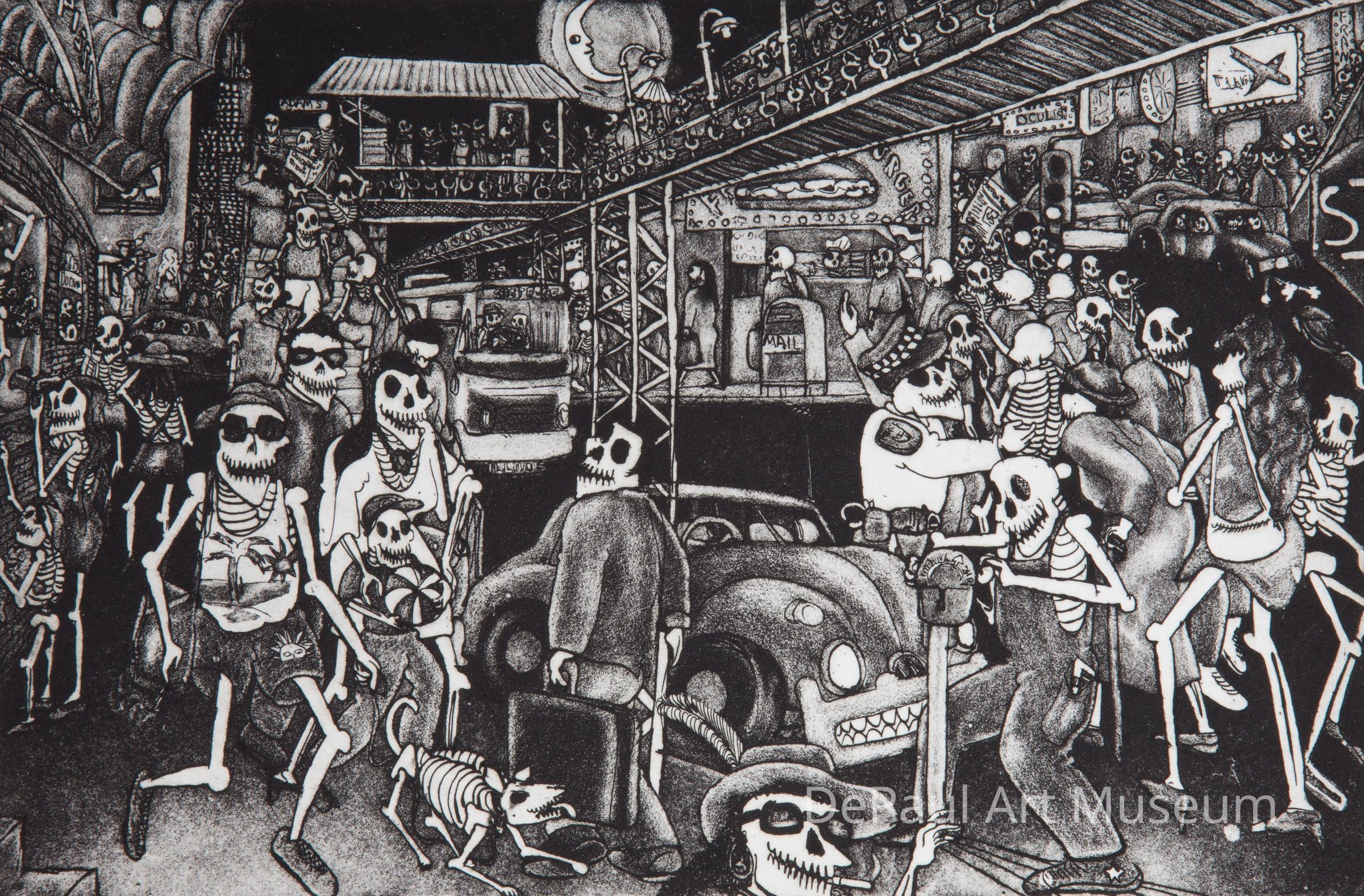
Chicago

Work on Paper

-

DePaul Art Museum

Name/Title

Chicago

Entry/Object ID

2016.33

Description

Skeletons in an outdoor bar scene with a car and mechanic skeleton in the foreground.

Artwork Details

Medium

Etching aquatint

Context

Engraving of memory and gratitude. Walking down the avenues, the neighborhood streets, take the train down Clark and Lake Avenue. Inhaling the smell of damp and smells mixture of metal and swift bodies. Walk down the Wabash Avenue between people in summer clothes lilting walk between those who imagine being alive. Live to run, to get to the appointment in time. Hearts pounding to get to the appointment of romance. Music slips between the screeching of a train not to go to downtown and continue their way to reach the suburban quietude of the big city. Chicago in taste, in their cultural environment even the beyond, where life and love continue.

Acquisition

Accession

2016.14-125

Source or Donor

Chuck Thurow

Acquisition Method

Gift

Credit Line

Collection of DePaul Art Museum, Gift of Chuck Thurow

Made/Created

Artist

DeJesus, Nicolas

Date made

1990

Ethnography

Notes

Mexican Guerrero, Mexico

Edition

Edition Size

95

Edition Number

11

Inscription/Signature/Marks

Notes

Inscription Type: 11/95

Notes

Inscription Type: Chicago

Notes

Inscription Type: Nicolas de Jesus

Notes

Inscription Type: 90

Lexicon

Getty AAT

Concept

identity, metaphysical concepts, philosophical concepts

Hierarchy Name

Associated Concepts (hierarchy name)

Facet

Associated Concepts Facet

LOC Thesaurus for Graphic Materials

City views

Dimensions

Dimension Description

overall

Width

13-1/2 in

Length

9-1/2 in

Exhibition

LATINXAMERICAN

Interpretative Labels

Label Type

Cultural/Historical Context

Label

Nicolás de Jesús hails from Ameyaltepec, a small village in La Mezcala, a Nahuatl region in the Mexican state of Guerrero. De Jesús arrived in Chicago in the late 1980s, where he applied his training in painting and etching on traditional amate paper — an ancient paper made of the bark of wild fig, nettle, and mulberry trees — to create lively depictions of the city’s urban life. A founding member of the still active Taller Mexicano de Grabado (The Mexican Printmaking Workshop), de Jesús often employs Día de Muertos imagery whose traditional calaveras, or skulls, also evoke the tradition of calaveras literarias, a satirical literary form that poked fun at the hubris of politicians and other public figures, reminding them of their mortality. By using traditional materials and imagery in such a way as to elevate them to the status of fine art, de Jesús challenges aesthetic hierarchies and notions of cultural superiority.