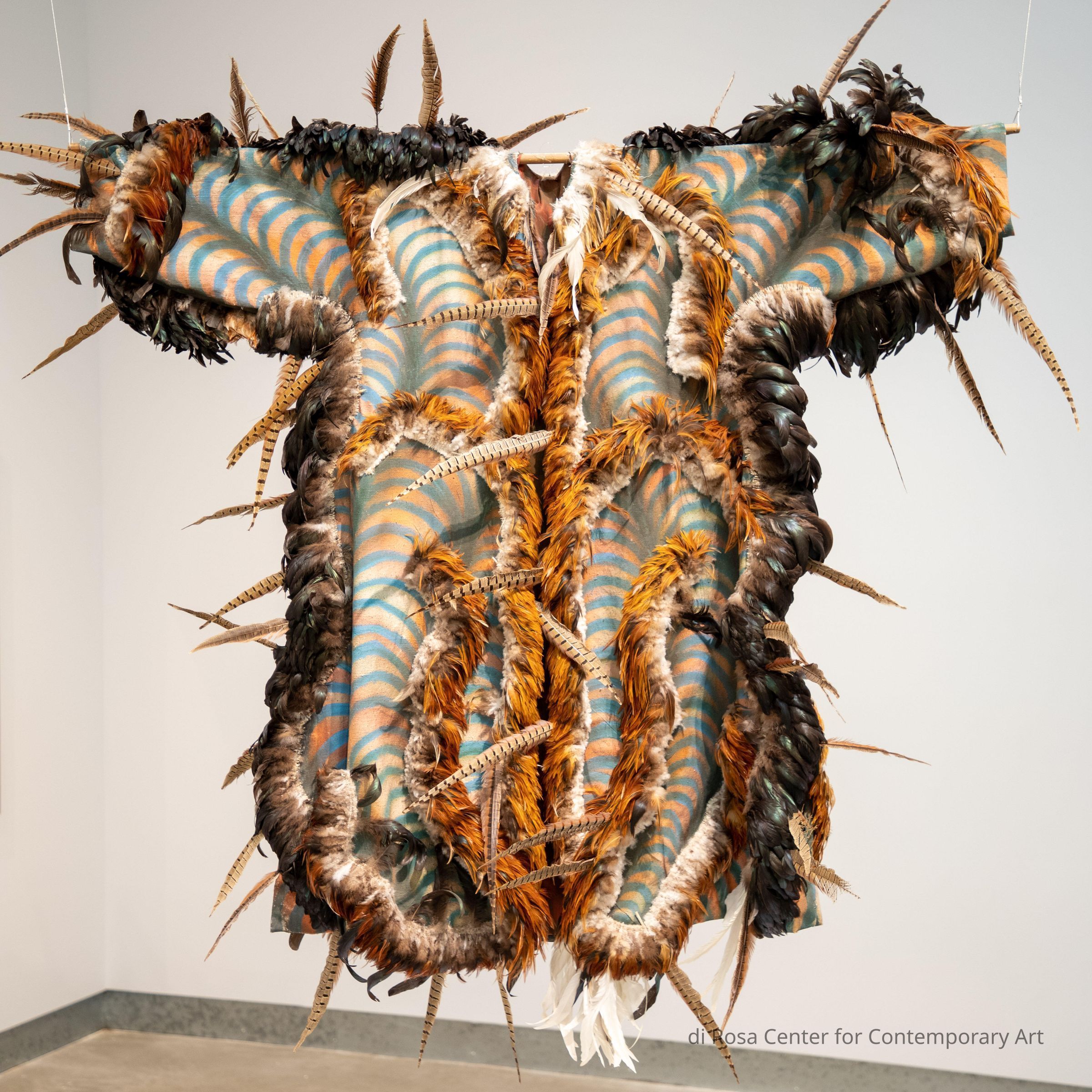
Third Coat

Photo credit: Robert Berg Photography

Photo credit: Robert Berg Photography

Name/Title

Third Coat

Entry/Object ID

408

Description

Canvas cloak decorated in paint and feathers; painted taffeta lining with bone, hair, and cloth dolls

Artwork Details

Medium

Cloth, canvas, taffeta, acrylic paint, feathers, bones, hair

Acquisition

Accession

AR408

Source or Donor

Carlos Villa

Acquisition Method

Purchase

Made/Created

Artist

Carlos Villa

Date made

1983

Lexicon

LOC Thesaurus for Graphic Materials

Feathers

Dimensions

Dimension Description

Object

Height

77 in

Width

79 in

Depth

22 in

Relationships

Related Publications

Publication

Local Color

Notes

Page 176 -177

Exhibitions

Exhibition

To the Max!

Notes

Friday, September 8, 2023 - Sunday, August 25, 2024, di Rosa Center for Contemporary Art, Napa

Exhibition

Building A Different Model: Selections from the di Rosa Collection

Notes

March 9 - December 30, 2019, di Rosa Center for Contemporary Art, Napa, CA,

Exhibition

The Incorrect Museum: Vignettes from the di Rosa Collection

Notes

Ongoing

Exhibition

Carlos Villa: Worlds in Collision

Notes

February 8, 2022 - May 8, 2022, The Newark Museum of Art, NJ; June 17, 2022 - October 24, 2022, The Asian Art Museum, San Francisco

Exhibition

FETISH: Objects of Power and Desire

Notes

January 14 - March 4, 2003, di Rosa Center for Contemporary Art Napa
Research Notes

Notes

Carlos Villa trained alongside William T. Wiley, Joan Brown, William Allan, and Manuel Neri in aesthetic modes he would later bring into dialogue with Minimalist sculpture and his own Filipino heritage. Villa sometimes used his sculptures in performances in the 1980s. These works advance ideas of sculptural space, the artist as shaman, and the very notion of what art can do. But Villa was adamant that his heritage not be the only lens through which his work was viewed. He likened his approach in this sense to, say, Bruce Conner’s unheralded identity as an Irish American. It’s there if you are looking for it, but ultimately the work is a fulsome expression of complexly woven strains of cultural identity.