Name/Title
Crandall Architectural Drawings Collection ListEntry/Object ID
1997.27.3Scope and Content
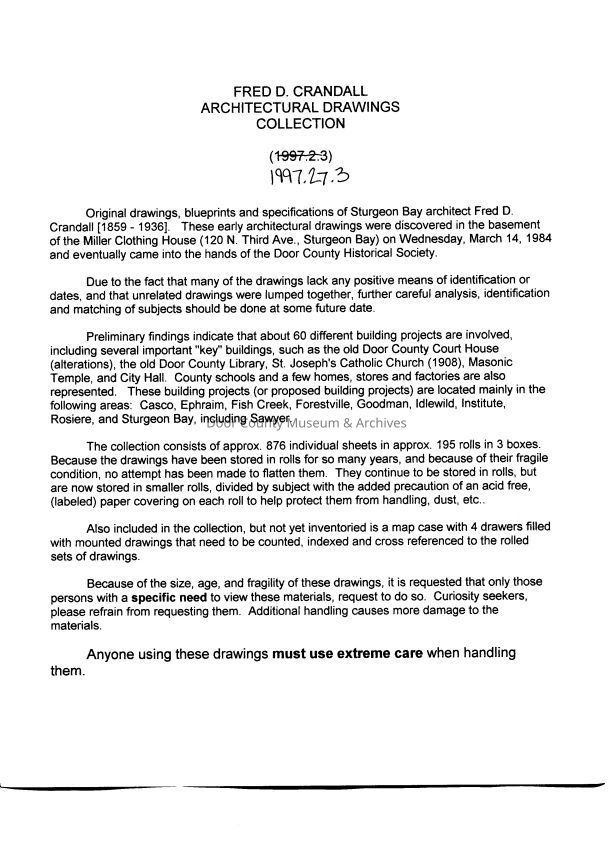
Original drawings, blueprints and specifications of Sturgeon Bay architect, Fred D. Crandall, from the early 1900's. Approx. 876 individual sheets in approx. 195 rolls in 3 boxes. As these prints were located at various times, there is still some matching of sets and combining of rolls to be done. There is also a map case with 4 drawers of mounted prints that need to be indexed and cross referenced to the rolled sets of prints. SEE INDEXES FOR CONTENTS & COMMENTS IN SOURCES BOOK.
Physical Characteristics: Approx. 876 sheets, in approx. 195 rolls, in 3 large boxes.Collection
Door County Archives Architectural Drawing Coll.Cataloged By
Sally TreichelAcquisition
Accession
1997.27Source or Donor
Door County Historical Society - Ex. Coll.Acquisition Method
GiftLexicon
Nomenclature 4.0
Nomenclature Secondary Object Term
Drawing, ArchitecturalNomenclature Primary Object Term
ProjectionNomenclature Sub-Class
Graphic DocumentsNomenclature Class
Documentary ObjectsNomenclature Category
Category 08: Communication ObjectsSearch Terms
Architectural Drawings, Buildings, CrandallArchive Details
Creator
Crandall, Fred D.Archive Size/Extent
Approx. 876 sheets, in 195 rolls, in 3 boxes.Restrictions
Access: Only those with a specific need to view these materials should request them. Too fragile.Primary Language
EnglishArchive Notes
Date(s) Created: Early 1900's
Date(s): Early 1900's
Finding Aids: Has indexes in Sources Book
Level of Description: ItemOther Names and Numbers
Other Numbers
Number Type
Old NumberOther Number
1997.02.003Provenance
Notes
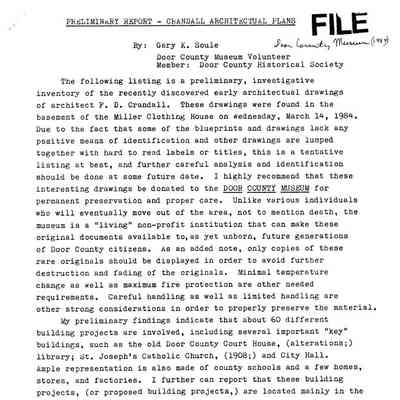
Custodial History: Most of these early architectural drawings were discovered in the basement of the Miller Clothing House (120 N. Third Ave., Sturgeon Bay) on Wednesday, March 14, 1984 and eventually came to the hands of the Door County Historical Society.General Notes
Note
Notes: Condition Notes - 1997: Some sheets are onion skin, some torn and with ragged edges, most are too large for efficient flat storage.
Because the drawings have been stored in rolls for so many years and because of their fragile condition, no attempt has been made to flatten them. They continue to be stored in rolls, but are now stored in smaller rolls, divided and labeled by subject with the added precaution of acid free (labeled) paper covering on each roll to help protect them from handling, dust, etc.
Due to the fact that many of the drawings lack any positive means of identification or dates, and that unrelated drawings were lumped together, further careful analysis, identification and matching of subjects should be done at some future date.
Status: OKCreate Date
June 16, 2001Update Date
July 1, 2026