Note
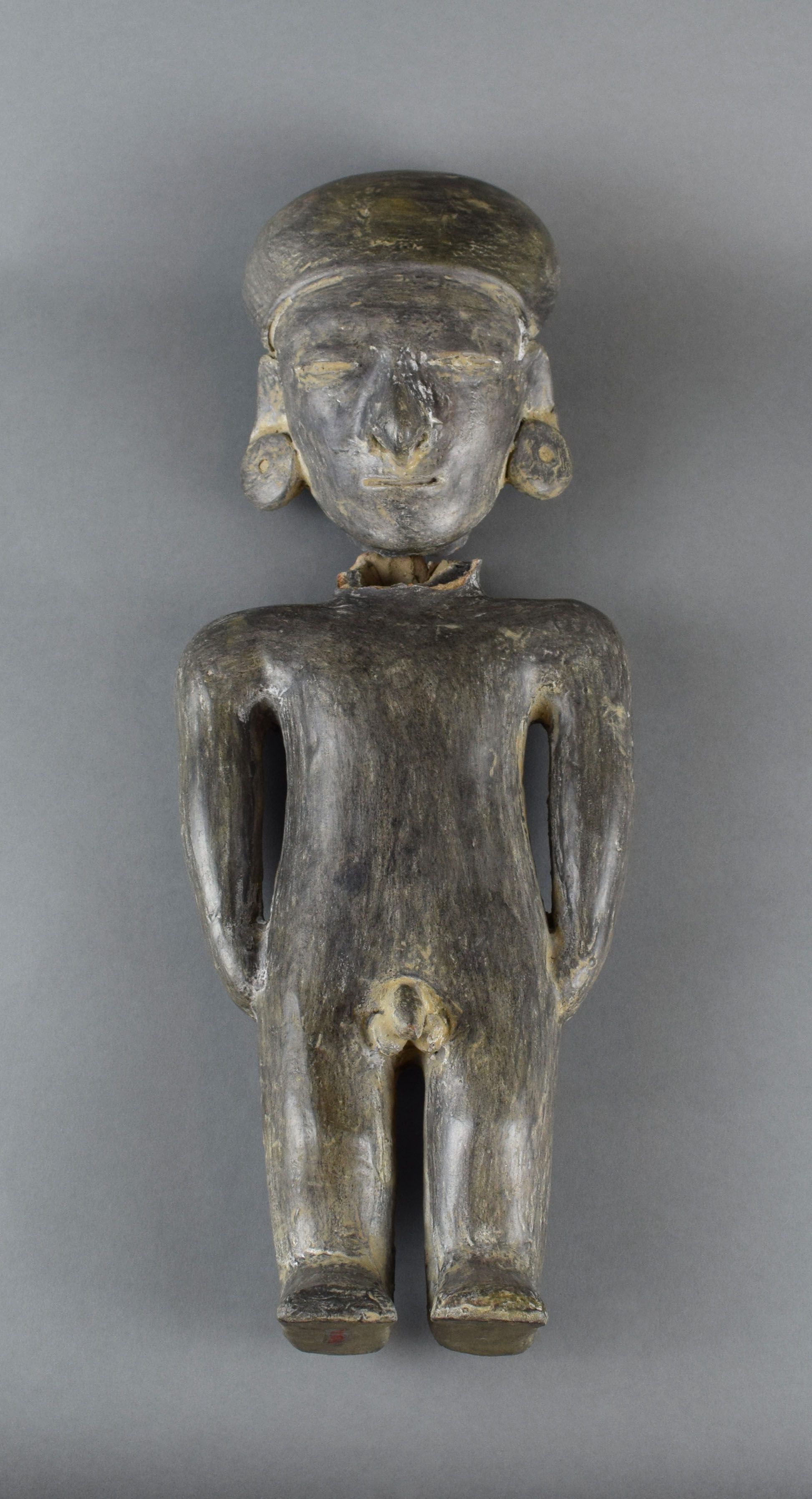
Possiblely not ancient. Donation unknown possibly 1994-1996. (Yanrong 7/29/2015)
The Moche, a non-consolidated culture situated along the north coast of Peru, reigned supreme in the years 100-700 AD. The Moche were governed by the Sipan, a group of warrior priests that exercised religious and non-religious power over Moche society.
The Chimu Culture, sometimes referred to as the Kingdom of Chimor, was situated on the northern coast of Peru between the tenth and fifteenth centuries CE. Unlike the Moche Culture, the Chimu, largely thought of as the cultural successor to the Moche, was not a loose confederation of groups, but a federation, with a capital city (Chan Chan), a four-tier hierarchal system, and a governing entity (elite class). The Chimu, widely renowned for their architecture, culture, and methods of regional governance, were able to forge the second largest empire in the history of the prehistoric Andes. The Chimu were so successful that the Inca, the cultural successors to the Chimu, would later go on to emulate the Chimu model of governance.
Given the Moche Cultures' preoccupation with war in its ceramic representations, and given that this sculpture of a man possesses neither a club, nor a shield, I am more inclined to attribute it to the Chimu culture. That being, said, it cannot be attributed to one culture or the other with full confidence. (B. Peters, 2/14/18)