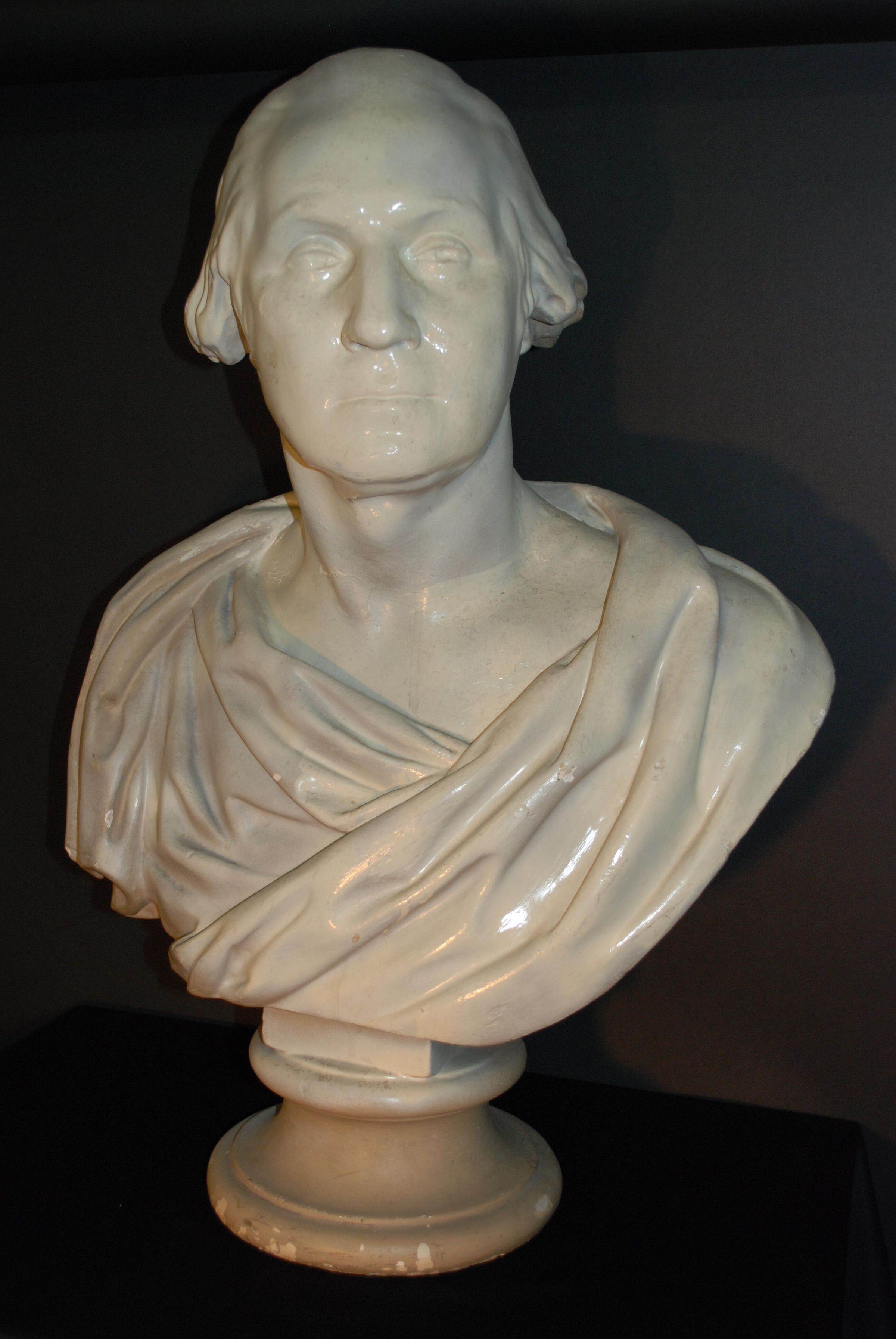
Mark: Underneath and inside of bust written in charcoal, "410"
Dimensions
Dimension Notes
H, L, W: 28 1/2x19 1/2x8 in
Height
28-1/2 in
Width
8 in
Length
19-1/2 in
Exhibitions
Practical & Cultural: The Drexel Collection as Teaching Tool
Interpretative Labels
Label Type
Exhibition Label
Label
Jean-Antoine Houdon, 1741-1828, a master of sculpted portraiture, began his career at the age of 9. Upon successful completion of the rigors prescribed by the Académie Royale, Houdon won the Prix de Rome; finding almost immediate fame by establishing a reputation with large marble statues as well as smaller bust-length portraits, many of which were reproduced as plaster replicas widely used for instruction.
General Notes
Note
George Washington was the first American president, and the subject of many of Houdon's sculptures, including ones of monumental scale. The artist captured the likeness of many great American leaders of the time in the 1780's. In this decpiction, Washington is clothed in a draped garmet, instead of period clothing. This is to reflect the democracy of Ancient Greece and the United States, which is meant to honor the subject and portray them as a timeless, eternal leader.
from the Smithsonian National Museum of American History website and Jean-Antoine Houdon, George Washington by Dr. Bryan Zygmont
Cast collections became especially prominent in the 15th century as a way to have many copies of the same work of art, which would allow pieces to become well known and also serve teaching purposes. Plaster casts in particular are very cheap and easy to make, and allow a famous work of art to be in many places at once. At Drexel, the plaster cast busts in the collection were most likely used as decorative purposes or for art students to learn from. A three-dimensional object is easier to learn from because of the detail preserved in pieces and by making pieces that are priceless more accessible.
from the Univeristy of Cambridge Cast Collection website and the Cornell Univeristy Library website
Lara Bros 2/14/18