Cloisonné Jar with Lid
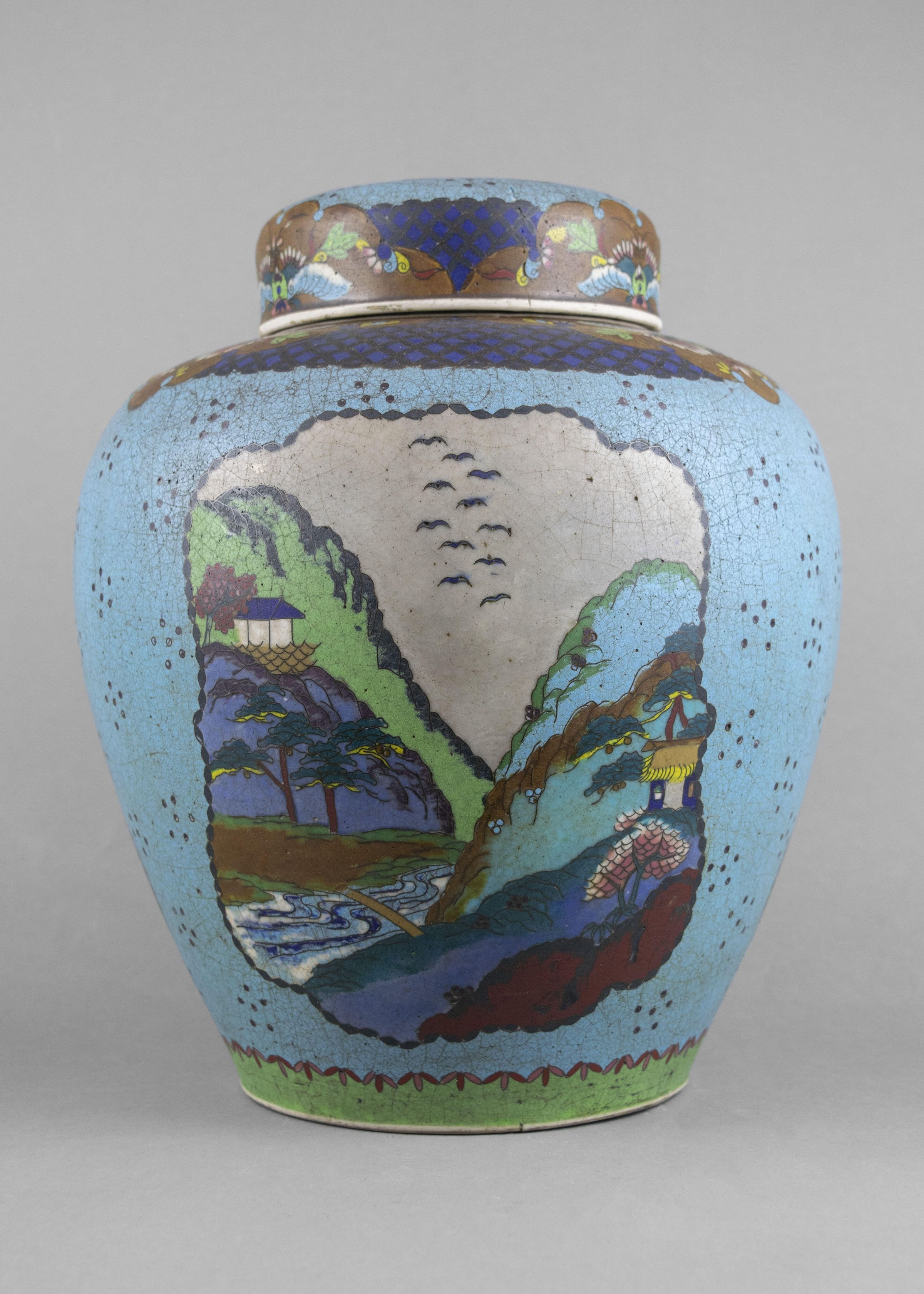
Ceramic

Object ID: 972

Drexel Founding Collection

#972, Photographed by Mary Elizabeth Kulesa, 2021

Side 1

Category

Ceramic

Acquisition

Notes

Credit Line: Donor Unknown Means of Accession: gift

Made/Created

Artist

Unidentified

Date made

circa 1870

Place

Country

Japan

Continent

Asia

Inscription/Signature/Marks

Notes

Mark: Underside, Four Japanese characters handpainted in red enamel

Dimensions

Height

12 in

Diameter

10 in

Materials

Hard paste porcelain, cloisonné

Exhibitions

Fired Works: Ceramics from Around the World
Arts of Asia: Selections from The Drexel Collection
Frozen in Flight: Taxidermy Birds from the Academy of Natural Sciences of Drexel University

Interpretative Labels

Label Type

Exhibition Label

Label

The cloisonné technique is typically used on a metallic body, but in 1868, Tsukamoto Kaisuke (1828–1887) of Japan discovered a way to apply the technique to a ceramic body. This form of decoration for ceramics proved to be shortlived — the cloisonné enamels tended to have a dull or dirty appearance when applied to a ceramic body, which can be seen in this jar.

Label Type

Exhibition Label

Label

In 1868 Tsukamoto Kaisuke (1828–1887) of Japan discovered a way to apply the Cloisonné technique to a ceramic body. This form of decoration for ceramics proved to be short-lived due to the fact that the cloisonné enamels tended to have a dull appearance when applied to a ceramic body as can be seen in this jar.

General Notes

Note

Per previous cataloguer: Identified by Jean Gordon Lee, Curator, Far Eastern Dept., PMA, 1982 The cloisonné technique is typically used on a metallic body, but in 1868, Tsukamoto Kaisuke (1828-1887) of Japan discovered a way to apply the technique to a ceramic body. This form of decoration proved to be shortlived - the cloisonné enamels tended to have a dull or dirty appearance when applied to a ceramic body. (Irvine, Gregory, Japanese Cloisonné: The Seven Treasures, Victoria & Albert Museum, 2006)