Note
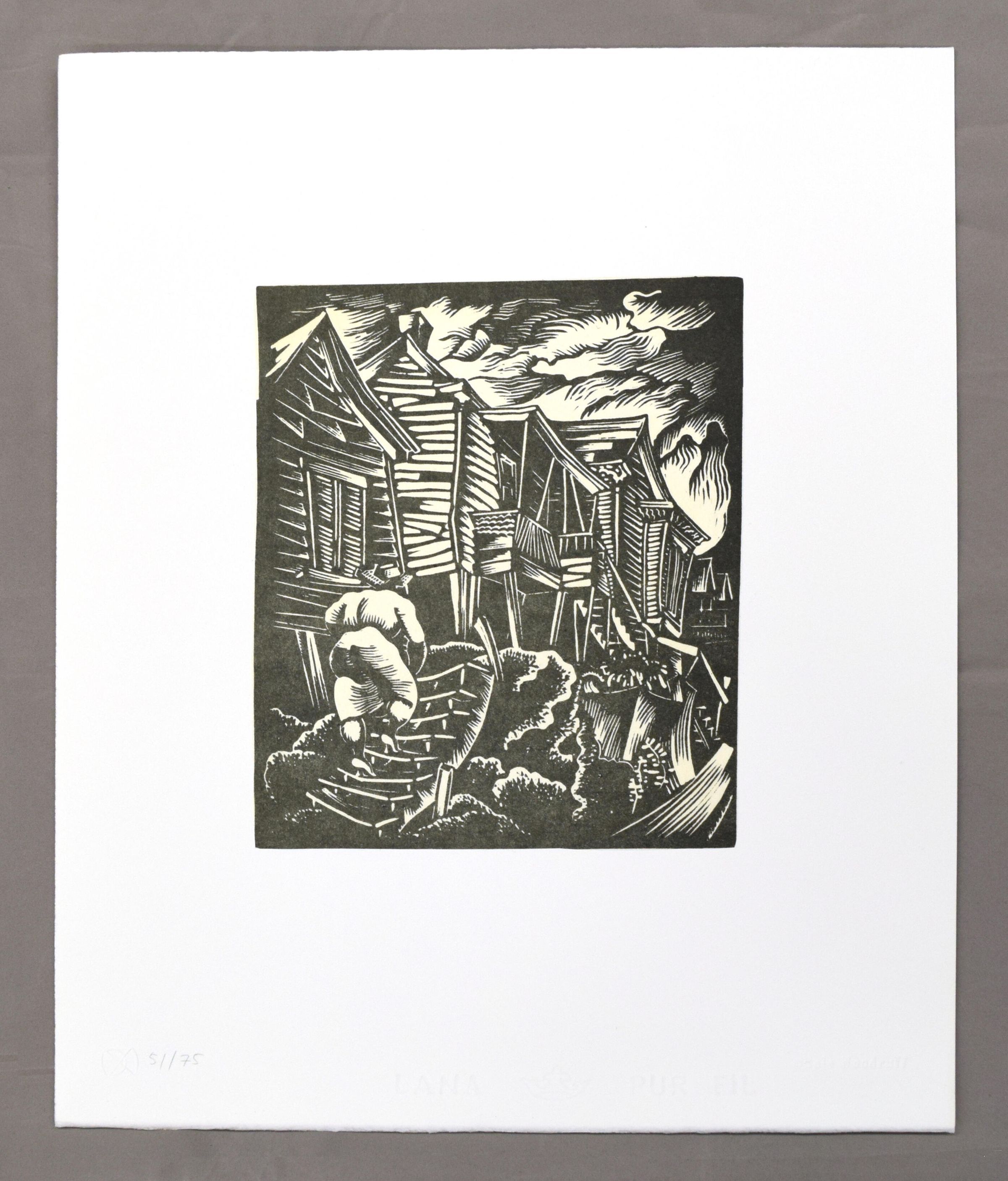
In Woodruff's image, a lone worker returns to her home at the end of the day. The rhythms created by the bowed steps, rickety shacks and tumultuous sky convey not only the weary woman's daily burden, but also the African American's struggle in general. In the forward-looking style characteristic of several prints from his Atlanta period, Woodruff offsets deprivation with pride. (Elnora, Inc. c/o E.T. Williams, Owner of Hale Woodruff Estate)
Printed posthumously in 1996 by Bob Blackburn's Printmaking Workshop in New York. After studying the original prints made over half a century ago, the master printer rendered the edition from Woodruff's own linoleum blocks. After the blocks were officially presented to the Schonburg Center for Research in Black Culture in 1996. Blackburn ceremoniously "crossed out" one of the blocks by etching a mark across it. This cancelling is the printmaker's gesture to preserve the artist's integrity and his own dedication to high-quality reprinting. According to the print curator at the Whitney Museum at the time, these prints were better than the originals and also included some he had never seen. (Elnora, Inc. c/o E.T. Williams, Owner of Hale Woodruff Estate)
A pioneering artist and educator, Hale Woodruff is best known for his murals at Atlanta University and Talladega College. Woodruff also established the Fine Arts Department at Atlanta University and the Atlanta Annuals competition.
Woodruff’s Atlanta period dealt with black themes related to the state of Georgia. They depict the African American’s general struggle in this time period and documented and brought to light the experience of African Americans, from cornerstones of the African American community and their heritage to the fight against injustice and the increased lynchings after World War I.