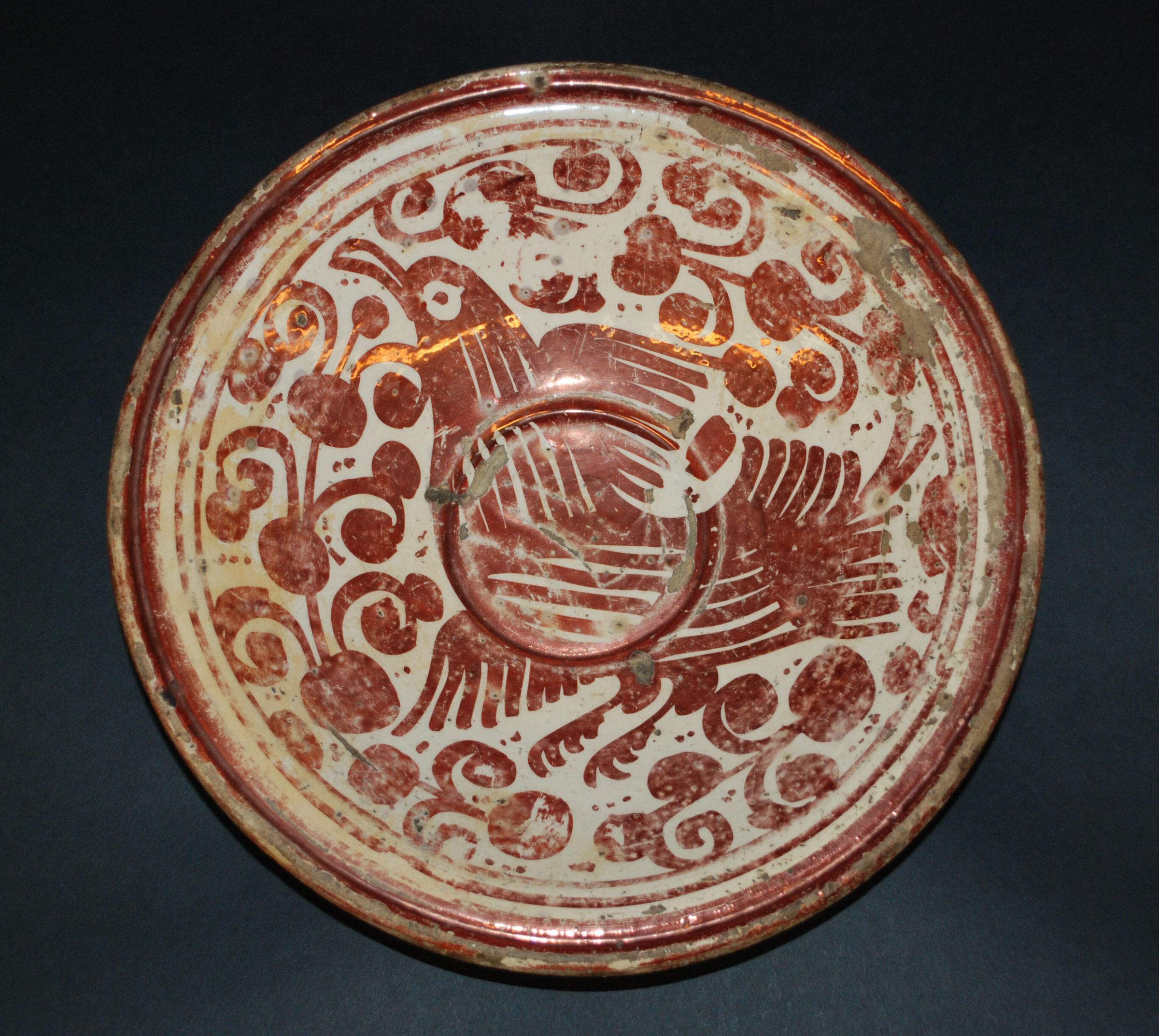
Copper Lustre Bowl

Ceramic

Object ID: 502

Drexel Founding Collection

Copper Lustre Bowl

Category

Ceramic

Acquisition

Accession

1891.001

Source or Donor

Anthony J. Drexel, Philadelphia

Acquisition Method

Gift

Credit Line

Gift of Anthony J. Drexel

Made/Created

Artist

Unidentified

Date made

circa 1700

Place

Country

Spain

Continent

Europe

Dimensions

Height

2-1/2 in

Diameter

11-3/8 in

Materials

Earthenware (lustreware), lead glaze

Exhibitions

Curiouser & Curiouser: Beyond the Glass
Earliest Acquisitions at Drexel: President MacAlister's European Visit
Where Am I From?

Interpretative Labels

Label Type

Exhibition Label

Label

The Hispano Moresque style came about in Spain while it was under the rule of the Islamic Moors. Lusterware was a specialty of Islamic pottery because the use of gold and silver is prohibited by the Hadiths.

Label Type

Exhibition Label

Label

This lustreware bowl was made in Spain, c. 1700. Lustreware was some of the finest ceramics produced in Spain.

Label Type

Exhibition Label

Label

Flowers, vines, birds and animals were popular motifs, but humans were rare. The Spanish potters were also familiar with the classical forms of decoration, but the motifs never gained popularity in lustreware.

Label Type

Exhibition Label

Label

The combination of the Islamic and Christian religions in Spain during the period when lustreware was popular, created a combination of Islamic style and the Gothic style, popular in Christianity at the time.

General Notes

Note

Per Cooper, Ten Thousand Years of Pottery, 2000: Lustreware ceramics were some of the finest made in Spain. Lustre is metallic decoration applied to ceramics through precipitation, using salts of silver, gold or copper that are dissolved and then mixed with an organic medium and painted onto the surface of the ceramic before firing. This style of decoration was invented in the Near East around the 9th century AD and then spread to the Islamic culture in Spain. The technique did not come to England until the 19th century when the potter William De Morgan began to develop lustrewares. (Trench, Materials & Techniques in the Decorative Arts, 2000)