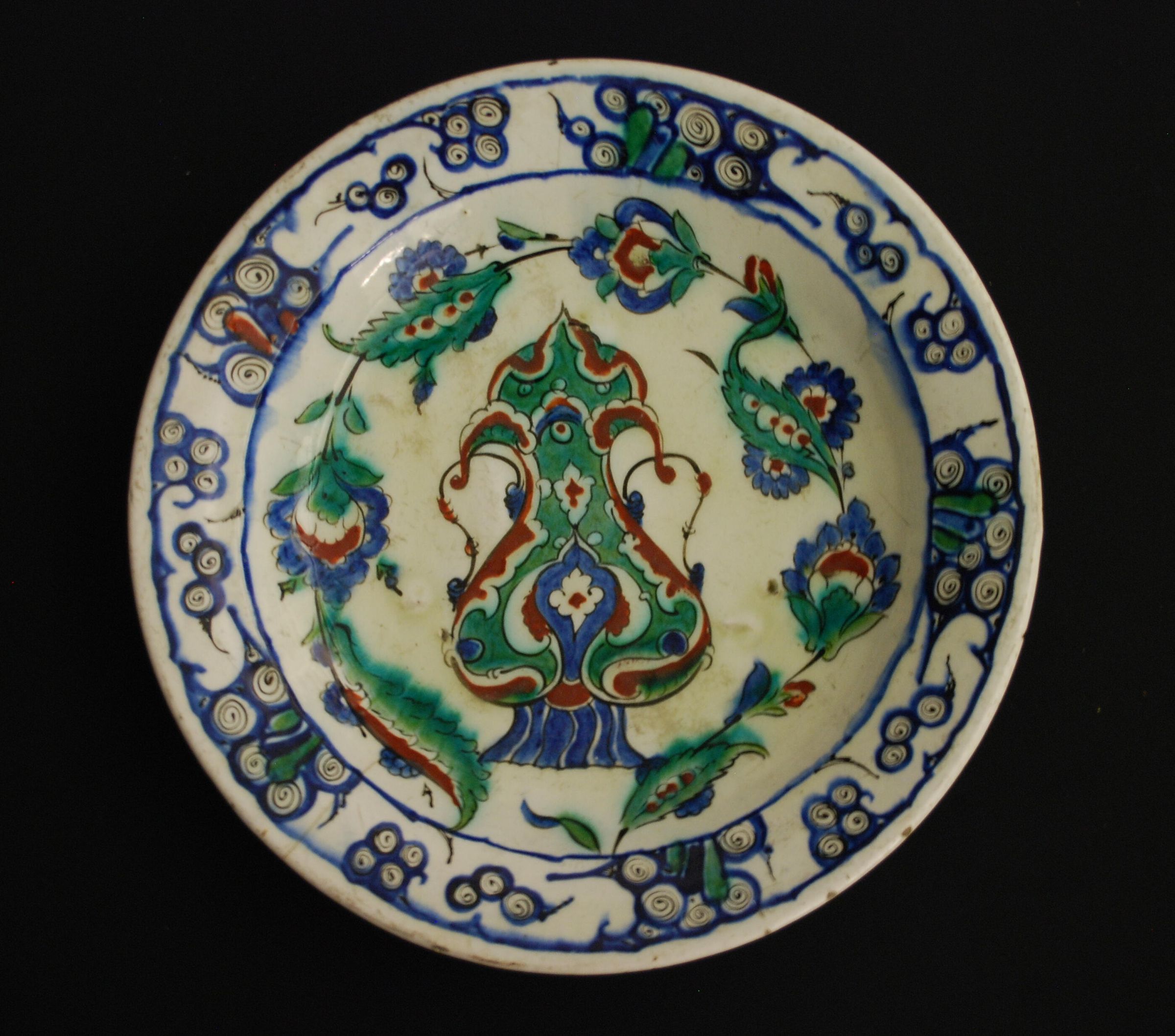
Dish

Ceramic

Object ID: 1257

Drexel Founding Collection

Dish

Category

Ceramic

Acquisition

Accession

1891.001

Source or Donor

Anthony J. Drexel, Philadelphia

Acquisition Method

Gift

Credit Line

Gift of Anthony J. Drexel

Made/Created

Artist

Unidentified

Place

City

Iznik

State/Province

Bursa

Country

Turkey

Region

Middle East

Continent

Asia

Inscription/Signature/Marks

Notes

Label: Underside, White rectangle divided into quarters with " CONSIGN. NO. DATE/ Drexel/ LOT NO. REMARKS/ 732 100/ 6" typed in black ink and handwritten in pencil Label: Underside, White circle with "148" handwritten in black ink

Dimensions

Height

2 in

Diameter

11-5/8 in

Materials

Earthenware, tin glaze with in-glaze decoration, cobalt, armenian bole

Provenance

Notes

Purchased by James MacAlister in London, 1891

Exhibitions

Earliest Acquisitions at Drexel: President MacAlister's European Visit
The Drexel Collection: Celebrating 125 Years
Fired Works: Ceramics from Around the World
Arts of Asia: Selections from The Drexel Collection
Practical & Cultural: The Drexel Collection as Teaching Tool
125 Years: Drexel & the City
Gateway to the University: The Collections at Drexel

Interpretative Labels

Label Type

Exhibition Label

Label

This dish is an example of Iznik pottery of the third style, c. 1550, which incorporated the addition of sealing-wax red.

Label Type

Exhibition Label

Label

This dish is an example of underglaze decorated earthenware produced in the famous kiln town of Iznik. The sealing-wax red color started to be incorporated in the decoration of the Iznik pottery from c.1550 onwards.

Label Type

Exhibition Label

Label

These ceramics were made around the height of the Ottoman Empire; in the town of Iznik which is famous for their pottery. The Ottoman court admired Chinese porcelain but was unable to create it themselves so the ceramics of Iznik adapted by making fritware, a low-fired ceramic comprising of mainly silica and glass.

General Notes

Note

This dish is an example of Iznik pottery of the third style, c. 1550, which incorporated the addition of sealing wax red. (Lane, Arthur, Guide to the Collection of Tiles, Victoria & Albert Museum, 1939, pp. 13-21) Iznik, Turkey was a major pottery town until the 17th century. The height of production was during the height of the Ottoman Empire c. 1560-1600 and the majority of the tiles for the Ottoman Empire mosques in Istanbul were made in Iznik. (https://www.christies.com/features/Iznik-Pottery-Collecting-Guide-7183-1.aspx) Per previous cataloguer: The color palette on this dish is known as "Rhodian."