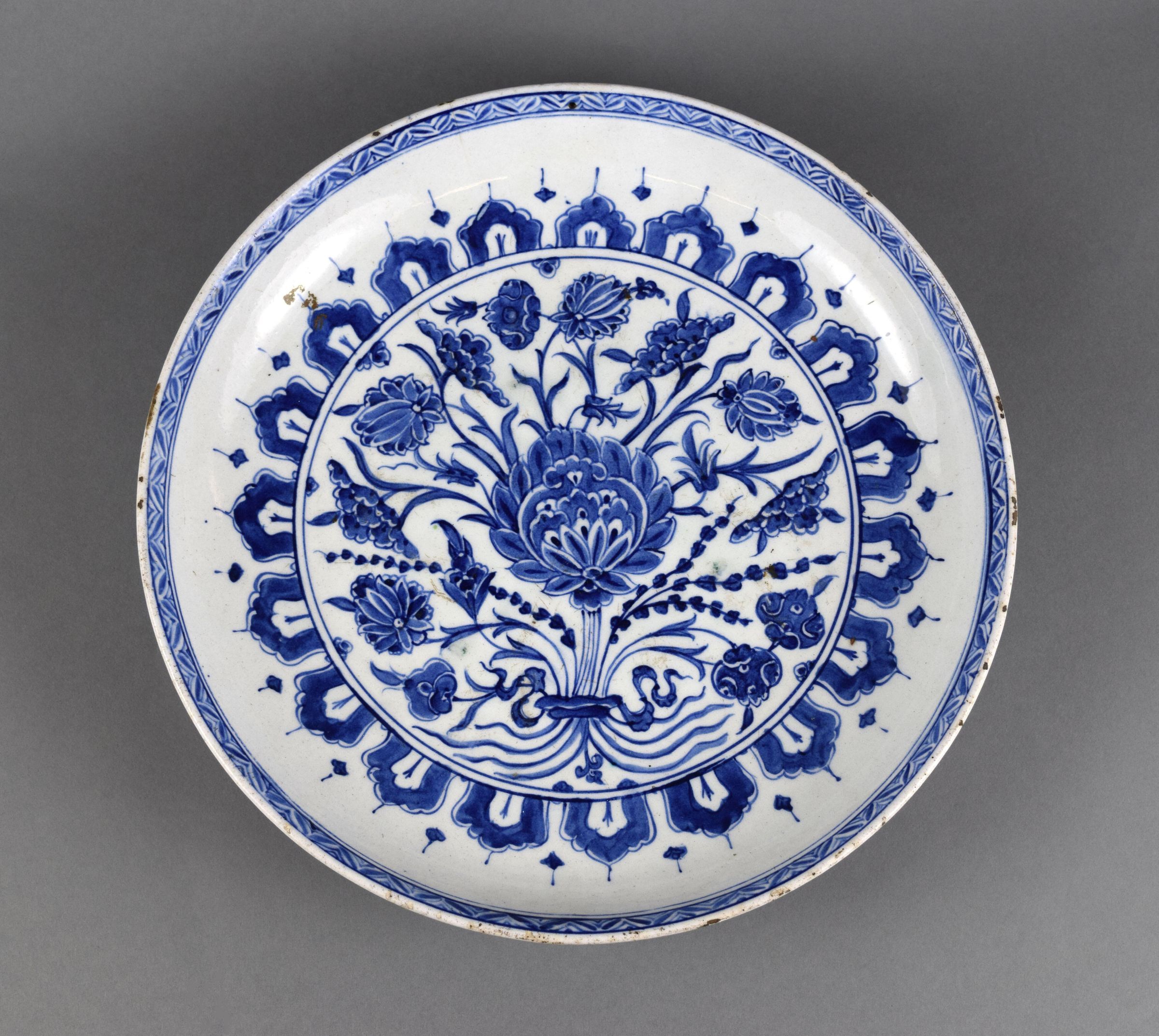
Dish

Ceramic

Object ID: 286

Drexel Founding Collection

Dish

Category

Ceramic

Acquisition

Accession

1891.001

Source or Donor

Anthony J. Drexel, Philadelphia

Acquisition Method

Gift

Credit Line

Gift of Anthony J. Drexel

Made/Created

Artist

Unidentified

Time Period

15th - 17th century

Place

Country

Turkey

Region

Middle East

Continent

Asia

Inscription/Signature/Marks

Notes

Inscription: Underside, "147" handwritten in black paint

Dimensions

Height

2 in

Diameter

11-7/8 in

Materials

cobalt, lead glaze, Fritware

Provenance

Notes

Purchased by James MacAlister in London, 1891

Exhibitions

Curiouser & Curiouser: Beyond the Glass
Earliest Acquisitions at Drexel: President MacAlister's European Visit
The Drexel Collection: Celebrating 125 Years
Arts of Asia: Selections from The Drexel Collection
125 Years: Drexel & the City
The Study Exhibition: MacAlister's Treasures

Interpretative Labels

Label Type

Exhibition Label

Label

Chinese blue and white porcelain produced during the Ming Dynasty (1368-1644) was widely exported to the Ottoman court since the end of the 15th century and became the catalyst for many regional imitations. In order to imitate the white and translucent body of Chinese porcelain, Near Eastern potters developed a new technology based on old Egyptian practices: fritware, where ground quartz was mixed with clay and silica giving a pure white appearance to the earthenware after it was fired.

Label Type

Exhibition Label

Label

These ceramics were made around the height of the Ottoman Empire; in the town of Iznik which is famous for their pottery. The Ottoman court admired Chinese porcelain but was unable to create it themselves so the ceramics of Iznik adapted by making fritware, a low-fired ceramic comprising of mainly silica and glass.

General Notes

Note

İznik pottery which is a Turkish fritware with cobalt blue decoration under a colorless lead glaze produced from the last quarter of the 15th century until the end of the 17th century. Fritware is a relatively low firing, white bodied ceramic with the main component being quartz, made in imitation of porcelain. (Trench, Materials & Techniques in the Decorative Arts, 2000) Previously dated 1490-1555. (L. Clouser, 11/16/2016)