Ecuell with Cover and Stand
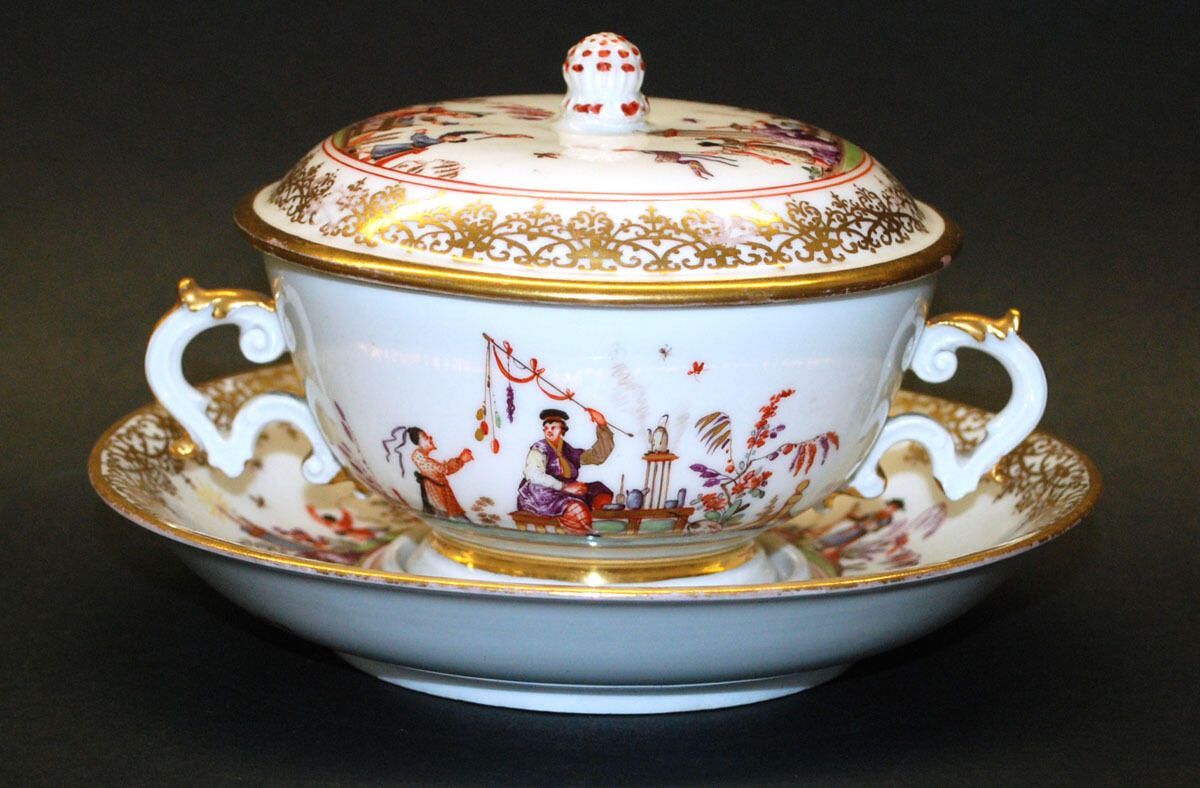
2006.00A.0005 A-C
Overall
Category
Ceramic
Acquisition
Source (if not Accessioned)
Harold Shaub, HaddonfieldNotes
Date: 1991 Credit Line: Gift of Harold A. Shaub Means of Accession: Gift Source: Harold A. Shaub, former president of Campbell Soup CompanyMade/Created
Artist
Meissen Porcelain FactoryDate made
circa 1730Place
City
MeissenCountry
GermanyContinent
EuropeInscription/Signature/Marks
Notes
Maker's mark: Underside saucer (A), Two crossed swords in underglaze blue Maker's mark: Underside cup (B), Two crossed swords in underglaze blue Mark: Underside cup (B), "5." handpainted in gilding Mark: Underside lid (C), "5." handpainted in gildingDimensions
Dimension Description
Part AHeight
1 inDiameter
6-1/2 inDimension Description
Part BHeight
2-1/4 inWidth
4-1/4 inLength
6 inDimension Description
Overall Height: Part B, CHeight
3-1/2 inDimension Description
Part CHeight
1-1/4 inDiameter
4-5/8 inDimension Description
Overall Part A-CHeight
4 inDiameter
6-1/2 inMaterials
Hard paste porcelain, polychrome enamels, gilding, lime (alkaline) glaze
Exhibitions
Curator Pick of the Month
Fired Works: Ceramics from Around the World
Practical & Cultural: The Drexel Collection as Teaching Tool
Holding Your Drink: 3,000 Years of Drinking Vessels from the Drexel and Salzberg Collections
Gateway to the University: The Collections at Drexel