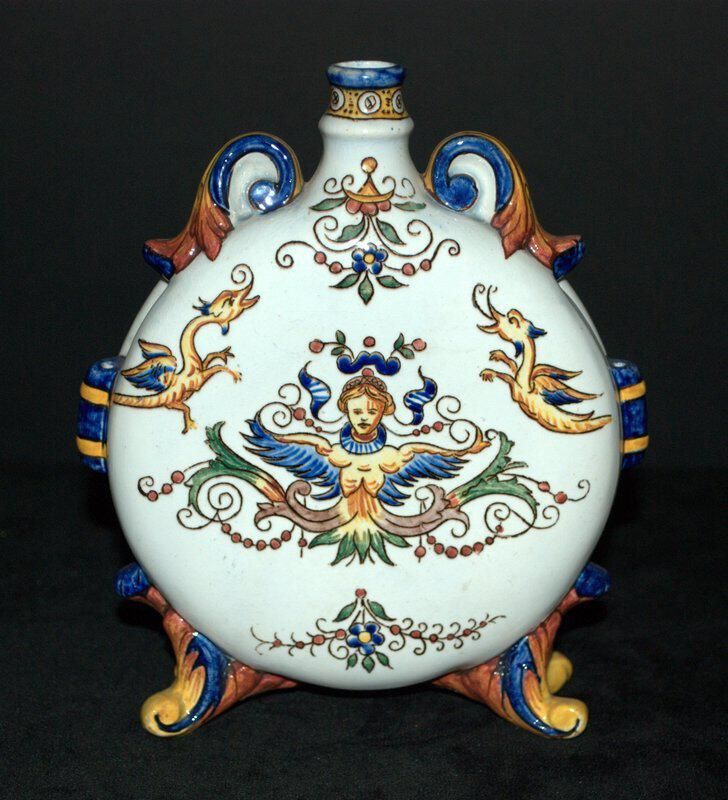
Faience Vase

Ceramic

Object ID: 977

Drexel Founding Collection

Faience Vase

Category

Ceramic

Acquisition

Source (if not Accessioned)

Mrs. William H. Rawle

Notes

Date: 1894 Credit Line: Bequest from the estate of Mrs. William H. Rawle Means of Accession: Bequest

Made/Created

Artist

Faiencerie de Gien

Date made

circa 1870

Place

Country

France

Continent

Europe

Inscription/Signature/Marks

Type

Inscription

Location

Underside

Transcription

Indecipherable "[801]"

Material/Technique

Handwritten

Notes

handwritten in light purple

Type

Label

Location

Underside foot

Transcription

"613"

Material/Technique

Handwritten, Ink

Notes

White circular with "613" handwritten in black ink

Type

Makers Mark

Location

Underside

Transcription

"GIEN"

Material/Technique

enamel

Notes

in Roman lettering within a banner in black enamel

Dimensions

Height

7-1/4 in

Width

1-1/2 in

Length

6 in

Materials

Earthenware, tin glaze

Exhibitions

The Drexel Collection: Celebrating 125 Years
Fired Works: Ceramics from Around the World
Style Within: Interior Design of the 19th Century
125 Years: Drexel & the City

Interpretative Labels

Label Type

Exhibition Label

Label

In France, tin-glazed earthenware is known as faience. Production began in southern France near Avignon as early as the 12th to the 13th century, but it wasn’t until Italian artisans settled in Lyons, Montpellier and Nimes in the 16th century that the technique took off. These two examples of faience show influences from two other forms of tin-glazed earthenware, Dutch delftware in the charger and Italian majolica in the vase.

Label Type

Exhibition Label

Label

The Renaissance Revival saw a return in popularity of Italian majolica, tin-glazed earthenware. These four examples demonstrate some of the bold colors popular in the Renaissance Revival as well as some common motifs such as the masks and acanthus on the vases and the lotus blossom candle-cups.#974, 977, 1432, 1433

General Notes

Note

Date changed from late 19th century to c. 1870 based on the Gien mark. (L. Clouser, 11/16/2016) In France, tin-glazed earthenware is known as faience. Production began in southern France near Avignon as early as the 12th to the 13th century, but it wasn't until Italian artisans settled in Lyons, Montpellier and Nimes in the 16th century that the technique took off. (Cooper, Emmanuel, Ten Thousand Years of Potter, University of Pennsylvania Press, 2000)