Note
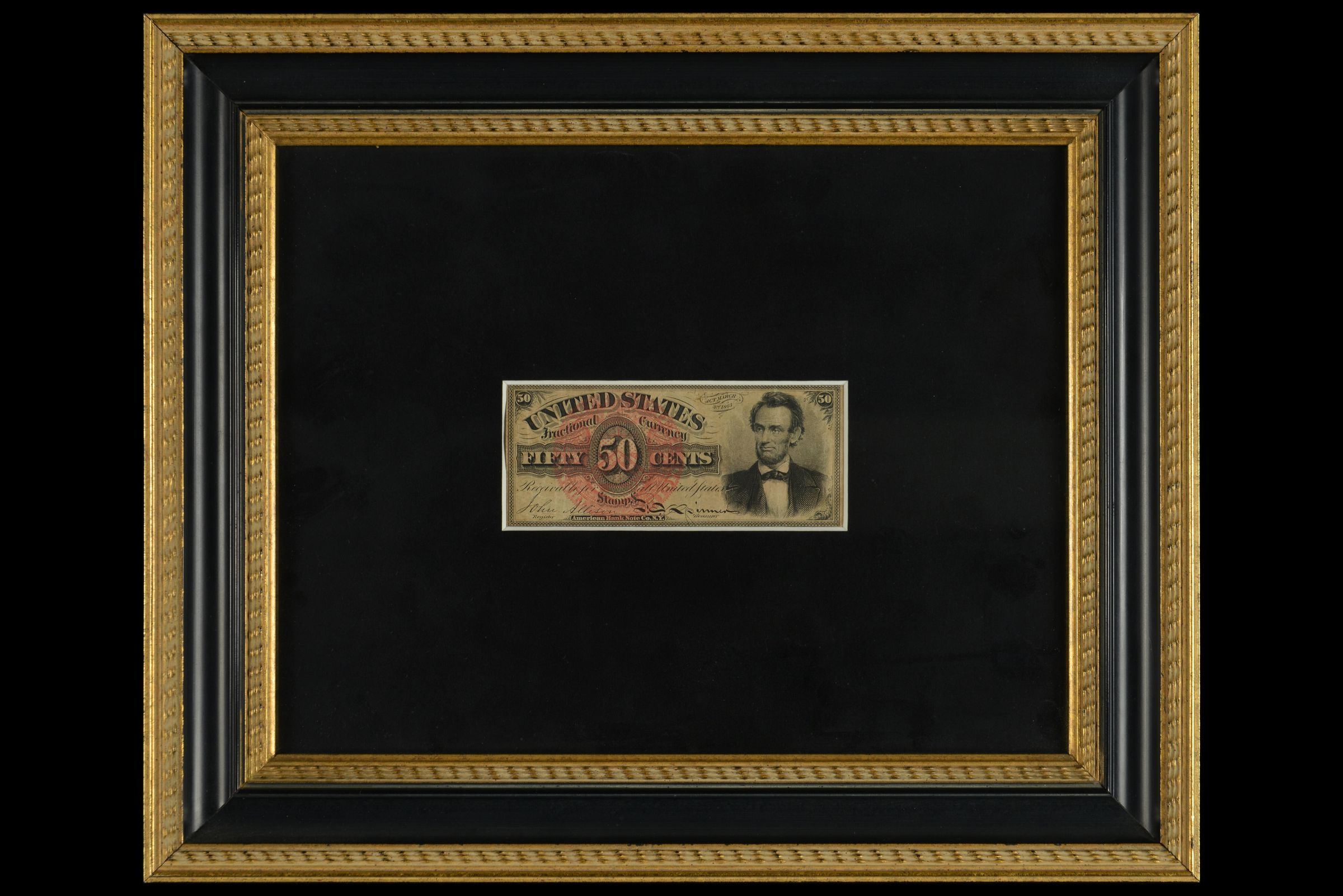
A fifty cent paper currency note from the New York National Bank Note Company in New York. Bill contains a portrait of President Abraham Lincoln on the front, dated from during the Civil War.
During the Civil War, paper money was becoming increasingly more viable as coinage was melted down for ammunition and weapons. The Union designed and created what were commonly known as Greenbacks to help pay for the Civil War. This newer form of paper money was not backed by the gold standard, and subsequently caused inflation after the war when the government had to pay back war bonds. The Greenbacks were first issued in the Legal Tender Act on February 26, 1862, and were basically promises that the government would honor these bank notes. This was instead of banks traditionally issuing currency that was backed by the money they had in their vaults, meaning the Greenbacks really had little value during economic hardship. The war was expected to end quickly, however when it didn’t, Lincoln and the Department of the Treasury issued another Legal Tender Acts to print and put into circulation these non-interest bearing monetary notes that were printed in green ink (hence their moniker). As seen in this fifty cent note, signatures of John Allison and Colby Spinner of the American Bank Note Company were printed onto the bill to avoid the issue of counterfeiting money, which was rampant in many of the paper denominations that were created during the Revolutionary War. This bill comes after the famous Greenbacks, but lacks the serial numbers that started appearing on money in 1862 as an additional measure against illegal copies. The red seal on this note is typical of this and the Greenbacks issued by national banks.
The American Bank Note Company was founded in 1795, and was the printer of American currency, in specific, Union currency. Banks like these were able to buy union bonds to help pay for the war, and then were allowed by the Department of the Treasury to charter contracts to print American money. This was able to create greater trust in banks by the American people because they were endorsed by the government. After the Civil War, this paper currency stayed in circulation in part due to the American public adopting the mindset that paper currency was “as good as gold.” In 1879, the government planned to convert the money back to coinage, but groups such as rural farmers and the Greenback Party, a political party set on the adoption of paper money by the U.S., combated this act due to the financial strain of the Panic of 1873, and the desire for more paper money as an economic cushion. These United States Notes were in circulation for over 100 years during and after the war, being pulled out of circulation in 1971.
L. Bros 6/7/2019
Bibliography:
1. Abhinav, Vivek. "Greenback Movement." Encyclopædia Britannica. July 29, 2013. Accessed May 14, 2019. https://www.britannica.com/event/Greenback-movement.
2. "American Bank Note Company Records, 1860-1987." Smithsonian Institution. Accessed May 14, 2019. https://www.si.edu/object/siris_arc_308860.
3. "Greenback." Museum of American Finance. Accessed May 14, 2019. https://www.moaf.org/exhibits/checks_balances/abraham-lincoln/greenback.
4. "The History of American Currency." U.S. Currency Education Program. Accessed May 14, 2019. https://www.uscurrency.gov/history.
5. "U.S. Paper Money, 1793-Present." US Paper Money, 1793-Present - Littleton Coin Company. Accessed May 14, 2019. https://www.littletoncoin.com/shop/US-Paper-Money-1793-Present.