Note
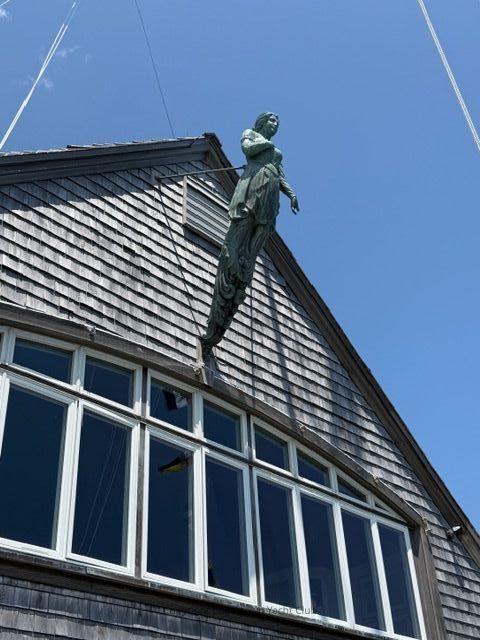
This is a copy, by sculptor Richard Orr, of the original figure head, allegedly purchased by Commodore Elmer J. Bliss from a pawn shop in Honolulu in 1940. The name of the sculptor and the vessel for which it was carved are unknown. In the late 1950's it was discovered that the original, which hung on the harbor face of the clubhouse, was suffering from dry rot. The original is now located in the Mystic Seaport Museum.Note Type
Historical NoteNote
From AI: The "White Lady" is a prominent artifact in the permanent collection at the Mystic Seaport Museum in Mystic, Connecticut. However, the museum’s research reveals a major twist: she is not actually a ship's figurehead. While displayed alongside the museum’s world-class collection of authentic, ocean-faring figureheads in the Wendell Gallery, historians discovered that the "White Lady" served a completely different purpose. The artifact is a ghost-like, life-sized carving of a woman painted entirely in white. For years, visitors assumed she once guided a 19th-century vessel through the ocean, but curators identified key structural clues that prove otherwise.
The Posture: true figureheads were hand-carved to lean dramatically forward to flush seamlessly with the natural, forward-curving swoop of a ship's bow. The White Lady stands completely straight and erect.
The Vulnerable Arm: She features an outstretched arm. A real ship figurehead would never have an arm reaching outward like this, as crashing Atlantic waves would have immediately snapped it off at sea.
The Scrollwork Base: She is mounted on an elaborate, decorative scrollwork base. This style of base is highly unusual for ship bows but very common for stationary land displays.
No Fastenings: The back and bottom of the wood lack any traces of the heavy iron or wooden bolts that would normally be drilled deep into the artifact to lock it onto a ship's hull.
What was she? Curators believe the "White Lady" was actually an elaborate outdoor trade sign or architectural decoration—likely standing proudly outside a 19th-century New England merchant shop, tavern, or shipping office rather than sailing the seas.