Name/Title
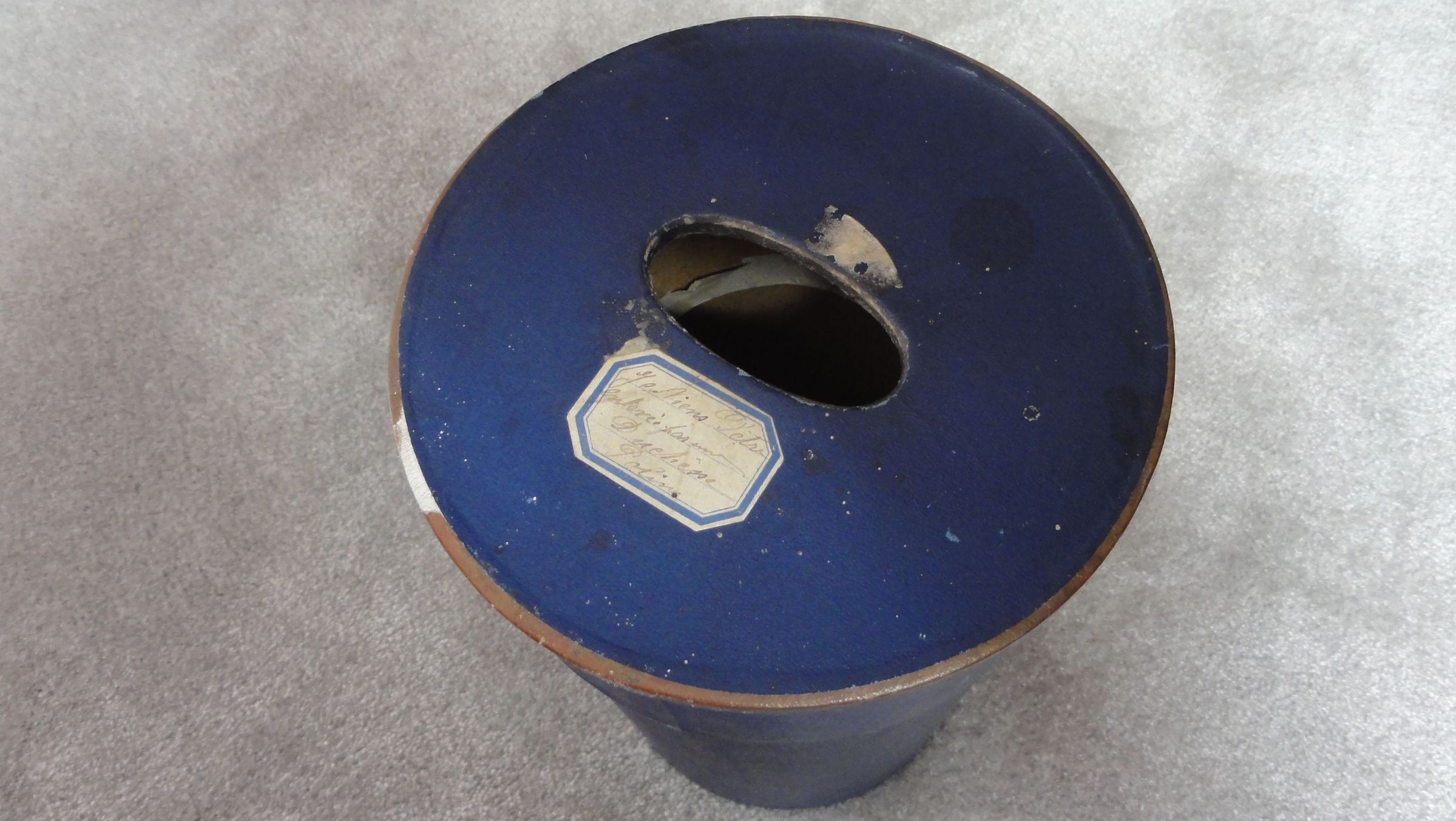
Pathé “Céleste” CylinderEntry/Object ID
262Description
Pathé Frères, Paris, ca. 1900
Historical Background
Around the turn of the century, many manufacturers experimented with oversized cylinders to achieve longer playing times and greater volume. Alongside Columbia’s “Grand/Multiplex” and Lioret’s “Idéal,” Pathé introduced the Céleste in 1899/1900. It was also showcased at the Paris World Exhibition in 1900.
The cylinder was extraordinarily large—about 13 cm in diameter and 21 cm in length—and could play for roughly five minutes, far longer than standard or concert cylinders. It sold for 20 to 40 francs, which in today’s money equals roughly €80–160—making it a genuine luxury item affordable only to wealthy customers.
Technology and Manufacture
Format: approx. 130 mm diameter × 216 mm length
Playing time: about 5 minutes
Material: brown Pathé wax, often with an impressed label
Compatibility: playable only on specially adapted Pathé “Céleste” phonographs
Production was extremely demanding:
Large wax blanks had to be cast and cooled with absolute uniformity.
The smallest air bubble or stress crack could ruin a cylinder.
Engraving and duplicating such oversized masters required special equipment and precision techniques.
These challenges made the process costly, error-prone, and unsuitable for mass production.
Comparison with the Multiplex Grand
While the Pathé Céleste was among the largest French cylinders, it was still smaller than the monumental Graphophone Multiplex Grand cylinder produced in the United States.
Céleste: ~13 cm diameter, 21 cm length, ~5 minutes.
Multiplex Grand: ~15.2 cm (6 inch) diameter, 30 cm (12 inch) length, up to 10–12 minutes.
Only 10–15 Céleste cylinders are thought to survive worldwide, whereas the Edisonium’s Multiplex Grand cylinder is the only documented example known anywhere in the world.
Rarity and Significance
Céleste cylinders were manufactured in very limited numbers and quickly vanished from the market. They served mainly as exhibition pieces or for spectacular demonstrations.
Today, original Pathé Céleste cylinders are extremely rare—with perhaps only a dozen surviving worldwide.
The example on display at the Edisonium Mariazell is one of these, and its presentation alongside the unique Multiplex Grand cylinder (Exhibit Nr. 252) highlights a short-lived era of “gigantism” in the history of recorded sound