Name/Title
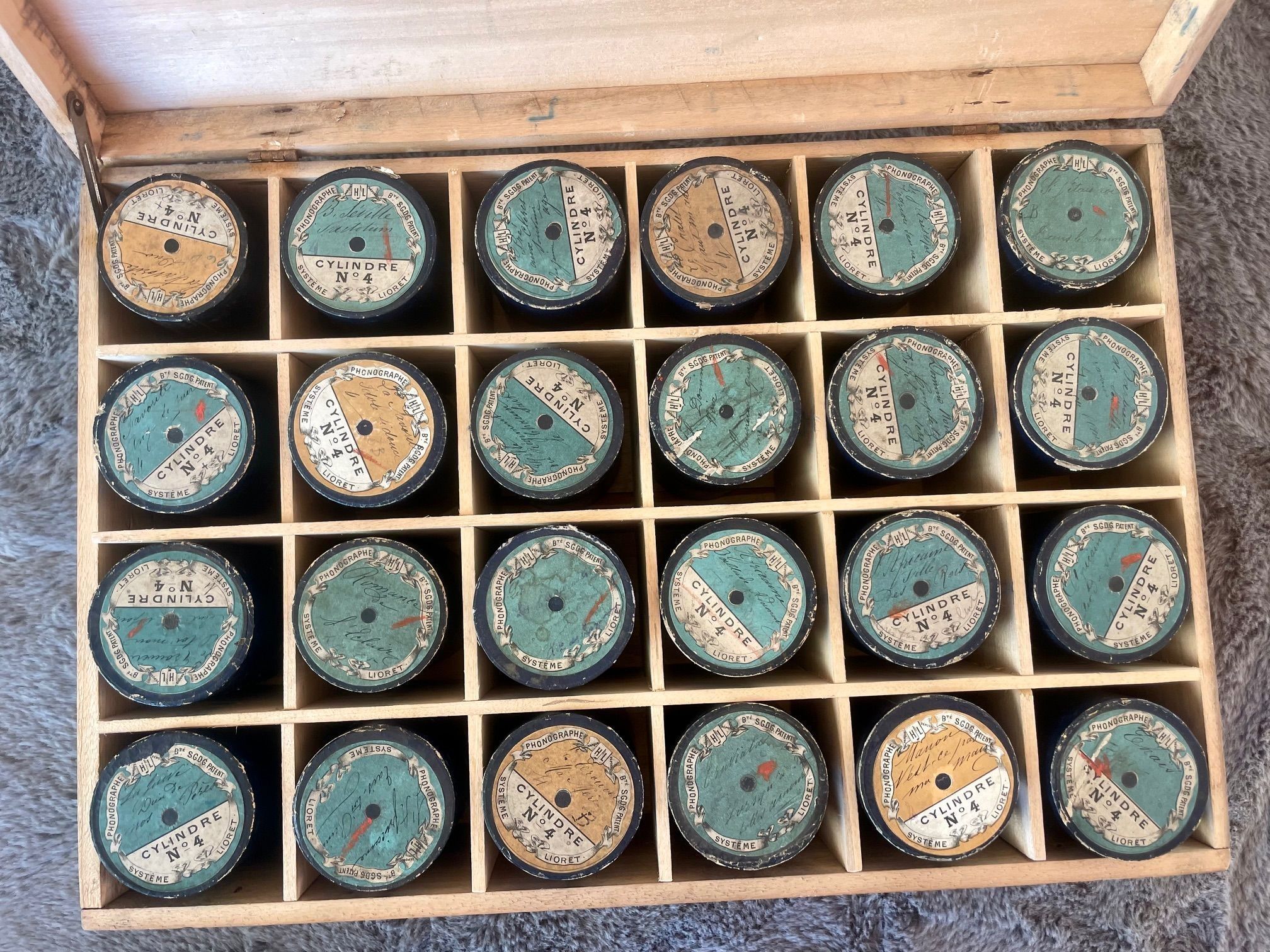
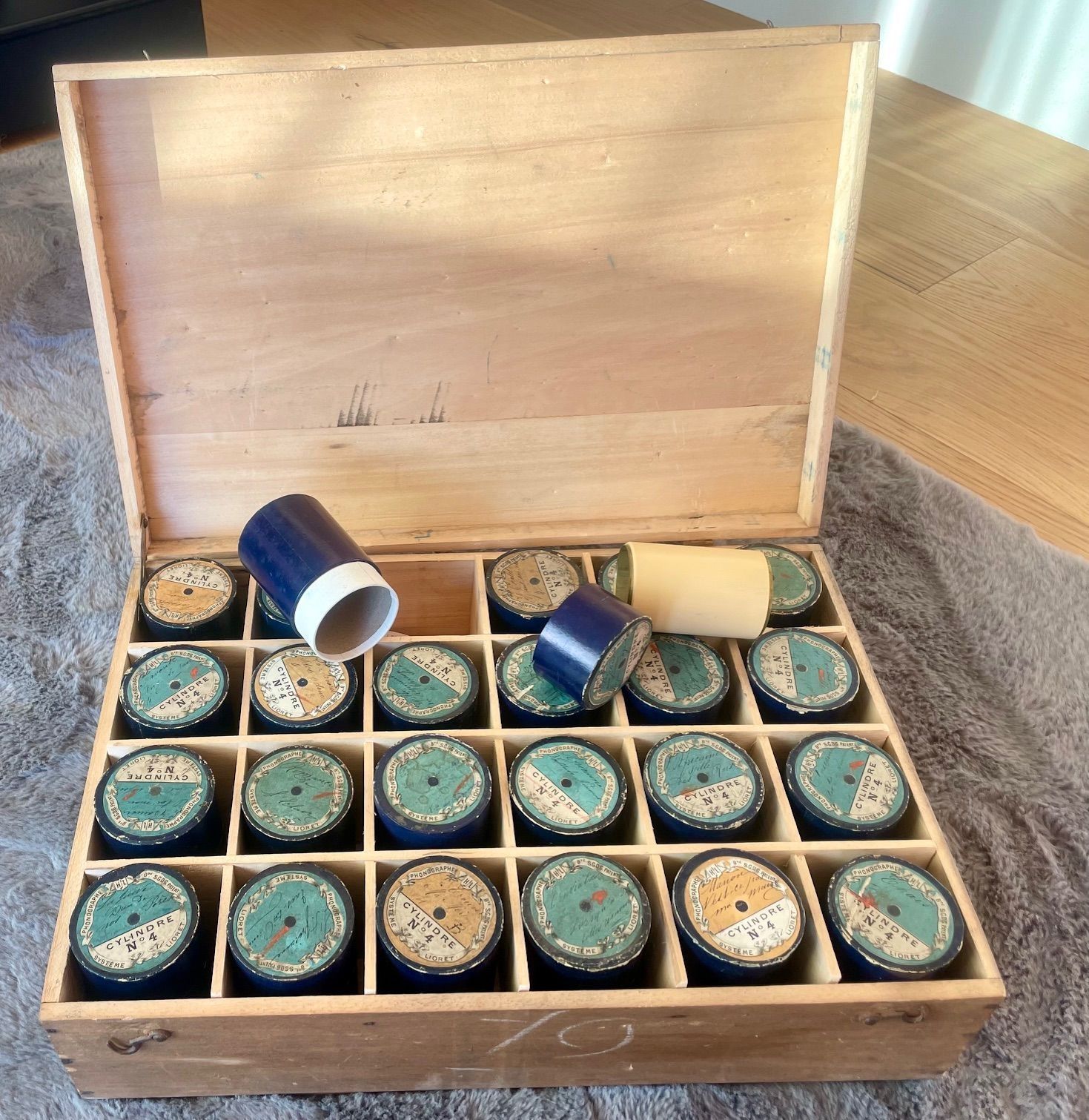
Lioret Cylinders “No. 4” (4-Minute, Eurêka) Complete set of 24 cylinders in original wooden caseEntry/Object ID
387Description
Lioret Cylinders “No. 4” (4-Minute, Eurêka)
Henri Lioret, Paris, ca. 1898–1901
Complete set of 24 cylinders in original wooden case
Purpose
These extremely rare No. 4 cylinders were designed specifically for the Lioretgraph No. 3 (weight-driven, à poids) – the very model exhibited in the Edisonium. They are not compatible with Edison or Pathé phonographs, since Lioret used his own unique format and mandrel design.
Technology
Material: Early celluloid cylinders (Eurêka) – much more durable than fragile wax.
Playing time: approx. 4 minutes, double the standard duration of the time.
Construction: celluloid tube reinforced with brass (sometimes aluminum) rings, ensuring stability.
Groove density: up to 133 tpi at 100 rpm – a technical limit of the era.
Labeling: Original paper labels marked Cylindre No. 4 – Système Lioret, some with red dots for studio catalogue classification.
Repertoire & price: Songs, duets, orchestral works; sold at 12–20 francs each (roughly €50–90 today).
Context
Introduced in 1898, the No. 4 (Eurêka) was Lioret’s boldest cylinder innovation: longer playtime, smaller rpm, and finer groove density. It was initially paired with the Lioretgraph No. 3, later adapted for other Lioret models after 1899. Contemporary catalogues proudly highlighted their “approx. four minutes of play” – a remarkable achievement for the time.
Rarity
Complete, uniform sets of 24 No. 4 cylinders are today extremely rare. Most were dispersed or lost, as celluloid was costly to produce and these were luxury items for elite customers.
Significance
Lioret’s No. 4 cylinders stand as a landmark in recorded sound: durable, long-playing, and technically ahead of their time. The Edisonium’s set of 24 cylinders is one of very few known worldwide and forms a perfect complement to the museum’s Lioretgraph No. 3 (à poids) – the machine for which they were originally created.