Name/Title
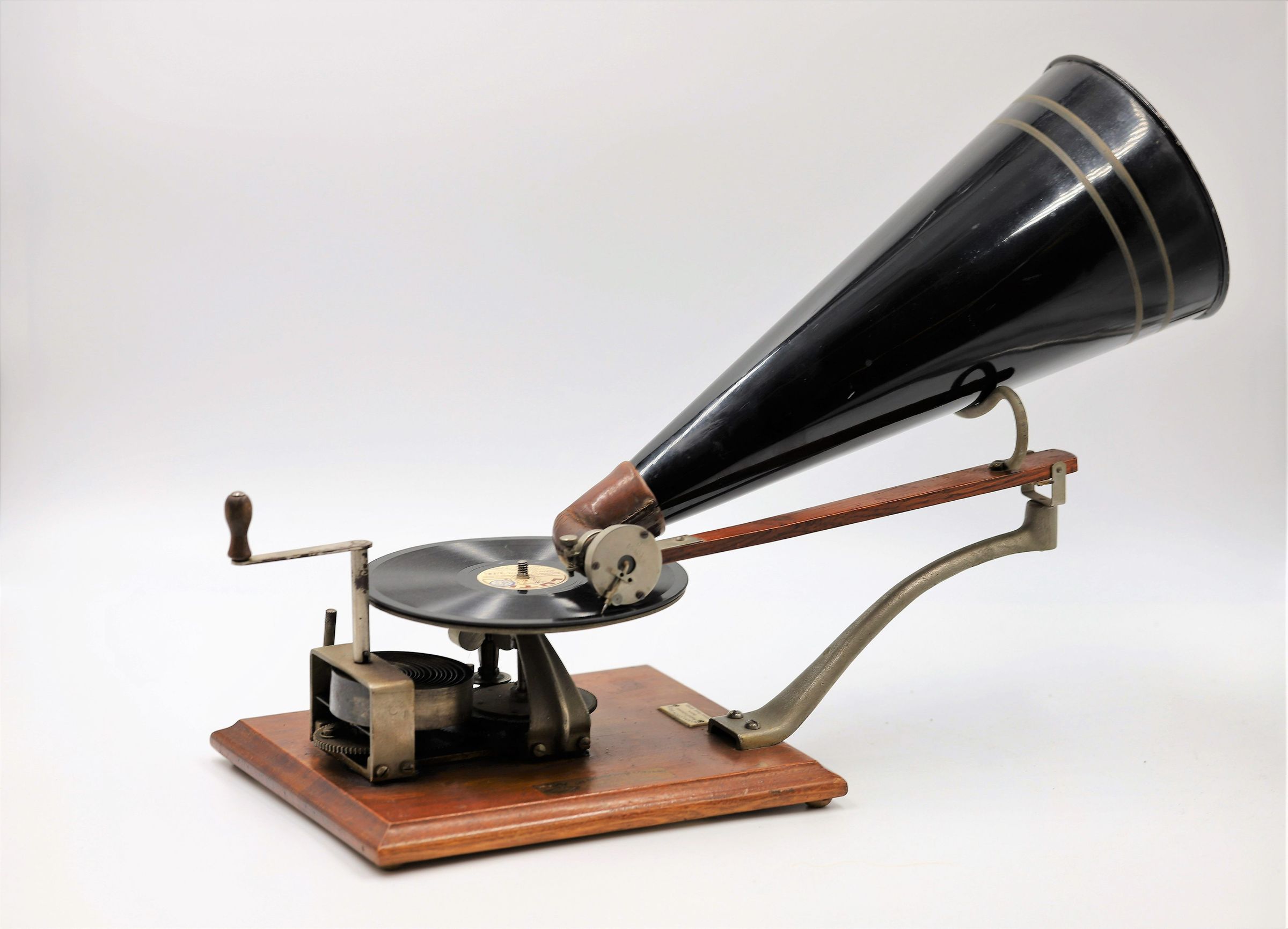
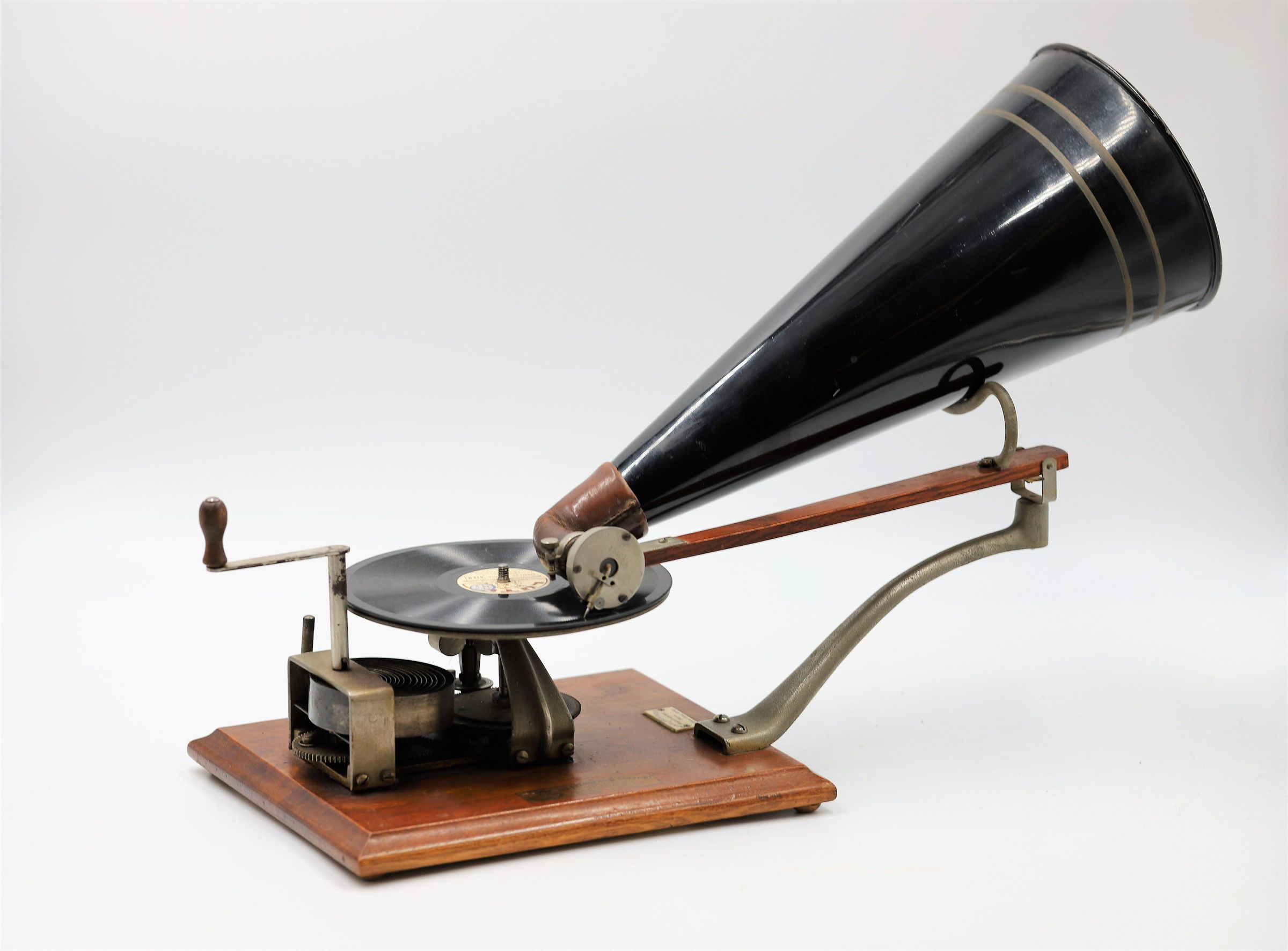
Gramophone Style No. 3, Early disc gramophone with open spring motorEntry/Object ID
127Description
Manufacturer / Distributor:
The Gramophone Company Ltd., London
(distributed internationally through branch offices)
Date: c. 1900–1903
Type: Acoustic disc gramophone, base-mounted model
Drive: open spring motor, hand-cranked
Crank: vertically arranged
Horn: black lacquered sheet-metal horn
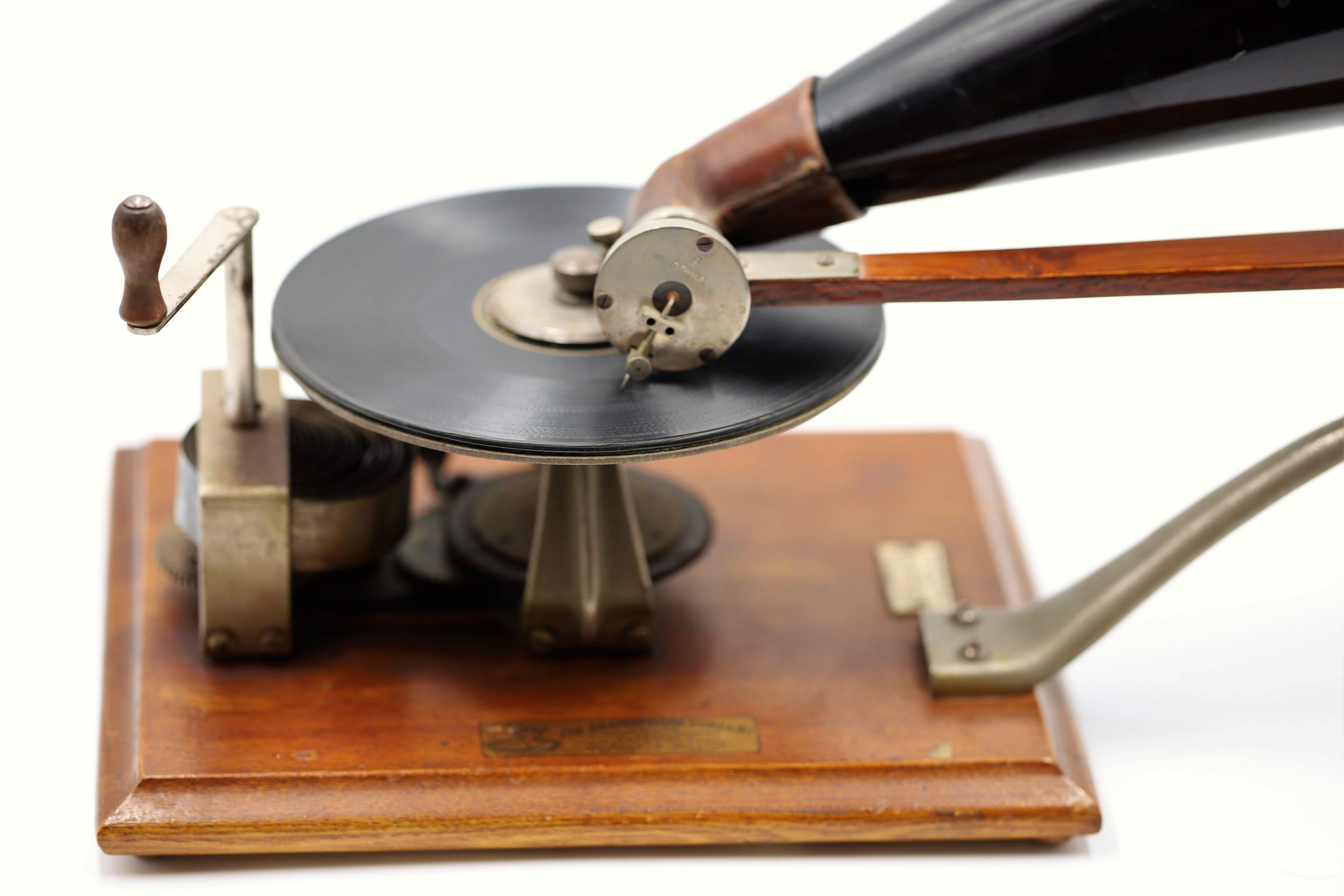
Soundbox: Clark-Johnson, later partly replaced by the “Concert” soundbox
Introductory price: approx. £3-3-0 (United Kingdom)
Historical Background
The Gramophone Style No. 3 ranks among the earliest serially marketed disc gramophones and marks a decisive step from the experimental apparatus toward a commercially distributed music playback device.
Introduced around 1900 by the Gramophone Company, it belongs to the simpler, functionally oriented spring-driven models of early gramophone production.
The motor is mounted uncovered on a wooden base plate, leaving the entire mechanism openly visible—an attribute typical of the earliest developmental phase.
Even simpler devices existed at the same time in the form of pure hand-driven models without a spring motor, which are generally classified as toy or demonstration apparatus rather than full gramophones.
Technology and Construction
The machine features an open spring motor with all components fully accessible. Speed regulation is controlled by a centrifugal governor. Early versions lacked a separate brake; stopping the motor was therefore partly performed manually.
The tonearm is of simple construction and fitted with an early Clark-Johnson soundbox, characteristic of the initial years of disc gramophones. Playback is performed using shellac discs with steel needles.
Despite its simple construction, the black lacquered external horn provides a surprisingly powerful sound projection.
Trademarks and Manufacturer Information
The wooden base bears the famous “His Master’s Voice” decal, depicting the dog Nipper listening to a horn—one of the most recognizable trademarks in the history of recorded sound.
The manufacturer’s label reads:
The Gramophone Company Ltd.
31 Maiden Lane, London W.C.
and lists patents in Great Britain, Germany, Austria, Belgium, France, and Italy.
This reflects the company’s early international orientation and its ambition to dominate the European gramophone market.
International Variants and Designations
Although technically largely identical, this model was marketed under different names depending on the country:
Great Britain / France: Gramophone No. 3
United States: Model 8 (manufactured by E. R. Johnson)
Canada: Berliner Standard Gram-o-phone Model A
These differing designations reflect the complex licensing and distribution structures of the early gramophone industry.
Rarity and Significance
The Style No. 3 was offered only for a relatively short period and was soon replaced by technically improved and more elaborately enclosed models.
Original surviving examples with an open motor, vertical crank, original horn, and a well-preserved decal are today very rare.
Significance within the Edisonium
This exhibit documents a key phase in the early history of the disc record:
the transition from experimental devices to serially produced music machines.
As one of the earliest commercially successful disc gramophones, this instrument forms a cornerstone of the Edisonium collection devoted to the early history of the gramophone.