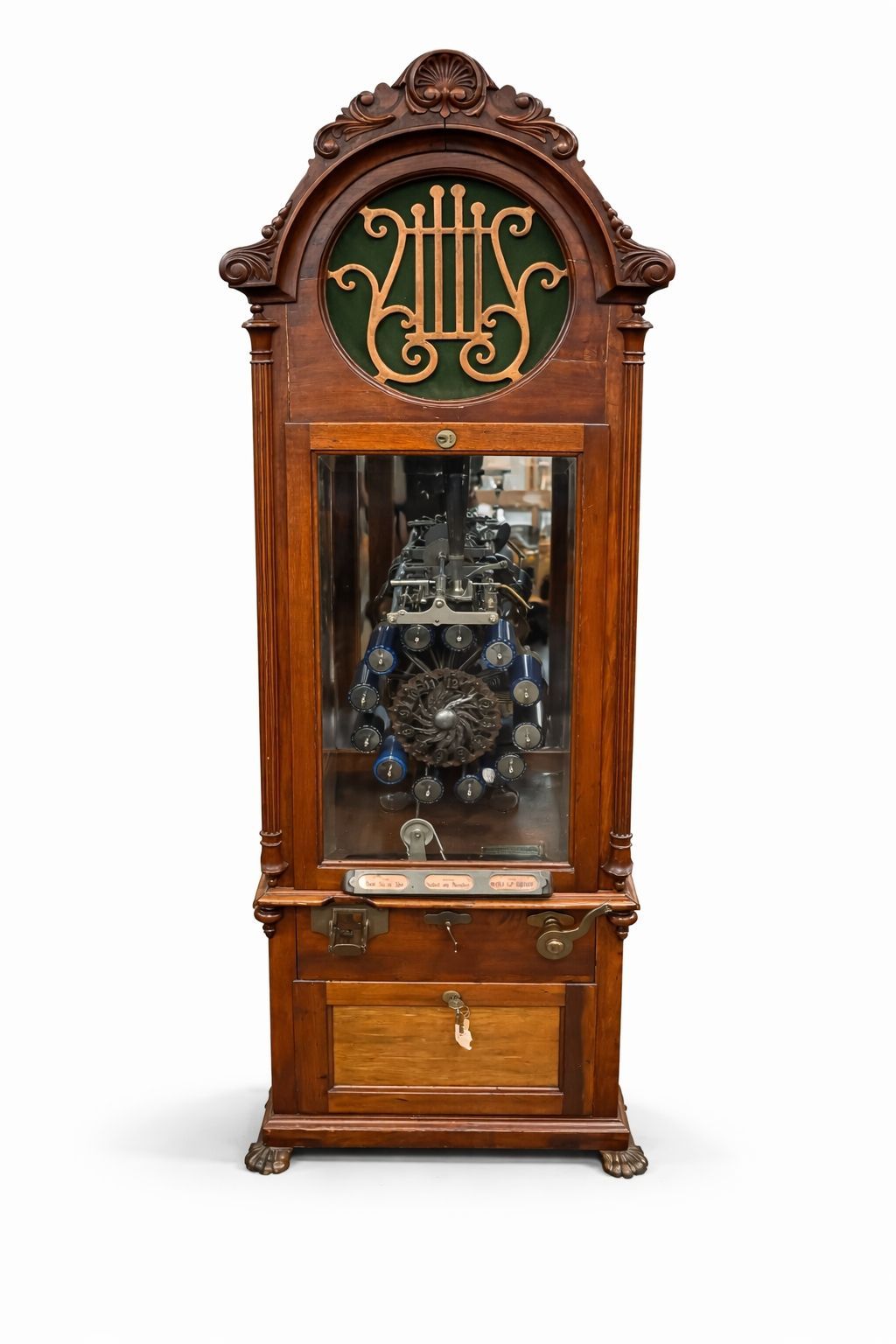
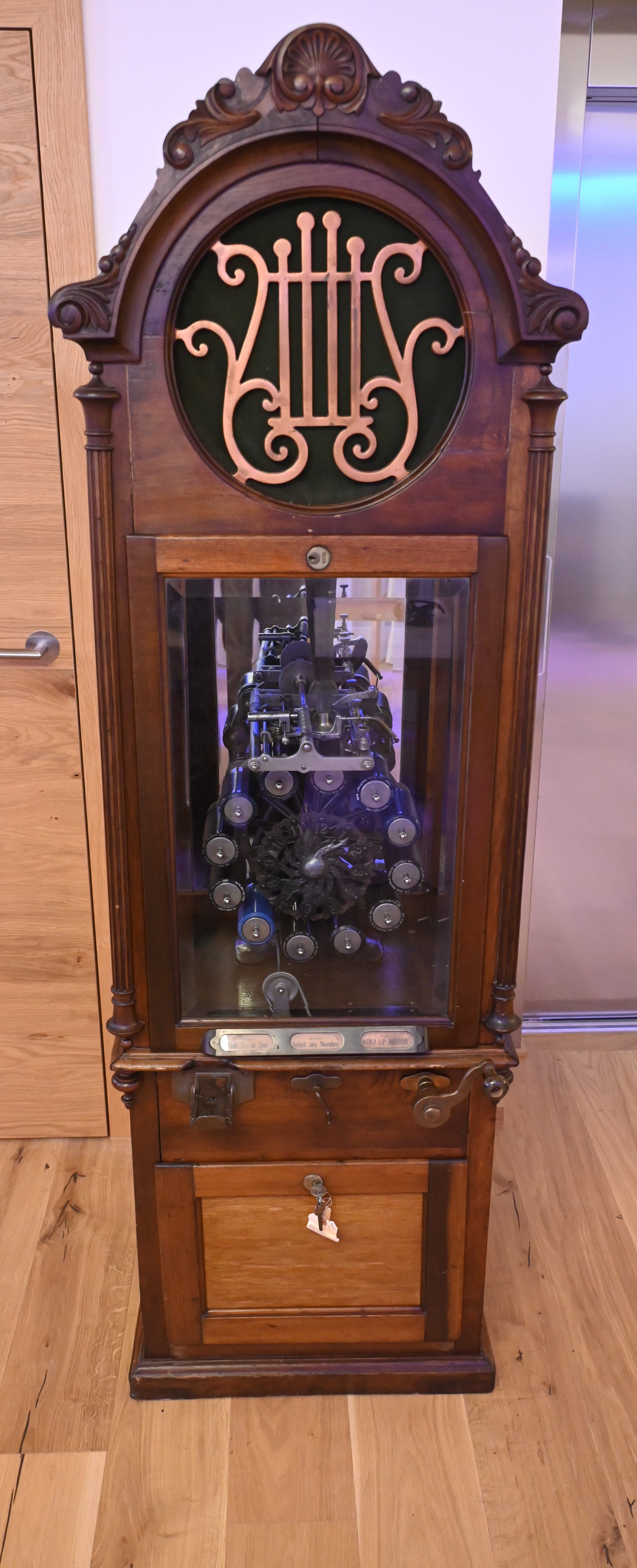
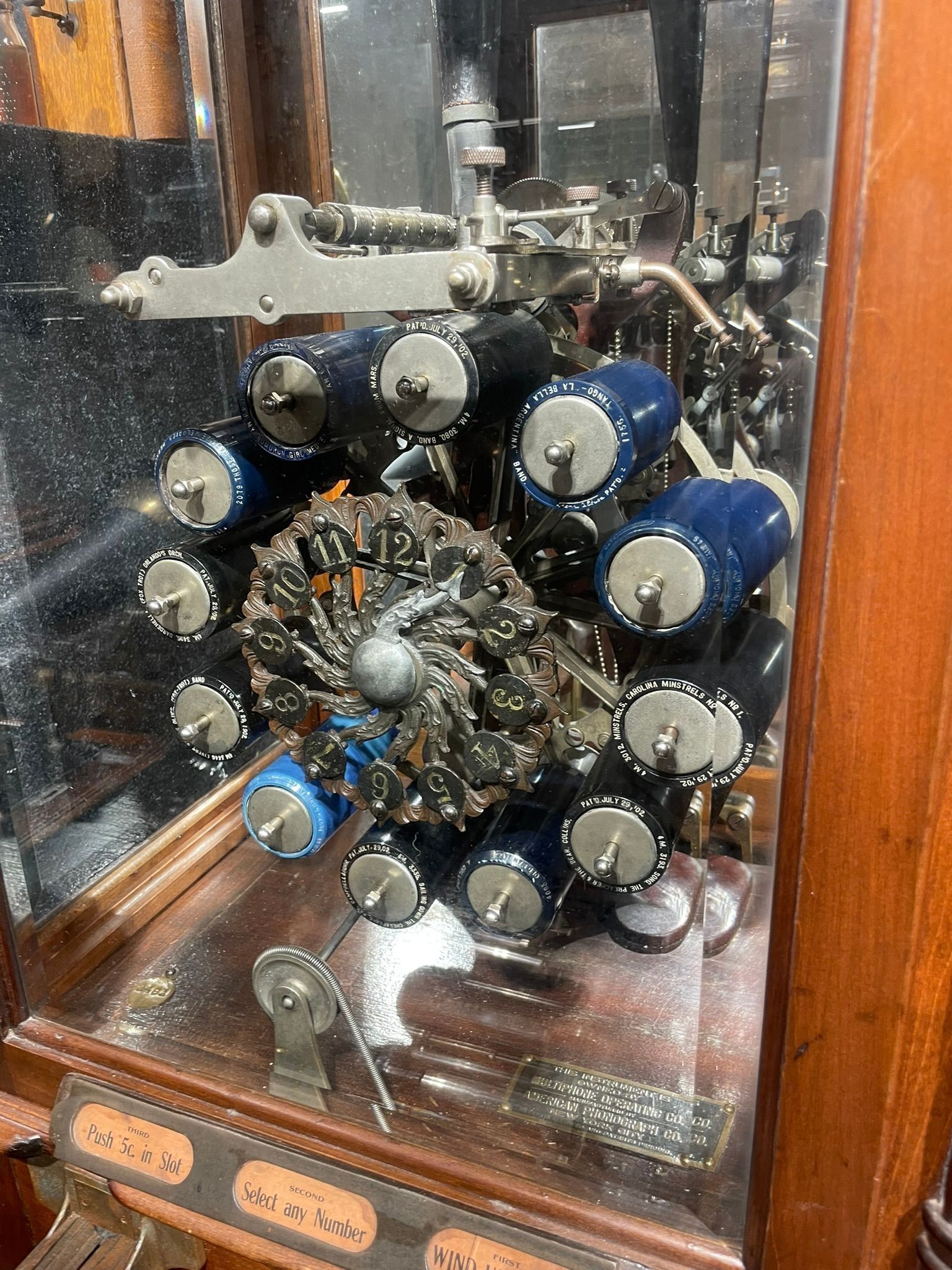
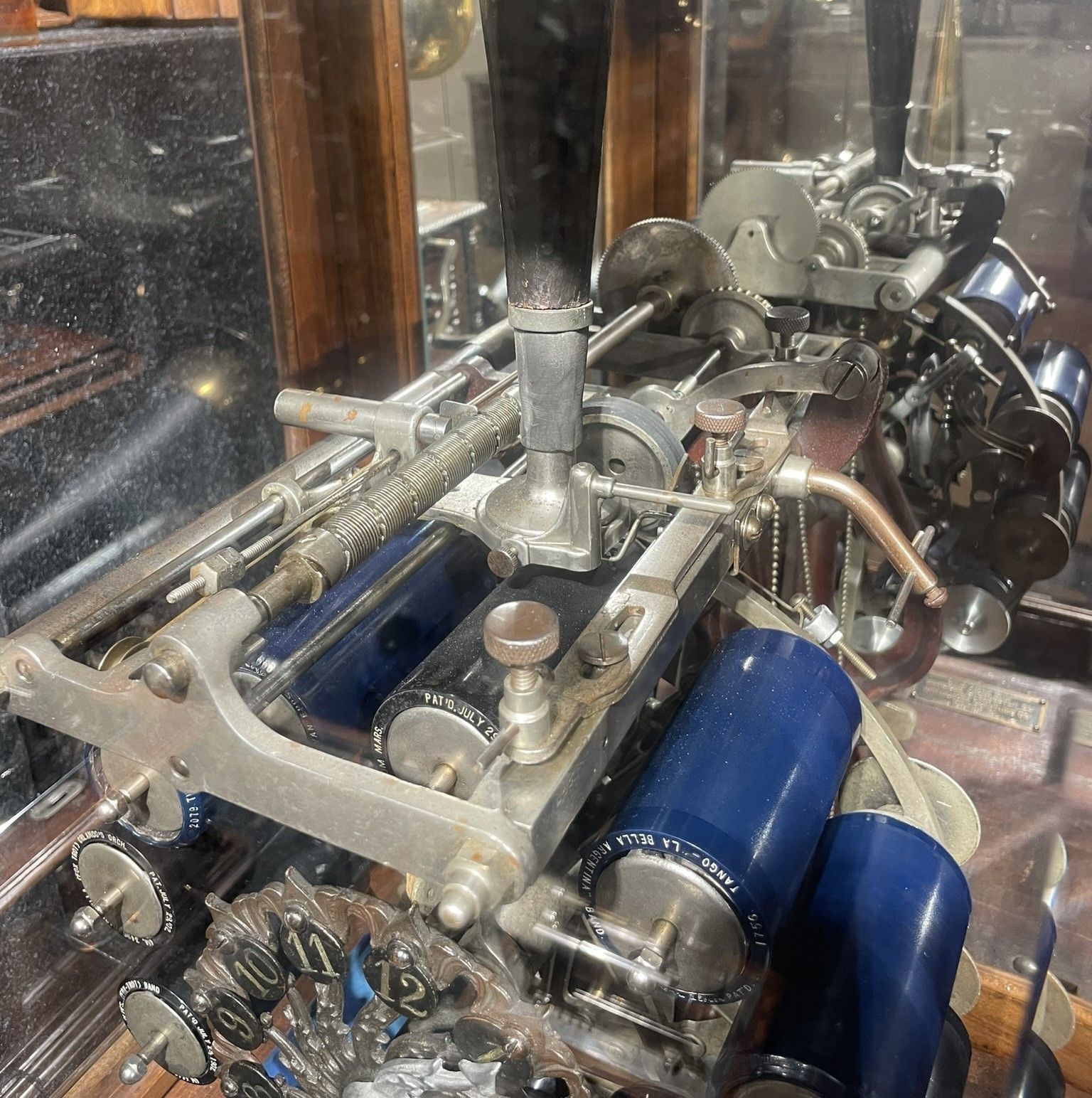
Multiphone with 12 Cylinders (USA, ca. 1905–1906)
The compact Multiphone – developed by Cyrus Shigley, the inventor of the jukebox
The Multiphone was a revolutionary leap in the history of recorded sound – a public music device that, for the first time, allowed users to select from multiple musical titles using a hand-crank. It was invented by American engineer Cyrus T. Shigley, who filed a patent in 1902 describing the device’s core principle: a rotating cylinder rack with individually selectable music cylinders.
The model on display here features 12 cylinders, making it one of the later known Multiphones – and one of only a very few surviving examples worldwide.
Technical Design and Operation
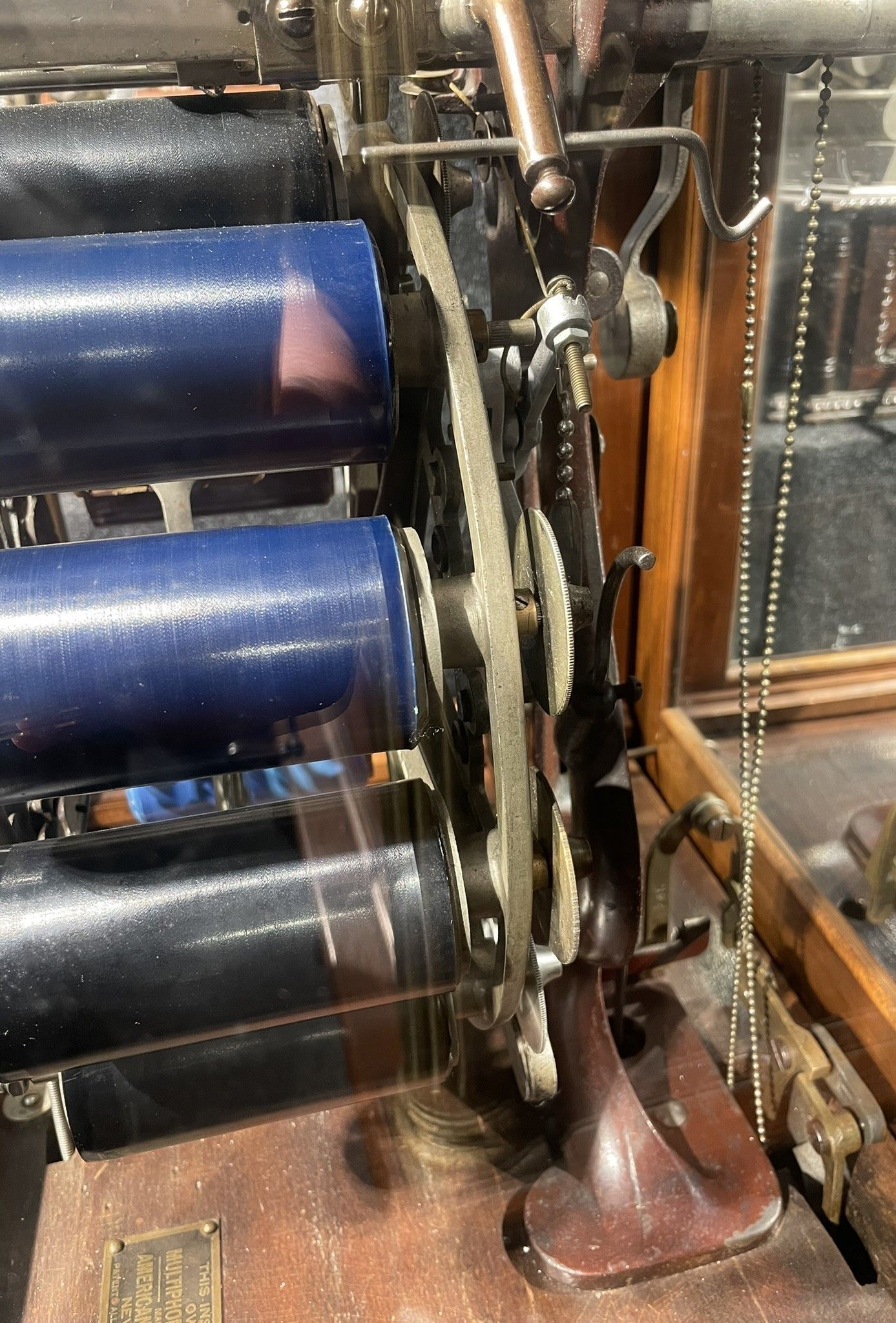
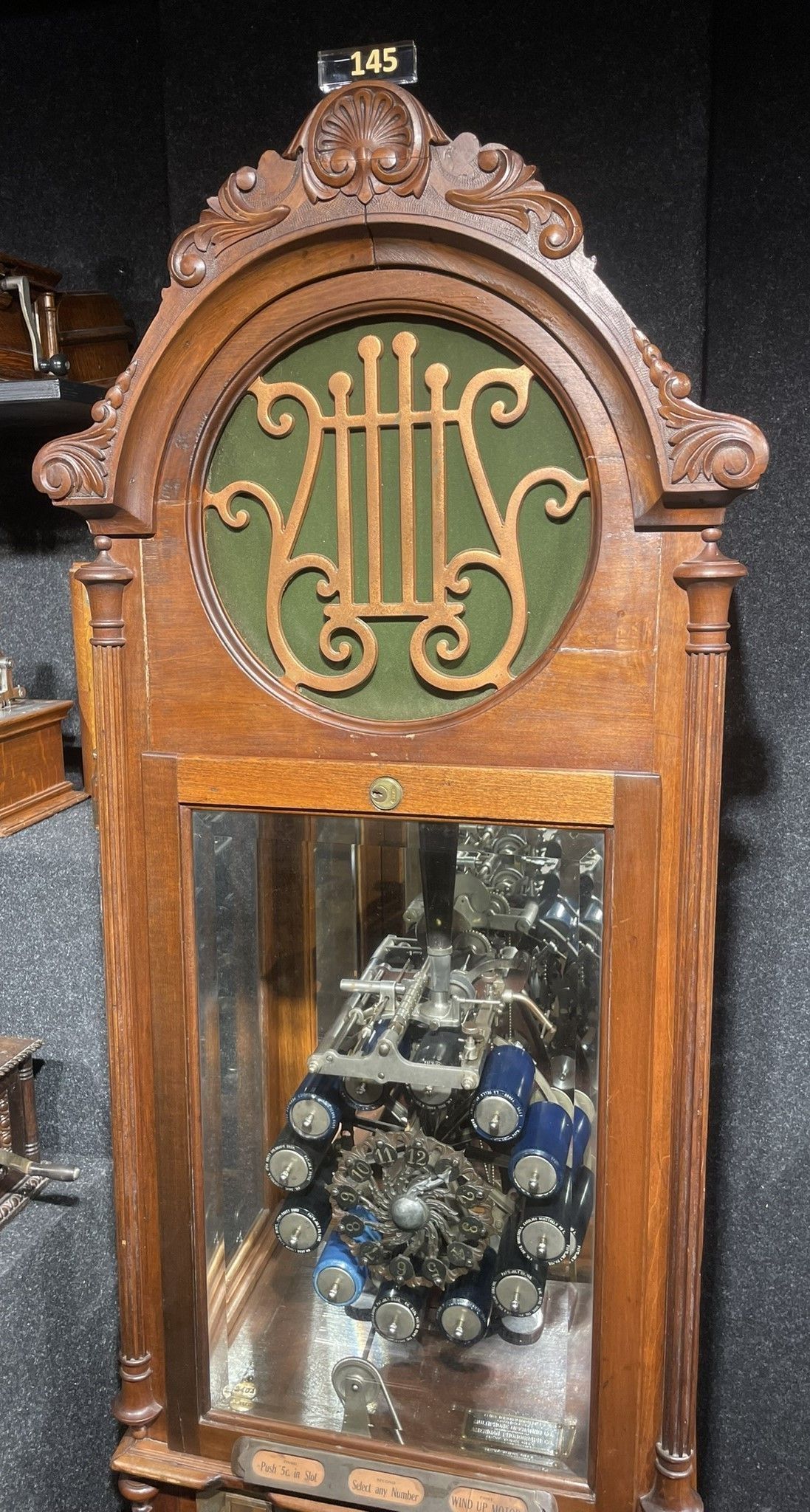
Cylinder Carousel: The central mechanism is a rotating rack holding 12 individual music cylinders. These are selected one at a time via a turntable pointer system, controlled by a small selection crank.
Dual Crank System: A large hand crank winds the spring motor; a second smaller crank is used to rotate the indicator and select the desired cylinder.
Coin Slot Activation: After selecting a song, the user inserts a coin, which activates the spring motor and triggers playback of the chosen cylinder.
Viewing Window: A glass panel allows users to watch the cylinder carousel in motion – a deliberate design feature to enhance the sense of fascination and interactivity.
The Multiphone was fully mechanical – no electricity, no electronics, but remarkable precision and functionality.
The Inventor: Cyrus T. Shigley
Cyrus T. Shigley, based in Newark, New Jersey, filed several patents in 1902 detailing an automated, multi-cylinder selection system. His goal was to create a public music machine that offered the benefits of the Edison phonograph while overcoming its limitations – particularly by enabling multiple song choices.
The Multiphone Company only produced the device between 1905 and 1908. The technology was later developed further by other firms and ultimately evolved into the electrically operated jukeboxes of the 1930s.