Name/Title
Pathé / Edison Class M Concert – Système Vérité GMEntry/Object ID
348Description
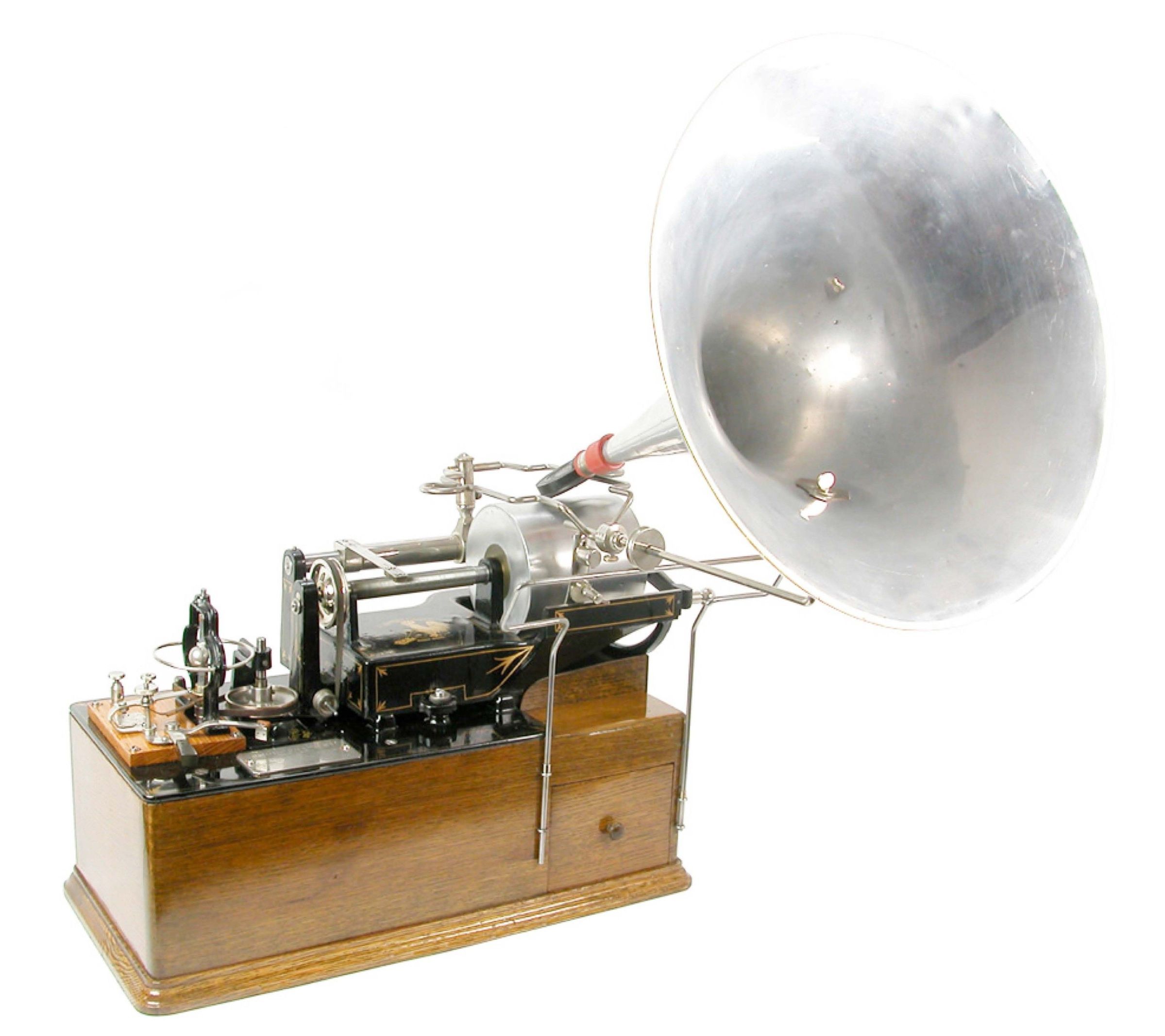
Electrically Driven Concert Phonograph – an Exceptional Pathé Factory Conversion
United States / France, American base machine from 1889; Pathé conversion probably c. 1903–1905
Provenance: Julien Anton Collection
An Exceptional Link between Edison and Pathé
This remarkable phonograph combines within a single instrument two clearly distinct phases in the early history of recorded sound.
Its technical foundation is an Edison Class M Electric Phonograph, one of the most important early electrically driven talking machines. The Class M was already being produced in 1889 and originally operated with a 2½-volt direct-current motor. Read and Welch specifically describe the Class M as an electric Edison phonograph produced by the North American Phonograph Company in 1889.
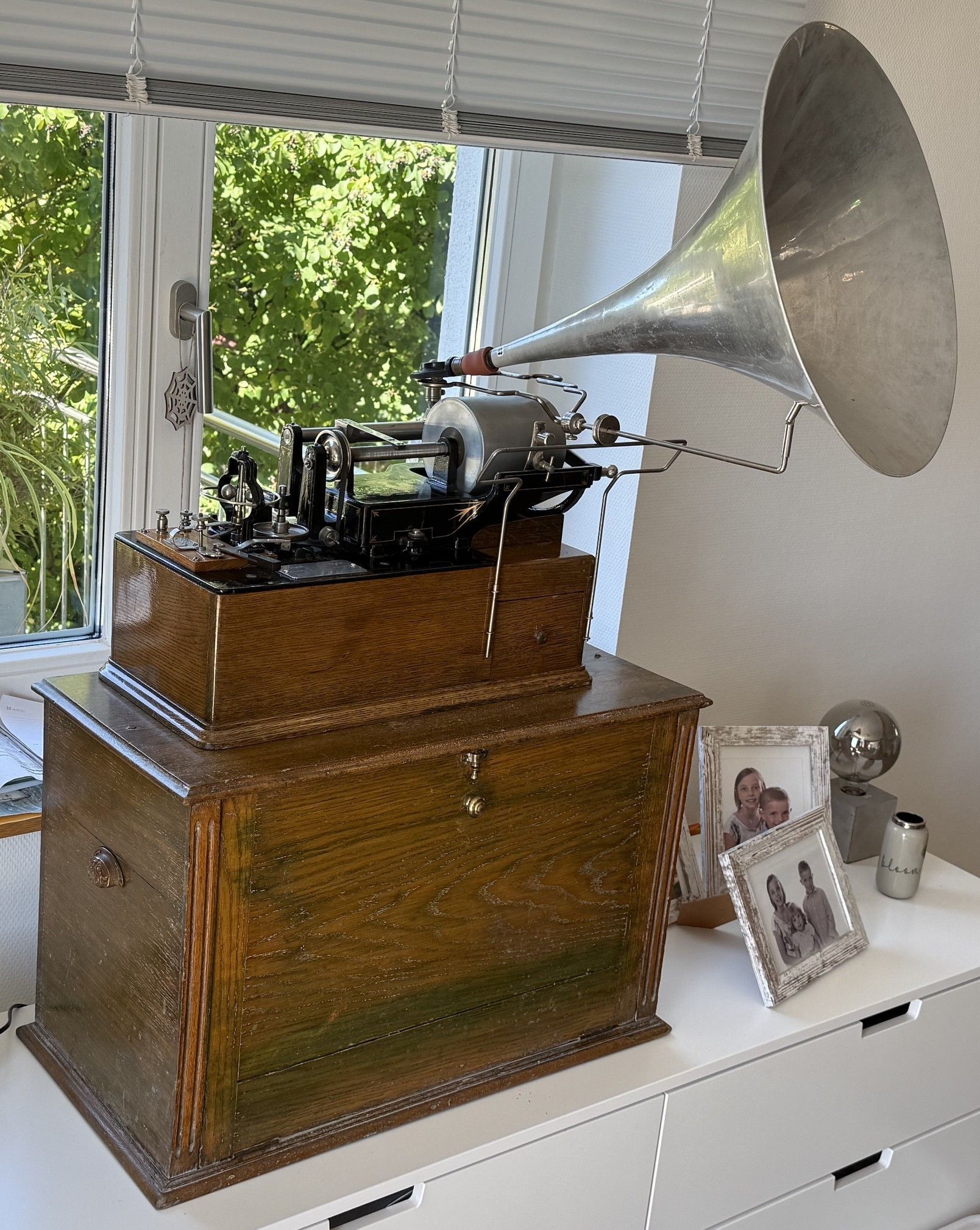
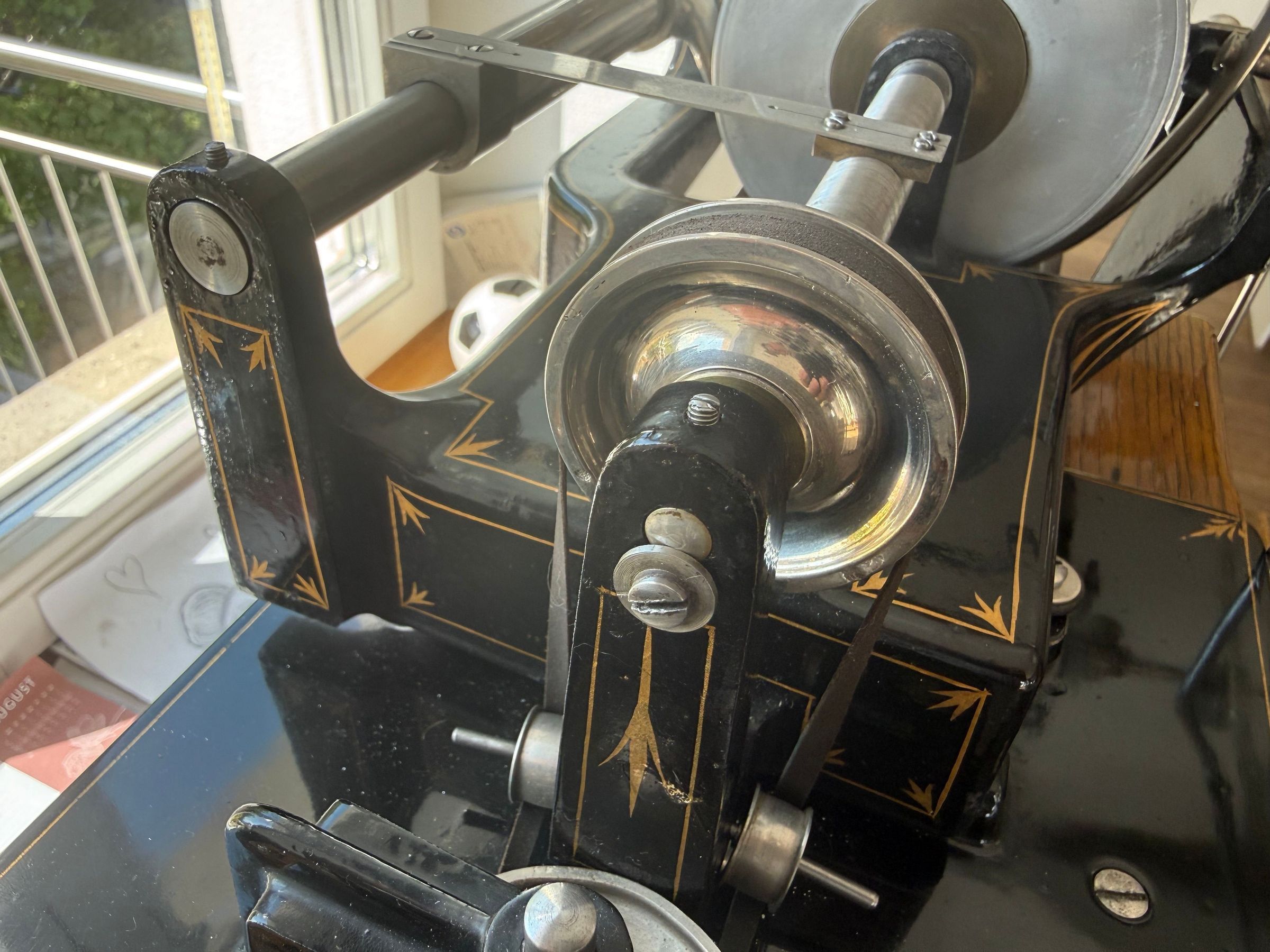
Several years later, this early American machine was extensively modified by Pathé in France for use with the large Concert-cylinder format. Julien Anton’s own inventory documentation identifies the machine explicitly as an “Edison – Class M Concert Pathé Vérité” and records the important note “Adaptation d'origine par Pathé en usine” — an original conversion carried out by Pathé at the factory. The documented equipment includes the large Pathé aluminium horn, a Pathé Rex reproducer, the large Système Pathé Vérité GM, and its purpose-built transport case.
This therefore is not a later private modification, but a historically documented combination of an early Edison machine with Pathé’s own Concert technology.
The American Foundation – North American Phonograph Company
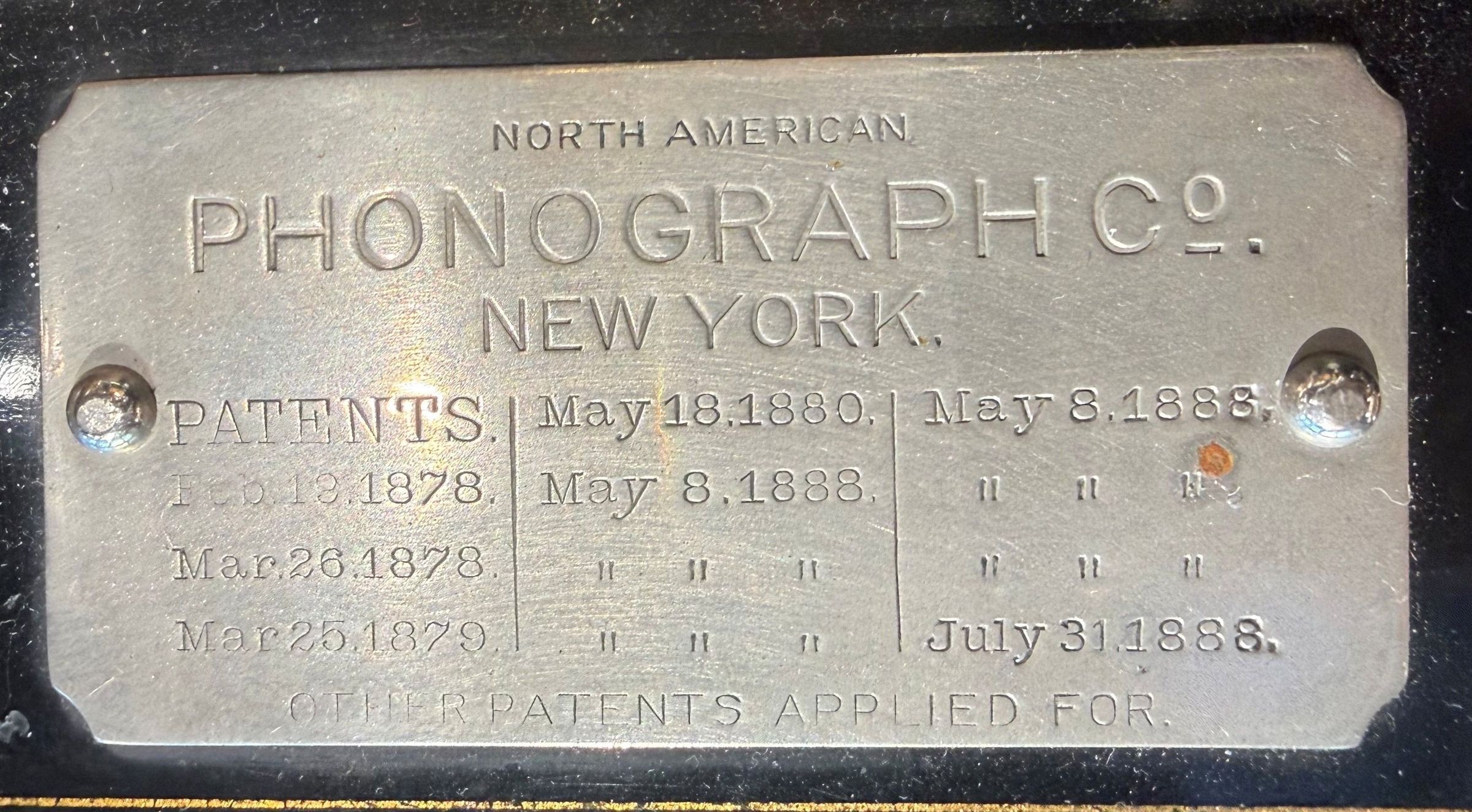
Of particular historical importance is the original metal plate mounted on the American base machine:
NORTH AMERICAN
PHONOGRAPH CO.
NEW YORK
Below the company name appears a sequence of Edison patent dates ranging from 1878 to 1888, followed by the inscription:
“OTHER PATENTS APPLIED FOR.”
The North American Phonograph Company was established in 1888 to market Edison phonographs in the United States. Behind the company stood entrepreneur Jesse H. Lippincott, who attempted to bring the rival Edison Phonograph and American Graphophone interests under a common distribution structure.
North American organized a network of regional license companies across the United States and played a central role in the first large-scale commercial phase of the wax-cylinder phonograph.
As an operating company, North American had only a short existence: approximately 1888 to 1894. Financial difficulties, complex licensing arrangements and patent disputes eventually led to its collapse and liquidation. The Edisonium documentation likewise places the company’s active period within 1888–1894.
The survival of the original North American plate is therefore highly significant. It proves that the American base machine predates the later Pathé Concert conversion by many years.
From the Standard Cylinder to the Concert Format
When the Edison Class M appeared at the end of the 1880s, the large-format cylinder later known as the Concert or Grand cylinder did not yet exist.
The large cylinder format of approximately 5 inches / 12.7 cm diameter emerged only at the end of the 1890s. Columbia introduced its Graphophone Grand in 1898, using the larger cylinder to achieve substantially greater acoustic volume through the higher surface speed of the recording.
Edison responded rapidly and introduced the Edison Concert Phonograph in February 1899, specifically designed for 5-inch Concert cylinders. The early Edison Concert preserved in the Edisonium documents this introduction.
This chronology is especially revealing in the present instrument.
The electric Edison base machine belongs to a technical generation that predates the Concert cylinder by roughly a decade. Only later was it comprehensively reworked by Pathé so that it could accommodate the large-format cylinders and Pathé’s own reproducing system.
It is therefore not an Edison Class M originally built as a Concert machine, but rather the technical upgrading and continued use of an earlier, high-quality Edison electric mechanism.
The Pathé Top Works – Closely Related to the Stentor
The entire upper mechanism is of exceptional interest.
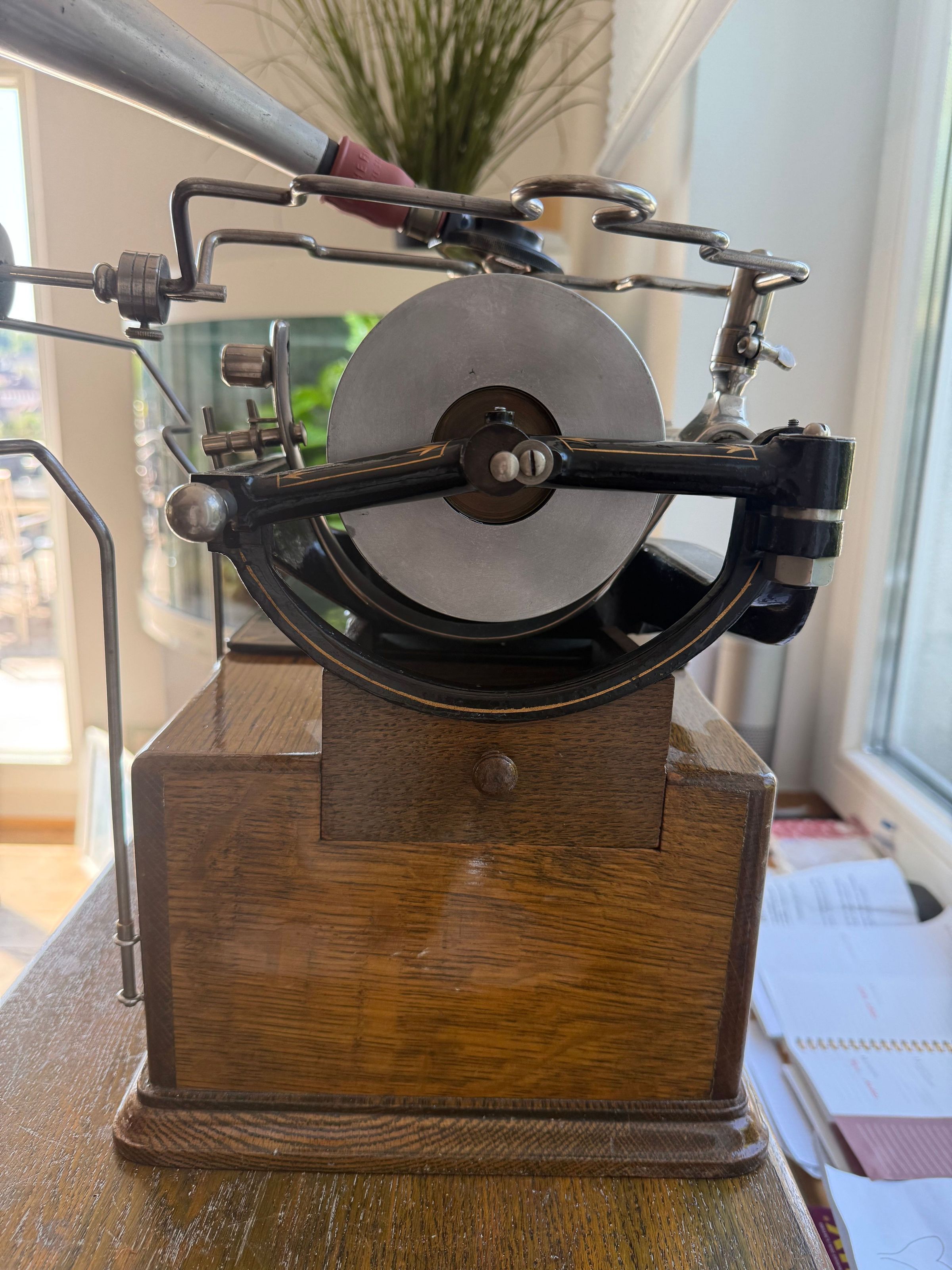
The heavy cast frame, Concert-cylinder arrangement, reproducer guidance and horn-support system correspond closely to the construction principles found on Pathé’s large Stentor machines.
A direct comparison with the Edison-based Pathé Stentor ED173 displayed at the Edisonium reveals striking similarities in the top works. ED173 likewise uses modified Edison Concert technology together with a Pathé Rex reproducer and the Vérité guidance system.
The crucial difference lies in the drive system.
ED173 is powered by a powerful mechanical spring motor, while the present machine retains the early electric Class M drive.
For this reason, the instrument can very appropriately be understood as a kind of:
“Electric Stentor.”
This expression should, however, be regarded as a modern descriptive term rather than a documented official Pathé model name.
Système Pathé Vérité GM
A central feature of the French conversion is the large Système Pathé Vérité GM.
The Vérité system was one of Pathé’s characteristic technical solutions during the first years of the 20th century. In this context, the term refers primarily to the special mechanical guidance of the reproducer and horn assembly.
Rather than placing the entire mass of the large horn directly upon the reproducing stylus, the system carries and guides the sound assembly through a separate supporting frame.
This arrangement allowed the reproducer to follow the cylinder accurately while largely isolating the delicate stylus from the weight of the large horn — a particularly important advantage when using large Concert cylinders and correspondingly substantial acoustic horns.
The Edison-based Stentor ED173 in the Edisonium likewise employs a Pathé Rex reproducer with screw-ring mounting together with the Vérité tracking arrangement.
It is important to distinguish the terminology carefully: on this instrument, “Système Vérité” refers to Pathé’s reproducer and tracking arrangement, not simply to Pathé’s vertical-cut recording system.
A Machine from Two Technological Eras
The combination of surviving components allows the machine to be placed within a remarkably clear historical sequence.
The North American plate and Class M construction belong to the period 1889–1894.
The large 5-inch Concert format cannot predate 1898/1899.
The Pathé Vérité equipment and its close relationship to later Pathé Concert and Stentor machines point to a French conversion in the early years of the 20th century, most plausibly around 1903–1905.
The exact year of conversion is not stated in the surviving Julien Anton documentation, so the dating of the Pathé modification should be understood as a technical and historical assessment rather than as a documented factory date.
This is precisely what makes the object so important: in a single machine, it preserves more than a decade of rapid development in phonograph technology.
Provenance and Exceptional State of Preservation
The instrument comes from the important collection of French phonograph researcher and collector Julien Anton.
Anton’s documentation identifies it specifically as an Edison Class M with Pathé Concert/Vérité conversion. A handwritten provenance document from the previous owner has also survived, providing further documentation of the machine’s history.
Its state of preservation is exceptional.
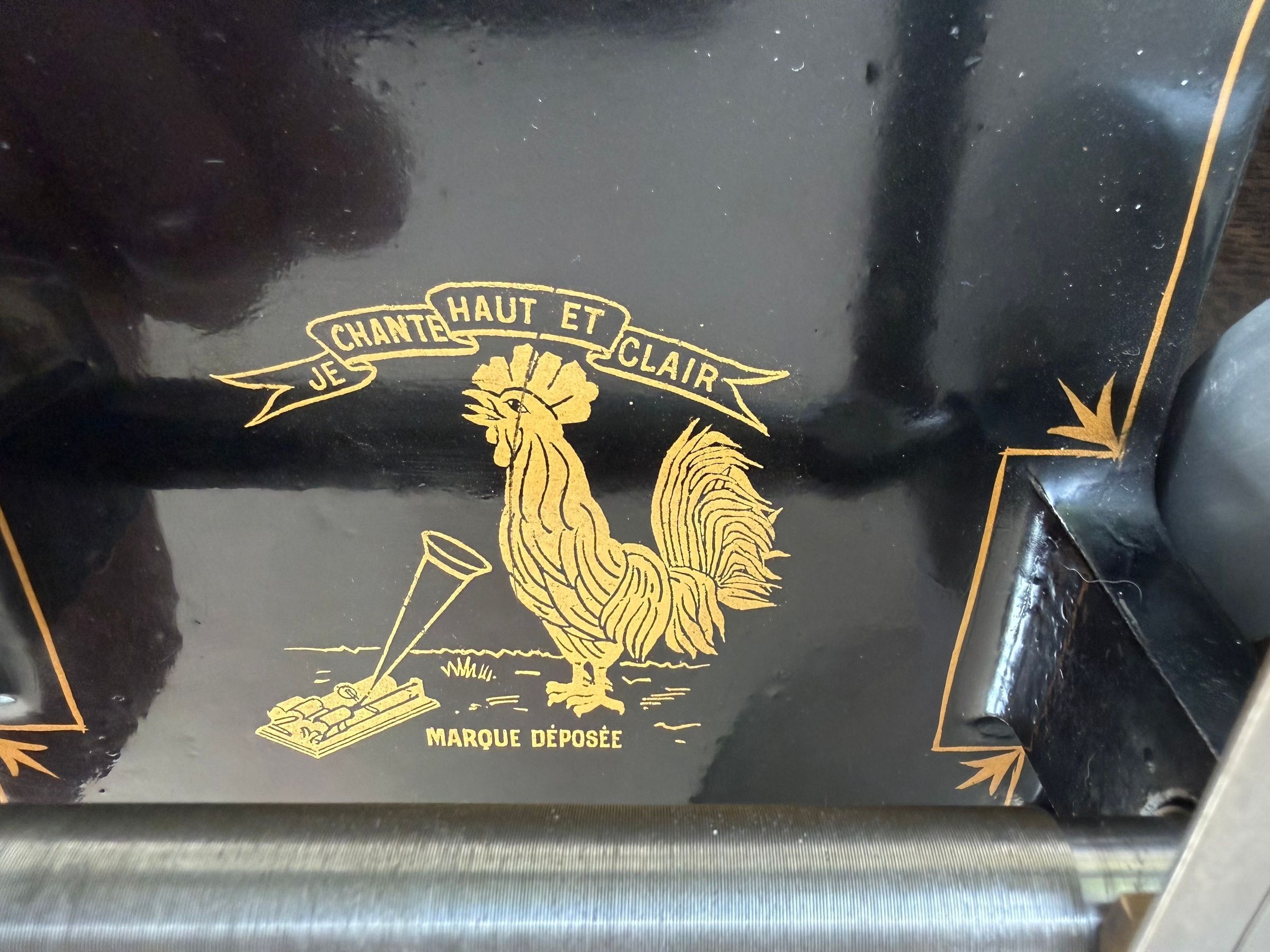
The wooden cabinet, black lacquer and gold lining of the upper mechanism, metal fittings, large aluminium horn and delicate Vérité assembly show remarkably little wear.
The survival of the instrument in such condition is very likely connected with its purpose-built transport and storage case, which is also listed as part of the ensemble in Anton’s documentation.
Rarity
According to current collector knowledge, only two examples of this electrically driven Pathé/Class M Concert configuration are known to survive worldwide.
It is important, however, to distinguish between the number of known surviving examples and an original production figure. No documented production quantity is presently known. The figure of two refers only to currently identified surviving machines.
Combined with its exceptional originality, documented Pathé factory conversion, North American base machine and provenance from the Julien Anton Collection, this example ranks among the most remarkable surviving Pathé/Edison hybrid phonographs.
Significance within the Edisonium
Within the Edisonium, this instrument has exceptional interpretive value because the individual stages of its development can be compared directly with other machines in the collection.
The early Edison Class M represents advanced electric phonograph technology of the late 1880s.
The Edison Concert documents the introduction of the large 5-inch cylinder from 1899 onward.
The Pathé Stentor ED173 demonstrates the French adaptation of Concert technology with a mechanical spring motor.
And this machine brings these evolutionary lines together in a single instrument.
It is an early electrically driven Edison Class M which, years after its original manufacture, was transformed by Pathé into a large-format Concert phonograph equipped with the Système Vérité — technically, in effect, an “Electric Stentor.”
The unique combination of North American, Edison, Concert technology and Pathé Vérité makes this machine an exceptional document of the international early history of recorded sound.