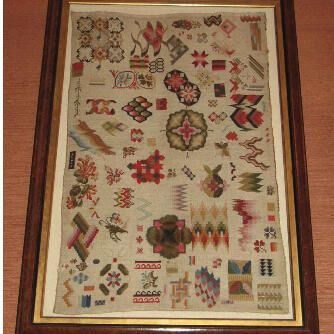
Berlin Woolwork Sampler
Name/Title
Berlin Woolwork SamplerEntry/Object ID
2001.1.1Tags
Berlin Woolwork, Canvas work, Embroidery, Sampler, Plush WorkDescription
The sampler with various polychrome geomteric pattersn and a pugged wool cross; burlwood frame; glassUse
Possibly used as an example for selling Berlin wools which were brightly colored threads that came into the marketplace in the 19th century accompanied by designs for working the wools.Context
Berlin wool work is a style of embroidery that was particularly popular in Europe and America from 1804 to 1875. It is typically executed with wool yarn on canvas, worked in a single stitch such as cross stitch or tent stitch, although Beeton's book of Needlework (1870) describes 15 different stitches for use in Berlin work. It was traditionally stitched in many colors and hues, producing intricate three-dimensional looks by careful shading of geometric patterns. Silk or beads were frequently used as highlights. The design of such embroidery was made possible by the great progress made in dyeing, initially with new mordants and chemical dyes, followed in 1856, especially by the discovery of aniline dyes, which produced bright colors. Berlin wool work patterns were first published in Berlin, Germany, early in the 19th century. The first Berlin wool patterns were printed in black and white on grid paper and then hand-colored. Counted stitch patterns on charted paper, similar to modern cross-stitch patterns, made it easier to execute the designs, because amateur embroiderers were able to follow the patterns using just a simple tent stitch. They were published mostly as single sheets which made them affordable to middle-class women. Soon they were exported to Britain and the United States. The patterns were used sparsely in the United States until the 1840s, when they started to appear in women's magazines, after which "Berlin work" became all the rage. Indeed, Berlin work became practically synonymous with canvas work. In Britain, Berlin work received a further boost through the Great Exhibition of 1851, and by the advent of ladies' magazines such as The Englishwoman's Domestic Magazine. The popularity of Berlin work was due largely to the fact that, for the first time in history, a fairly large number of women had leisure time to devote to needlework. Designs started to be published in Vienna and Paris as well, and included geometric, floral, and pictorial scenes, before sentimental Victorian tastes impacted the patterns. Subjects to be embroidered were influenced by Victorian Romanticism and included floral designs, Victorian paintings, biblical or allegorical motifs. Berlin work patterns could be applied to various kinds of clothing and home furnishings or could be made as stand-alone artworks, in the style of needle paintings, which are works that copy well-known master paintings in thread. In the late 1880s, the demand for Berlin wool work decreased dramatically, largely because the tastes had changed, but Berlin work publishers failed to accommodate new tastes. Other, less opulent styles of embroidery became more popular, such as the art needlework advocated by William Morris and his Arts and Crafts movement. Yet the wide distribution of Berlin work patterns had made needlework available to a large number of women, and it also caused them to become interested in other types of needlework.Collection
ERS Sampler CollectionCategory
19th century