Miser's Purse
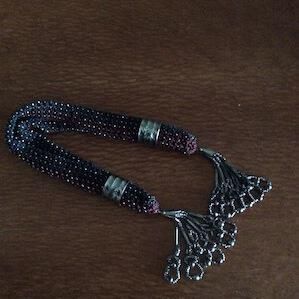
Name/Title
Miser's PurseEntry/Object ID
2003.2.1Tags
Miser's purseDescription
The long narrow purse with red and green mesh inset with metal beads and surrounded by two rings; the whoe terminating in cut metal tasselsUse
The miser purse was carried by both men and women. In the 18th century, men sometimes wore them hidden inside a sleeve, which is another possible source of the name “miser purse.” They also thrust them into pockets, as did ladies. Later, when the waistlines of dresses crept back down to the natural waist, miser purses were sometimes worn folded over a lady’s belt.Context
Miser purses — also called long purses, stocking purses, or ring purses — were popular in England and France from the mid-18th century through the early 20th century. A miser purse has a long, narrow, tubular shape, often wider at the ends and narrow in the middle. The narrow middle section had a short slit opening. The purse was pulled through two metal rings, called sliders. Both rings are slid to one side, coins are inserted through the opening into the other end of the tube, then one of the rings is slid tight against the end to secure the coins inside. Coins would be inserted into both ends in this way. The rings ensure that coins cannot escape through the central slit. Some scholars believe the design of the purse was a revival of the Medieval practice of carrying one’s coins in the toe of a stocking. A similar tube-shaped purse fastened with rings at each end had been popular with men during the 16th century. It is not entirely clear how the nickname “miser purse” came about. One theory is that they were so called because they were made to disgorge a single coin or just a few coins at a time, or because the design ensured that coins were secure and difficult to lose. One of the reasons for the long popularity of the miser purse was that it was fairly easy to make one, and it became fashionable for young ladies to net or knit purses to give as presents, especially to gentlemen. William Cowper wrote a poem to his cousin Anne Bodham “on receiving from her a network purse made by herself.” This would have been a miser purse. During the mid-19th century through the early 20th century, ladies’ magazines often published instructions and patterns for constructing miser purses. Thomas Gardon, a watch chain and purse maker on St. James Street, London, was one of the many vendors who provided all the necessary materials for purse-making. In the first years of the 19th century, he advertised that “Ladies may be accommodated with great choice of Purse-Twist, Tassels, and Sliders.” In fact, almost every issue of La Belle Assemblée in my collection includes advertisements for purse-making materials, including sliders, which were only used for miser purses. Clearly, it was certainly a popular Regency craft. This is confirmed by Mr. Bingley in Pride in Prejudice when he said that all accomplished young ladies “paint tables, cover screens, and net purses.”Collection
ERS Decorative ObjectsCategory
Clothing and dress