Zebiah Gore, Pictorial Sampler, 1791
Name/Title
Zebiah Gore, Pictorial Sampler, 1791Entry/Object ID
2018.1.1Tags
Colonial British America, Counted-thread embroidery, Embroidery, Pictorial needlework, SamplerDescription
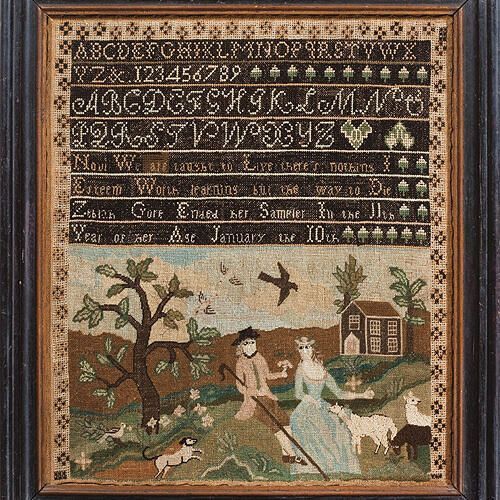
The sampler with two alphabets, a set of numbers, and a verse beginning, "now we are taught to live..." above a scene of a shepherd presenting flowers to a young lady in a pastoral setting with animals and virds, bordered with geometric framework; conservation mounted into original frame; original backboard preserved separately.Use
A pictorial sampler made to exhibit a young girls skill with the needle.Context
Inscribed “Now We are taught to Live there’s nothing I / Esteem Worth learning but the way to Die / Zebiah Gore Ended her Sampler In the 11th Year of her Age January the 10th,” this sampler is the work of Zebiah Gore (1780-1848), who embroidered it when she was 11 years old. The pencil inscription on the reverse “Zabiah Gore born July 27, 1780” indicates that the sampler dates to 1791. With its figural and pastoral artistic scene, this needlework showcases Zebiah’s talent and mastery with the needle. It descended in her family until 1939, when it was given to a family friend. Zebiah Gore was born on July 27, 1780 in Boston, the daughter of Jeremiah Gore (December 26, 1734-July 9, 1813) and Hannah Richards (Feb. 13, 1750-Nov. 25, 1816), who married on February 18, 1773. Jeremiah was a landowner in Boston as well as a member of the Roxbury fire company. He was the grandson of John Gore (1634-1705), who was a master mariner, surveyor of land, and civil engineer in Roxbury, where he served as selectman and town clerk. On January 24, 1802, Zebiah Gore married Edward Johnson (September 28, 1769-March 18, 1853) and they had two children: Zabiah (Johnson) Balch (January 24, 1807-May 2, 1892) and Hannah Richard (Johnson) Leeds (April 16, 1817-March 1, 1907). After the death of Zebiah on August 1, 1848 and her husband in 1853, this sampler became the property of their daughter Hannah. Her daughter, Mary Hannah Leeds (July 27, 1854-October 27, 1939), owned the sampler next, when it was illustrated in the publication, American Samplers by Ethel Bolton and Eva Coe in 1921. At her death, she gave this sampler, a clock by Aaron Willard and other possessions to her friend Edith S. Nichols in whose family the sampler descended until sold at a Sotheby's auction. A virtually identical sampler worked by Elizabeth Richards at age 10 and also finished on January 10th is in the collection of the Historic Odessa Foundation in Odessa, Delaware. Zebiah Gore and Elizabeth Richards were cousins and likely attended the same needlework school together in the Boston area. Both samplers follow the same pattern depicting a shepherd presenting a flower to a lady in a pastoral setting surrounded by animals. With their black outlines, the pronounced eyes of the figures on both samplers are distinctive and possibly unique.Collection
ERS Sampler CollectionCategory
Canvaswork picture
Counted thread embroidery
Made/Created
Artist Information
Artist
Zebiah GoreRole
StudentDate made
1791Time Period
18th CenturyPlace
City
Boston, MassachusettsContinent
North AmericaTextile Details
Textile Shape
SquareEthnography
Cultural Region
* Untyped Cultural Region
Colonial MassachussettsCulture/Tribe
Colonial America