Label Type
Credit LineLabel
Saint Joseph's University PurchaseLabel
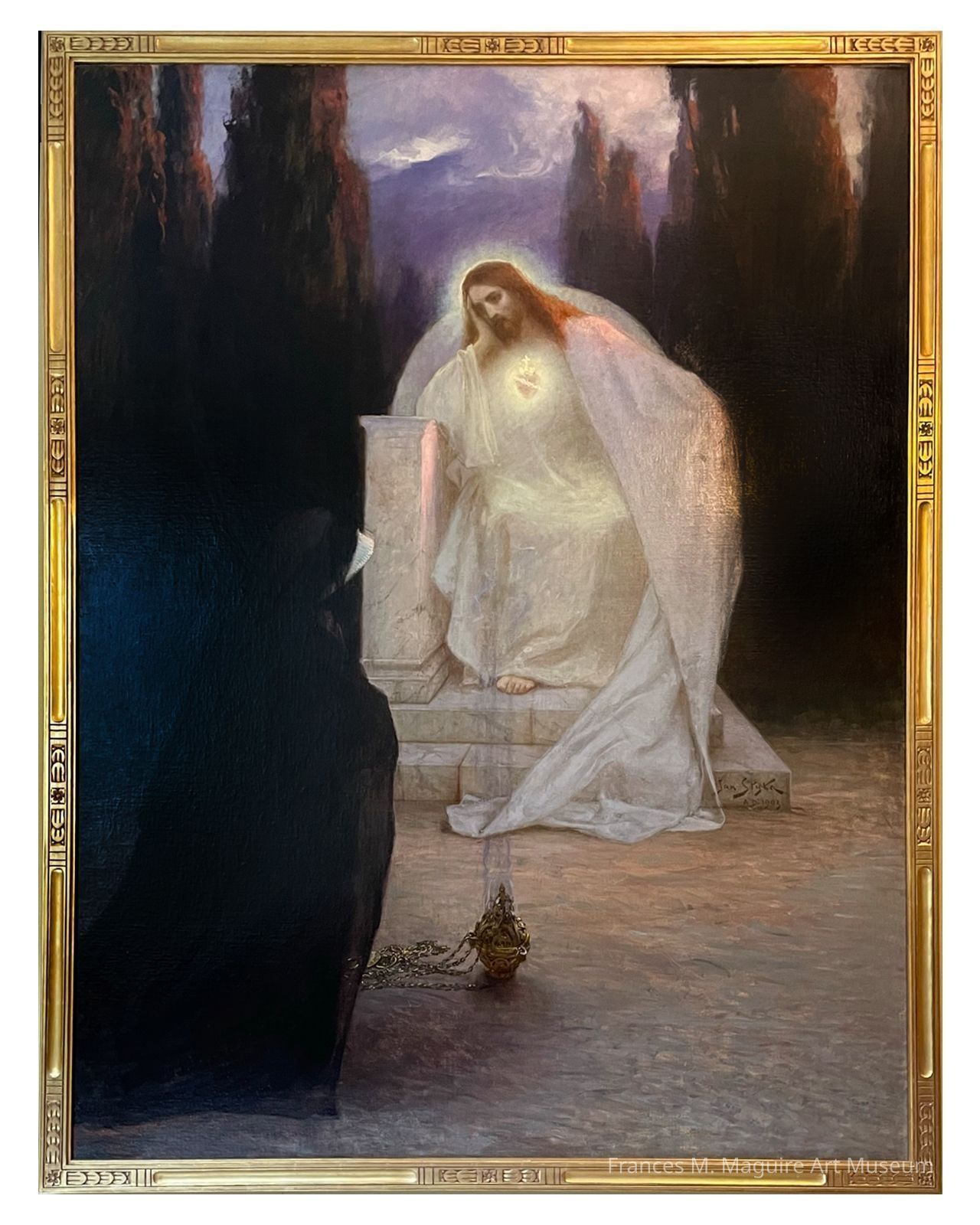
This painting depicts St. Madeleine Sophie Barat (1779-1865) kneeling in prayer before the seated figure of the Sacred Heart of Jesus. Barat is identified by the distinctive habit of the Society of the Sacred Heart, the religious community of women that she founded in 1800. The thurible she has brought and placed at the feet of the Sacred Heart is burning and incense vapors can be seen to rise to the figure of Jesus evoking Psalm 141:2: “Let my prayer be directed as incense in thy sight . . . .”
The most distinctive feature of the painting is the posture and facial expression of the Sacred Heart who sits with his head resting on his hand and a look of dismay upon his face. This atmosphere of distress defines the composition and connects it to the epic saga of devotion to the Sacred Heart of Jesus as it developed in early modern France.
Indeed, the work would have made little sense outside France, and, although the artist was a Polish national, he painted it while living in Paris, a capital city still smarting from defeat in the Franco-Prussian War of 1870 and the resulting loss of the territories of Alsace and Lorraine. There’s, and other national humiliations were interpreted by French-Catholic monarchists as divine punishment for the excesses of the French Revolution of 1789. It was said that France had lost its soul and only national consecration to the Sacred Heart of Jesus, according to the revelations of St. Margaret-Marie Alacoque (1647-1690), would suffice as national reparation.
This view was stark contrast to that of the republicans who blamed France’s troubles on the monarchists and clerics. These competing ideologies expressed themselves in two monumental Parisian architectural projects: the Eiffel Tower, built in 1889 to celebrate the centenary of the Revolution of 1789; and the Basilica of the Sacre-Coeur (“The Church of the National Vow”), built between 1875 and 1915 on Montmartre (the Mount of Martyrs) in atonement for France’s bloody revolution and betrayal of the true faith –– the very things that the Eiffel Tower was built to celebrate. These two monuments to competing world views dominate the Parisian skyline to this very day.Label Type
Credit LineLabel
Label written by Carmen R. Croce