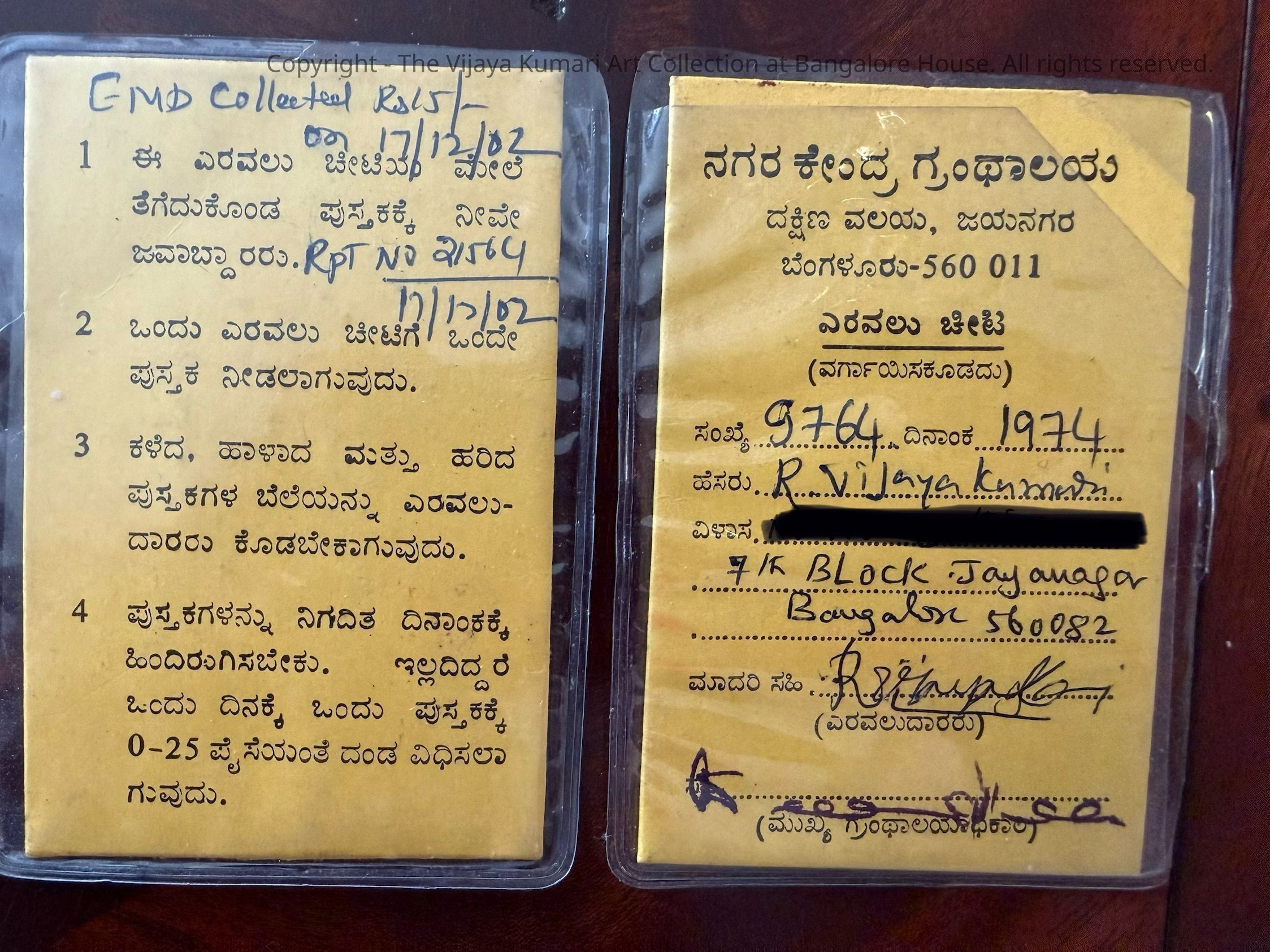
Name/Title
Bangalore City Central Library Borrowing Cards Issued to Vijaya Kumari RamakrishnaEntry/Object ID
167Description
Summary
Pair of library borrowing cards issued to Vijaya Kumari Ramakrishna by the Bangalore City Central Library system in 1974. The cards document her long-term participation in Bangalore’s public circulating library culture and reflect a sustained family engagement with reading, literature, newspapers, and current affairs. Maintaining two active borrowing cards allowed simultaneous borrowing of two books at a time and supported decades of shared family reading practices across three generations.
⸻
Detailed
Pair of printed Kannada-language borrowing cards issued by the Bangalore City Central Library system to Vijaya Kumari Ramakrishna in 1974. The cards survive in transparent plastic protective sleeves and contain manuscript entries including membership number, year of issue, name, residential address, and authorizing signatures.
The right-hand card identifies the issuing institution as the Bangalore City Central Library located in Gandhi Nagar, Bangalore 560011, and records membership number 9764 with year of issue noted as 1974. The card is issued in the name of “R. Vijaya Kumari.” The reverse card contains Kannada-language borrowing regulations governing circulation procedures, return periods, and penalties associated with library use.
The paired cards are historically significant as evidence of Bangalore’s mid-20th-century circulating public library culture. During the 1970s and 1980s, municipal and circulating libraries formed an important part of urban middle-class intellectual life in Bangalore, providing affordable access to fiction, magazines, newspapers, and current-affairs literature before widespread private book ownership became common.
Family history identifies Vijaya Kumari Ramakrishna as an avid reader with particular interest in fiction as well as news and public affairs. She continuously maintained two borrowing cards from the time of membership onward, permitting simultaneous borrowing of two books. The cards were actively used within the household across generations. After her son entered third grade, the cards were also used for family borrowing activities, while Vijaya Kumari’s father, who later lived with the family for more than a decade, became one of the heaviest users of the library privileges associated with the cards.
The objects therefore document not only individual reading habits, but also the role of public libraries within the intellectual and educational culture of a multigenerational Bangalore household. Within the context of Bangalore House and The Vijaya Kumari Art Collection, the cards function as modest but highly revealing artifacts of everyday intellectual life, civic participation, and sustained literary engagement.