Label Type
Tombstone LabelLabel
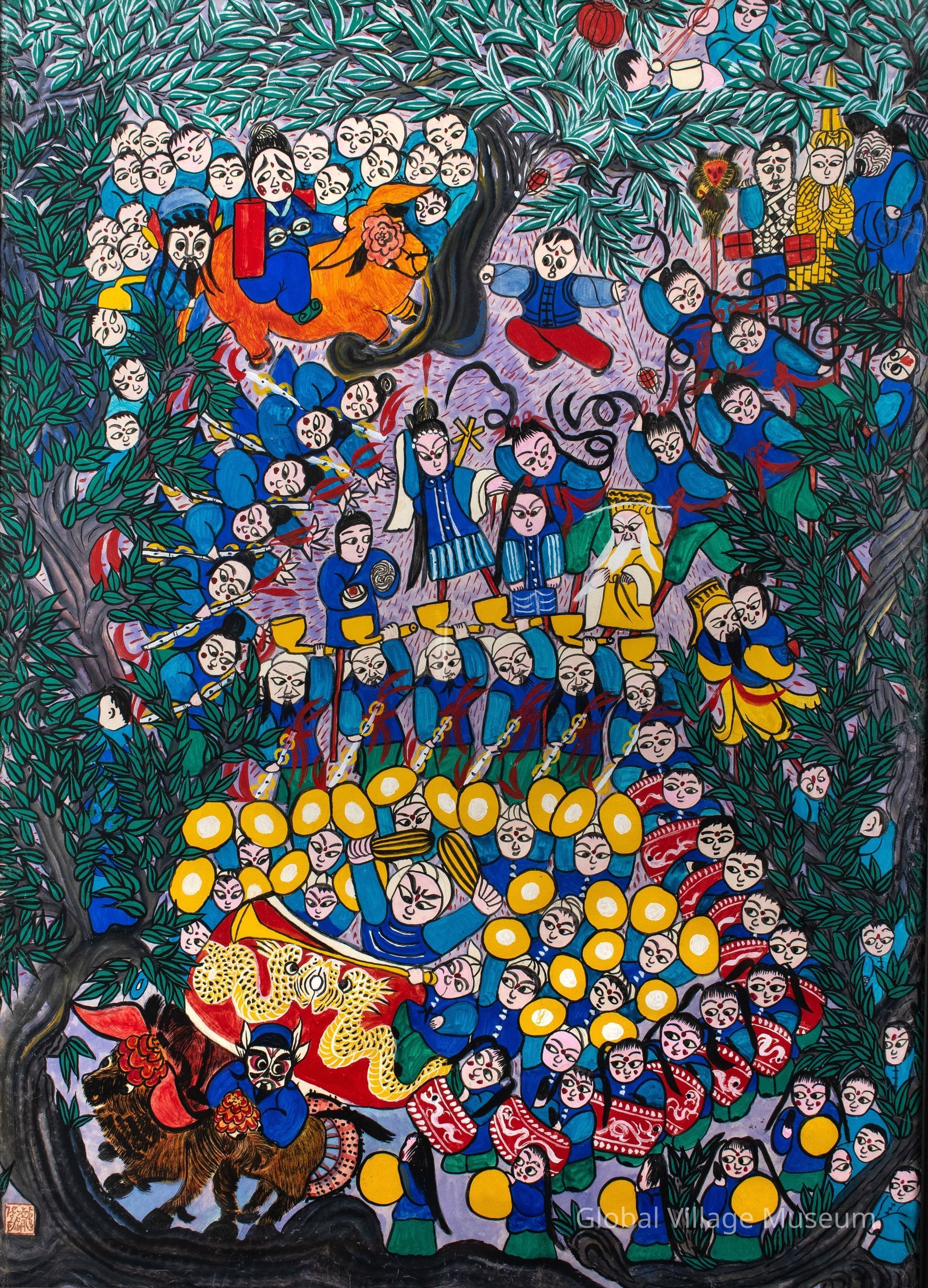
Celebration of the Lantern Festival
Wang Jinglong (Chinese, act. late 20th century)
1985
Paint on rice paper
Gift of Andrea and Irv Green, 2019.1.61Label Type
Cultural/Historical ContextLabel
A small number of Huxian painters are famous for relying neither on folk art forms nor on the traditional techniques taught by professional artists. Wang Jinglong is one who allows his personal style to develop and create at will. Can you find any decorative folk art conventions from paper cutting or embroidery here? Or a professional perspective? Neither could we in this unique, innovative painting of a Lantern Festival parade.
The artist says that he shaped his parade like a 6 in honor of the lucky dates of the month - 6, 16, and 26. Heads, hands, eyes and feet are bigger because they’re symbolic: big head means smart; big hands means a tight grasp; big eyes means you see through things; big feet means you stand steadfast.
Below, 24 cymbals (yellow with white centers) represent the 24 small weather variations in the lunar calendar, periods of which farmers are well aware.
The artist likes to paint dragons so there are dragons on the flag.
Five yellow circles at the bottom are gongs. Five gongs symbolize a bumper harvest. A god once offered farmers a gong to do away with weeds. Striking the gong killed all their weeds; this made people lazy. Eventually, people didn’t even bother to strike the gong. The god took away the gong and substituted a hoe.
Proverbial stories are being represented by groups of characters: for example, the man and woman on the right. In their story, the man is strong but not excessively bright. The woman is very bright but physically paralyzed. So he carries her everywhere on his back and she does everything else. The moral is that cooperation makes life work.