Label Type
Technique or ProcessLabel
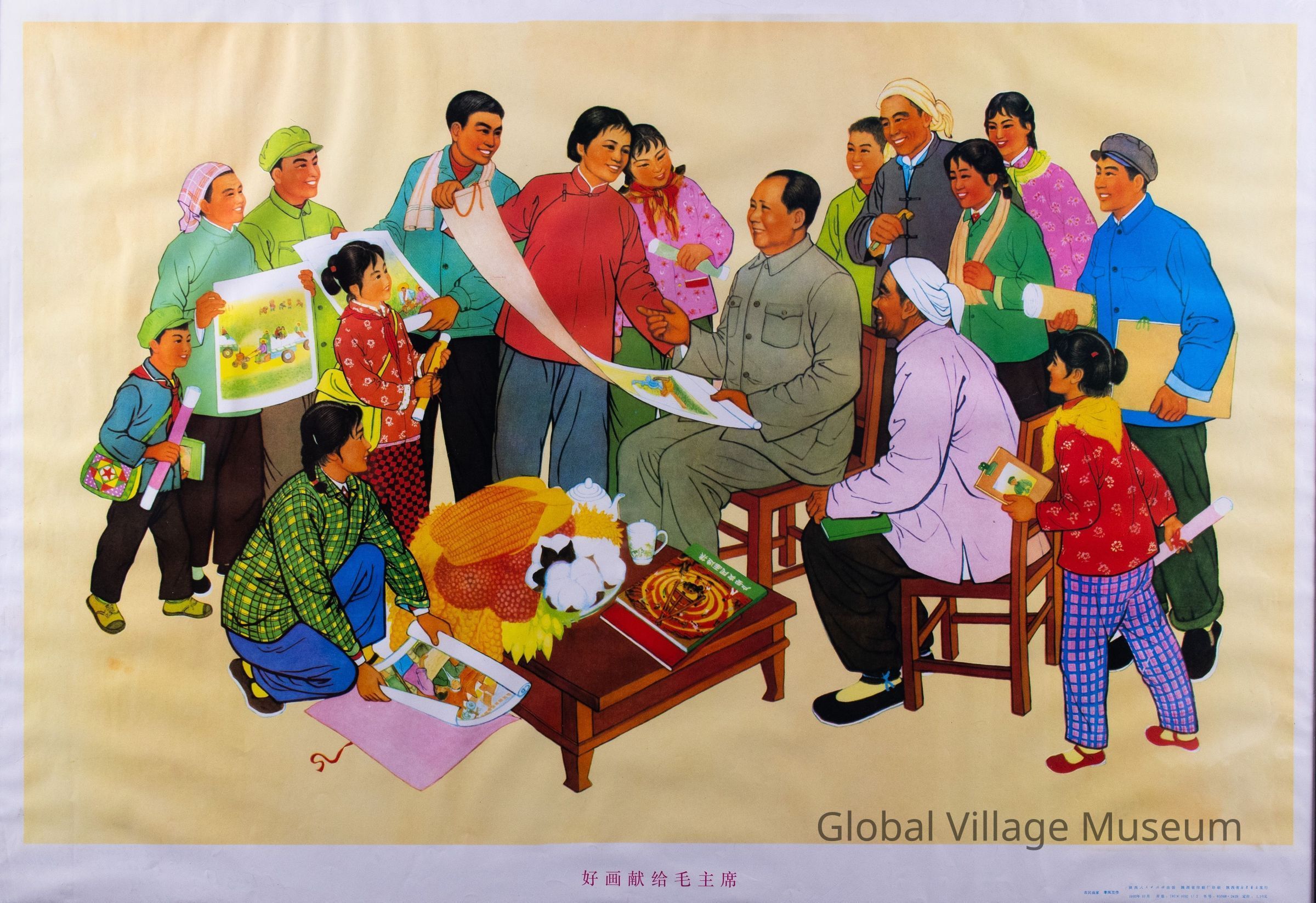
Good Paintings Presented to Chairman Mao
After a painting by Li Fenglan (Chinese, b. 1934)
1976
Digital print
Gift of Andrea and Irv Green, 2019.1.6Label Type
Cultural/Historical ContextLabel
During the Maoist period, the Chinese Communist Party promoted the artwork of farmers to encourage agricultural production, and realistic figures with natural colors were expected to align with state policies. Folk art and artists, once associated with "old evils," were to be eradicated. This replication poster of an actual painting from the Cultural Revolution exemplifies the Realist style that was encouraged during the Great Leap Forward.
It is important to note that "Realism" here does not necessarily mean a neutral or purely observational style. It refers to Socialist Realism – a style meant to depict life not as it is, but as it should be under socialism. As a result, the artwork often showcased harmony, abundance, and loyalty, even in times of hardship. These cheerful, community-oriented scenes functioned as propaganda. The question is thus raised: were artists truly free to paint what they saw and felt, or were they painting what was expected of them?
In 1958, professional artists from the Central Academy of Fine Arts visited rural villages to teach farmers how to paint. The people of Huxian embraced these teachings, and farmers during both the Great Leap Forward (1958-1961) and the Cultural Revolution (1966-1976) were encouraged to create simple, straightforward paintings. This was in contrast to the highly decorative art of urban professional painters.
Li began painting that same year and ultimately produced about 300 works, 100 of which were published. She saw Huxian painting as a reflection of farmers’ daily lives. Though Fenglan never met Mao, she was inspired by hearing him speak at numerous conferences in Beijing. Her painting, Good Paintings Presented to Chairman Mao, imagines an offering of artwork to Mao on behalf of all peasant painters. Though fictional, it reflects her admiration of Mao and the influence that the Party Chairman held over rural artists.