Label Type
Technique or ProcessLabel
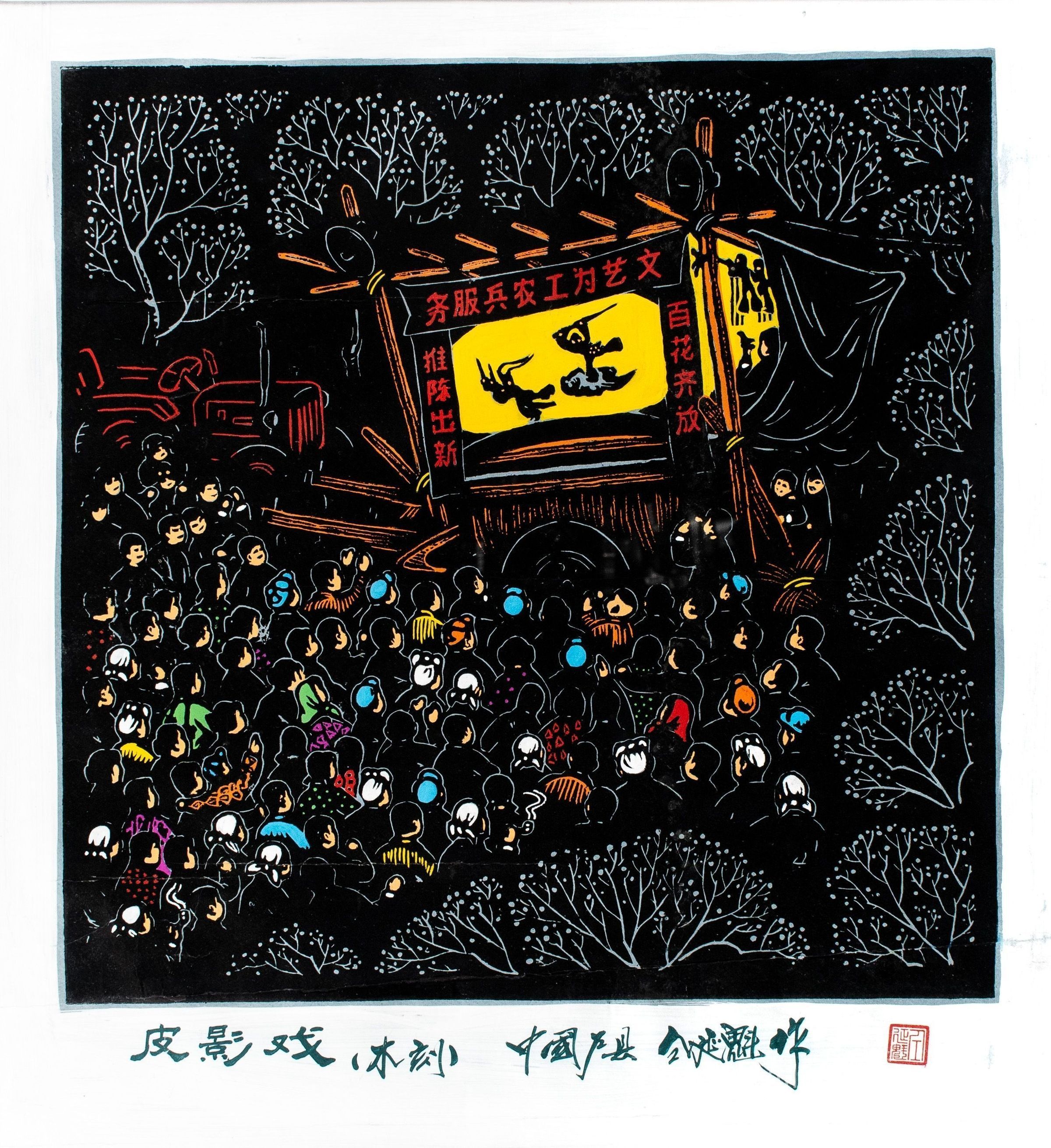
Shadow Puppet Show
Tong Yankui (Chinese, b. 1950)
1973
Color woodcut and paint on rice paper
Gift of Andrea and Irv Green, 2019.1.13Label Type
Cultural/Historical ContextLabel
This work is a combination of woodblock print and hand painting. Some areas are intentionally left unpainted, allowing the blue paper to become part of the composition. Although created during the Cultural Revolution – a period marked by the campaign to eradicate the “Four Olds” (old customs, culture, habits, and ideas) – this piece highlights the enduring presence of traditional Chinese folk arts, particularly shadow puppetry.
Its depiction of a classic cultural performance may be seen as a quiet form of cultural preservation, suggesting that long-standing traditions continued to thrive in rural areas, even under political pressure. At the same time, this work reflects how folk art was sometimes co-opted by the state and transformed into a vehicle for propaganda. During the Cultural Revolution, shadow puppet shows were occasionally used to dramatize political narratives glorifying Mao Zedong, the People’s Liberation Army, and socialist values.
The slogans featured in the artwork are emblematic of the era: “Literature and Art Serve the Workers, Peasants, and Soldiers” runs across the top; on the left, “Weed Out the Old and Bring Forth the New;” and on the right, “Let 100 Flowers Blossom.” Together, they reinforce the ideological aims that art was expected to uphold at the time.
Tong began painting in 1968, and over the course of his career, he produced more than 300 paintings. Some 200 were published and several received awards. Shadow Puppet Show not only reflects the aesthetic techniques of the Cultural Revolution period; it also captures the complex tension between tradition and ideology that shaped much of the visual culture of the time.