Label Type
Tombstone LabelLabel
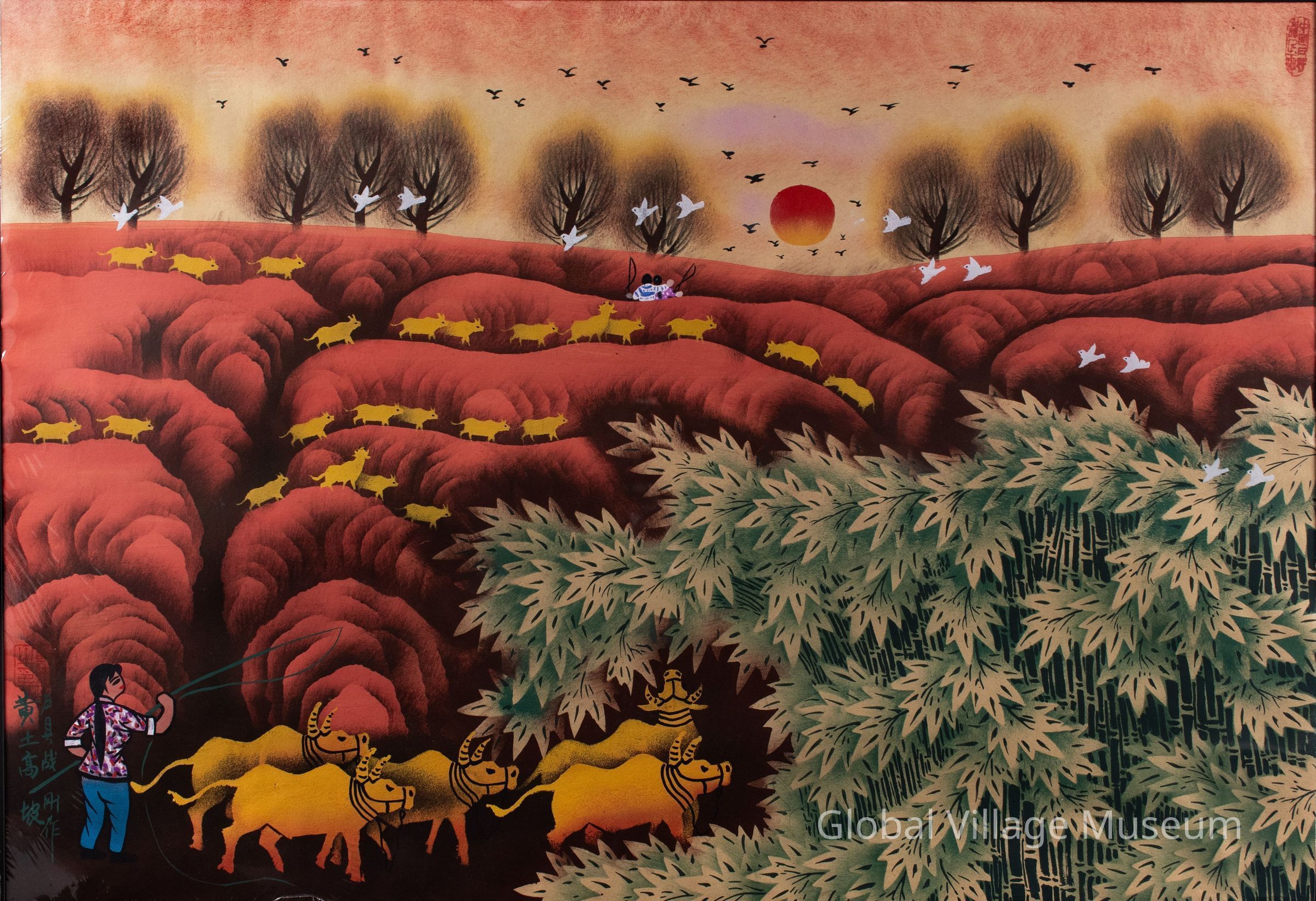
The Yellow Earth (Loess) Plateau
Zhang Zhangang (Chinese, b. 1961)
1993
Paint on rice paper
Gift of Andrea and Irv Green, 2019.1.55Label Type
Cultural/Historical ContextLabel
This painting depicts China’s Loess Plateau, which spans nearly all of Shaanxi province. This region played a crucial role in Chinese history as one of the early cradles of Chinese civilization. Its soft, eroded silt – deposited by wind and shaped by the floods of the Yellow River – gave rise to the fertile lands of the North China Plain.
The inspiration for this piece came from a nature program the artist saw on television. Struck by the beauty of the setting sun, Zhang expanded the scene into a full painting, adding bamboo in the foreground and willow trees along the horizon. Yellow cattle, commonly raised for beef, graze peacefully across the landscape. The composition is densely filled – a hallmark of the Huxian painting style.
One painter once compared this style – completely filling the frame – to the farmers themselves, who cultivated every inch of usable land to leave nothing to waste.
Zhang began painting in 1987 at the age of 19. He grew up during a period when the soil was heavily strained under state-directed agricultural practices, such as monocropping and forced cultivation of crops unsuited to local soils. These policies led to widespread soil degradation and famine, and in some cases, the land remains infertile to this day.
This painting was widely recognized: it won the Outstanding Award at the 1997 China National Writing and Painting Competition; was featured on page 4 of the April 17, 1997 issue of The China Farmers News; and received the Excellence Award in the 1999 County Farmer Writing and Painting Competition.