Label Type
Tombstone LabelLabel
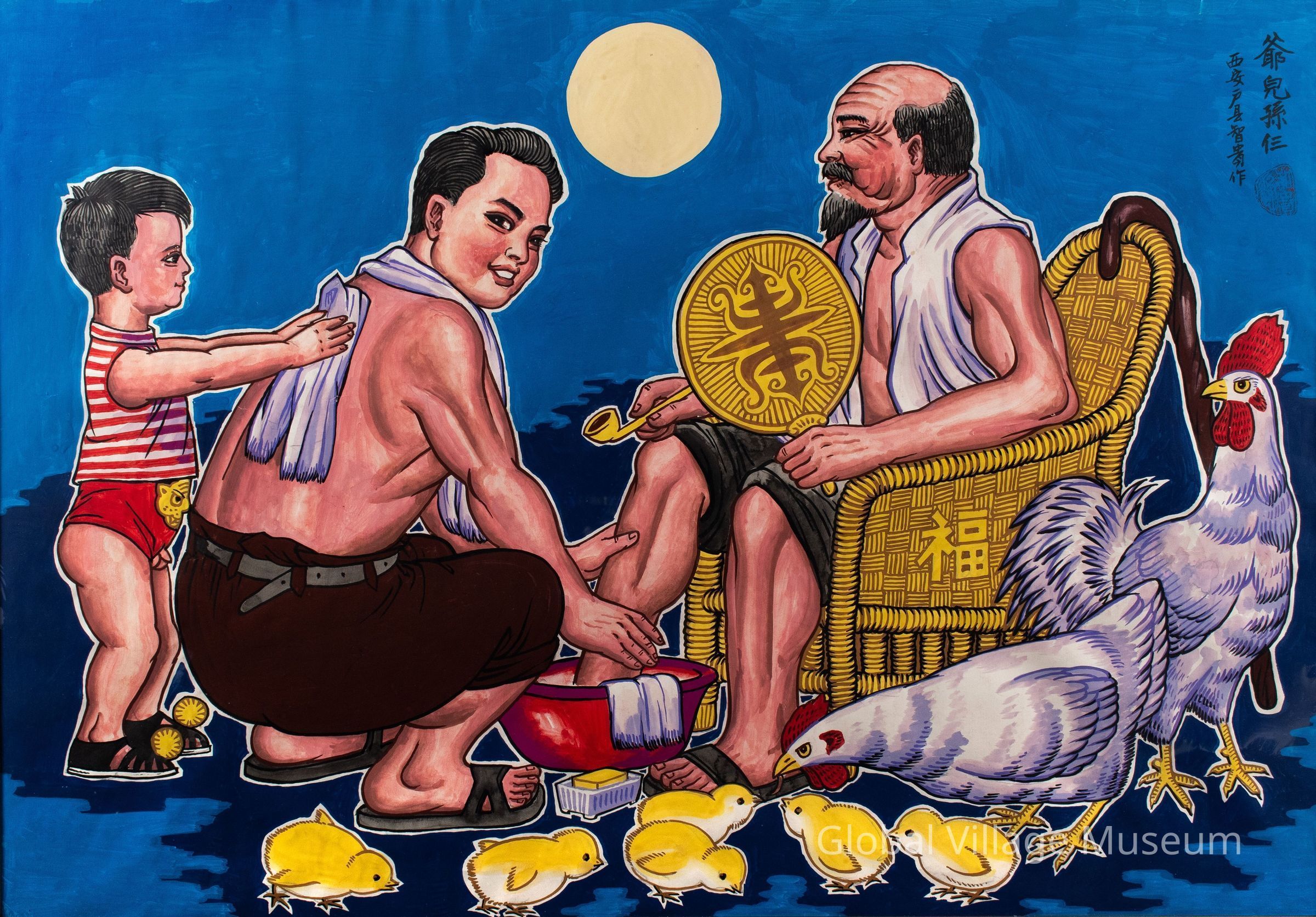
Three Generations
Liu Zhigui (Chinese, act. late 20th century)
1982
Paint on rice paper
Gift of Andrea and Irv Green, 2019.1.70Label Type
Cultural/Historical ContextLabel
The artist says this scene actually happened: One hot summer when he returned from the fields, he noticed how hot his father looked. He brought him a basin of water and an easy chair and washed his feet. His son was very little, and because he was helping his grandpa, he wanted to help, too. His grandpa said, “Your daddy is sweating all over.” So, the father’s son went to find something to wash his father’s back. At bottom, the family of village chickens represents the principle of caring for your children, who in turn care for you when you need it. This became a popular painting nationally. The character on the chair means happiness, The one on the fan, longevity. The painter wishes both for his father. The little boy has a vest on; most did not wear trousers in summer, just briefs with an opening for convenience. The tiger embroidered on this boy’s briefs means he will be strong.
Paintings like this were not enough to prevent the Great Leap Forward from failing with an estimated 20 to 45 millions deaths from famine. The Cultural Revolution in the 1960s and 70s set Chinese ruthlessly against Chinese and reversed, rather than promoted, economic development.
Over 50 of the paintings in this exhibit, however, were created later-during the 1980s and 1990s, which is called the Reform and Opening-Up Period. After Mao’s death and following the failures of both the Great Leap Forward and the Cultural Revolution, pragmatists in the Party like Deng Xiaoping gained the political power to carry out market reforms. The early 1980s saw the de-collectivization of agriculture from communes to private farms. The country opened up to foreign investment, and permission was given for entrepreneurs to start their own businesses. The 1985 lifting of price controls was another major reform. The 1990s experienced privatization of much state-owned industry. Protectionist policies and regulations followed.
There was a concomitant opening up of Huxian painting styles as well. Post-1980 Hu County artists were venturing away from the realistic figures that socioeconomic pressures had limited them to. Painting technique swung from the more rigid rules of realism back to the folk-art derived expressions of artists’ subjective ideas of life.