Name/Title
3rd c. Fragment of Sarcophagus Lid with the Personification of WinterEntry/Object ID
HM-300Description
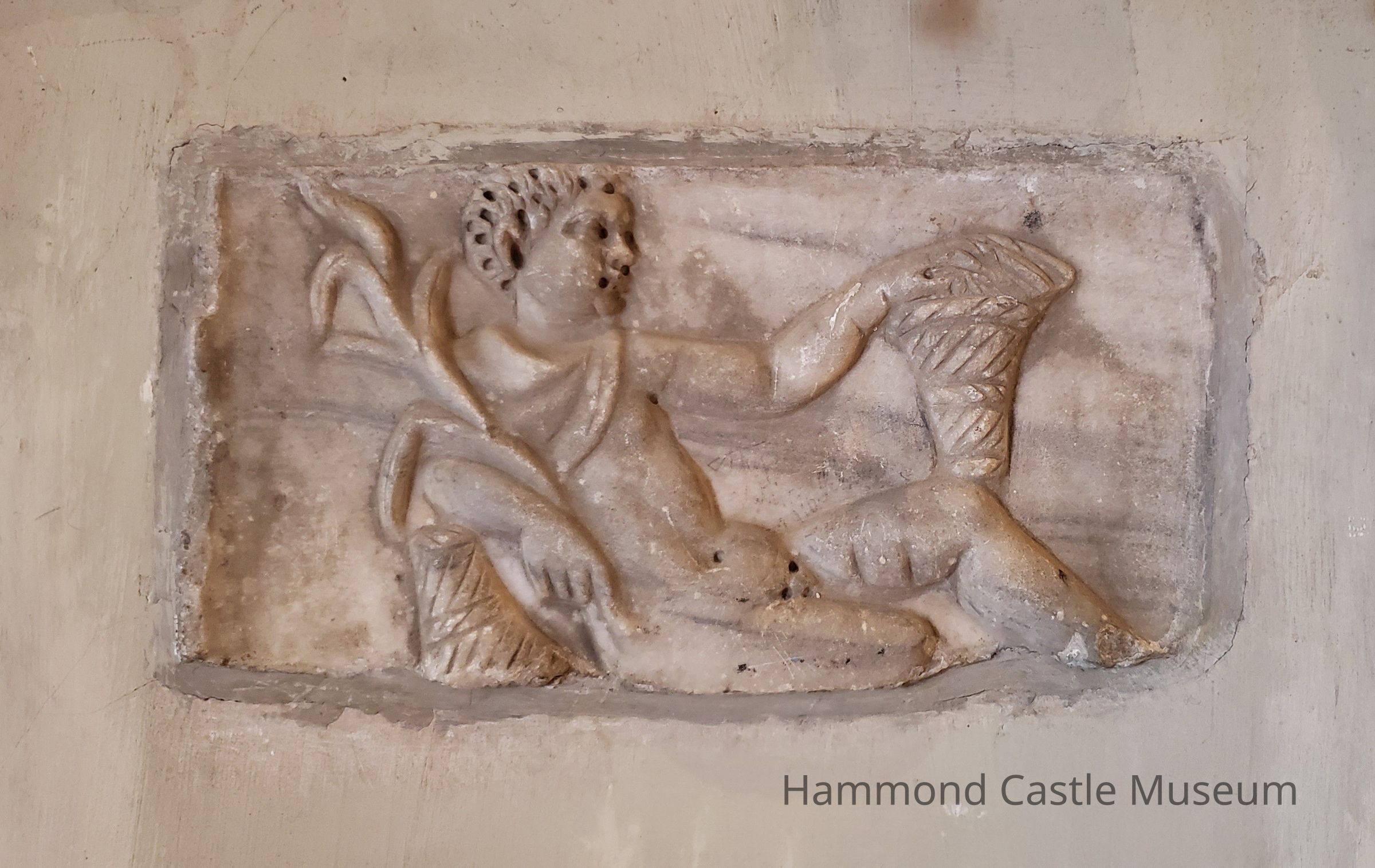
Fragment of Sarcophagus Lid with the Personification of Winter
Roman
Imperial Period
Ca. 260 to early 280s CE
Material
Proconnesian marble
Dimensions
20.5 cm high x 39.5 cm long
Condition
Fragment of far-left side of lid. Figure intact except for left foot. Some graffiti on the relief ground above the belly.
Description
The four Seasons appear frequently on Roman sarcophagi, and the reed in this figure’s right hand defines him as Winter. Facing our right, he stretches his left hand over ears of grain in a basket resting on his raised, bent left knee. Except for a mantle covering his right shoulder and upper right arm, he is nude. His adolescent torso is trim save for rolls of baby fat on his left thigh and lower left arm. He retains a baby’s slight double chin.
Although the carving is mediocre, the torso in three-quarters view and the lower right arm emerging from under the mantle offer a sense of three-dimensionality. The style is “pointillistic:” drill cavities emphasize every facial feature and highlight the navel, genitals, left underarm, and base of the left hand’s thumb. Several cavities separate the few sculpted locks of hair.
Discussion
Elements of the iconography are unusual. Despite the reed’s association with winter months, the sculptor carelessly placed grain—associated with summertime—in the upright basket. Further, the figure reclines against an overturned basket, not the usual rock.
The fragment probably comes from the lid’s front left side. The raised vertical element behind the figure suggests the lid’s outer edge, and Winter sometimes begins the sequence of Seasons. Probably Spring reclined opposite him and to our right Summer opposite Fall; a tabula naming the deceased held the center.
The appearance of the four Seasons on sarcophagi most likely relates to the deceased entering into a bountiful cycle of renewal.
Provenance
This may very well be one of the seven marble fragments obtained by Armando Pacifici in March 1927 from Siniscalchib and Arturo Dolcetti, both of Rome.
Notes
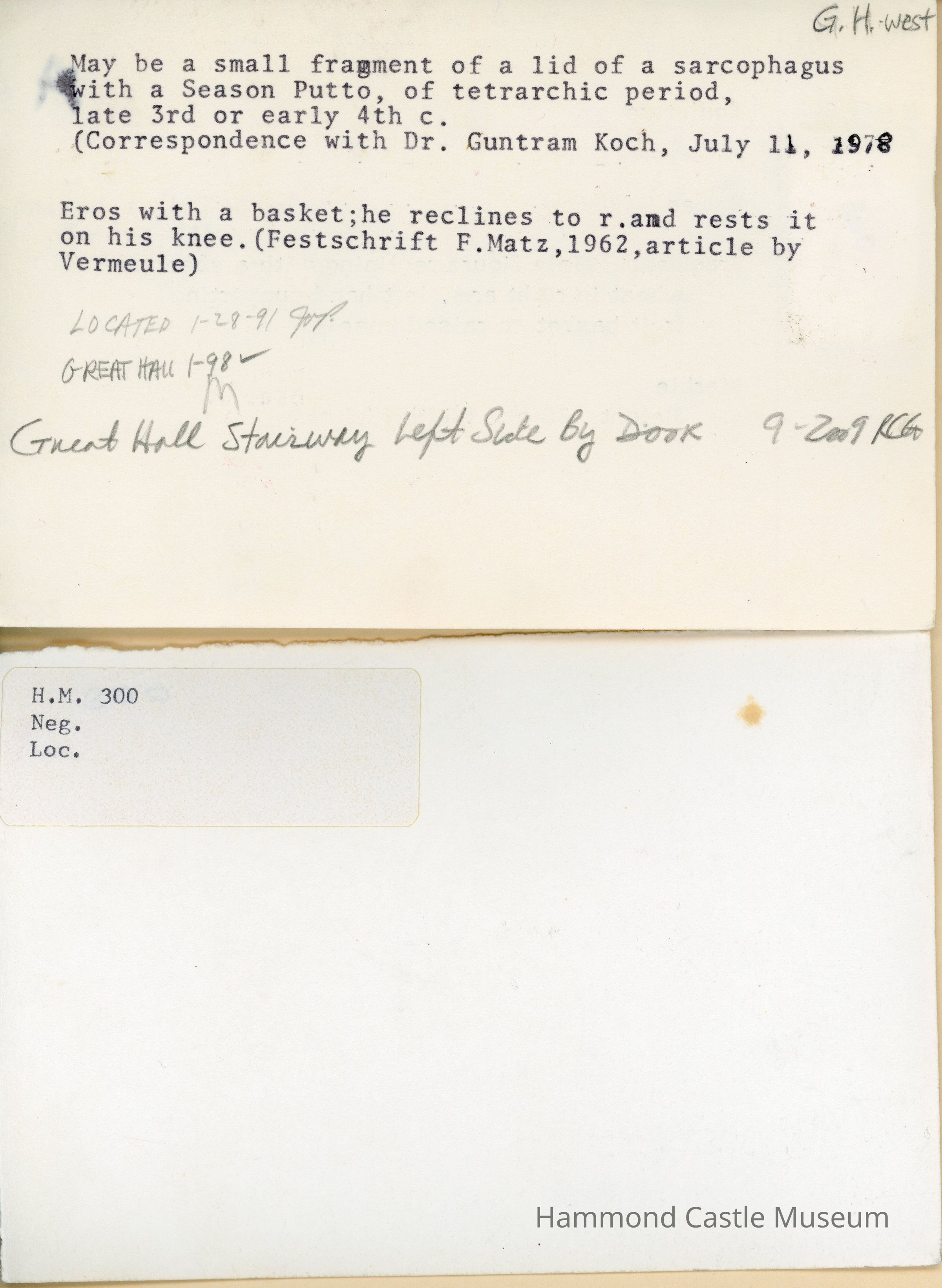
Scholarship on this fragment is minimal. Vermeule published it as a Season sarcophagus lid portraying Eros with a basket: Cornelius Vermeule, “Roman Sarcophagi in America: A Short Inventory,” in: Nikolaus Himmelmann-Wildschütz and Hagen Biesantz (eds.), Festschrift für Friedrich Matz (Mainz: Philipp von Zabern, 1962), 102, no. 4b. Lacking a photograph, Kranz could only note Vermeule’s description: Peter Kranz, Jahreszeiten–Sarkophage: Entwicklung und Ikonographie des Motivs der vier Jahreszeiten auf kaiserzeitlichen Sarkophage. Die Antiken Sarkophagreliefs V. 4 (Gebr. Mann, Berlin, 1984), 261, cat. no. 414.
The dating of this fragment is based on the similarities with fragments of two Season sarcophagus lids: primarily, Vatican City, Musei Vaticani, Magazzino Galli, inv. no. 4940; secondarily, Paris, Musée du Louvre, inv. no. Ma 1585 (Kranz (1984), 272, cat. 514, pl. 107. 4; 265, cat. 449, pl. 108. 2).
For lids with this kind of personification of the Seasons: Kranz (1984), 83–85. For the popularity of Season sarcophagi from ca. 250–310 CE: Mont Allen, The Death of Myth on Roman Sarcophagi (Cambridge: Cambridge University Press, 2022), 31 (fig. 9), 37, 74, 137–38.
For Winter’s canonical attributes and the careless placement of incorrect attributes: Kranz (1984), 125–26.
For pointillism: Guntram Koch, “Grundlage der Chronologie,” in: Guntram Koch and Helmut Sichtermann, Römische Sarkophage. Handbuch der Archäologie (Munich: C. H. Beck, 1982), 257–58.
For another example of Winter reclining against a basket: Gallienic sarcophagus in S. Maria in Anima, Rome (Kranz (1984), 270, cat. 498, pl. 109. 2). Tellus similarly reclines on a basket: late Gallienic sarcophagus, Brussels, Musée Cinquantenaire, inv. no. A 3680 (Kranz (1984), 192, cat. 30, pl. 33. 2).
For Winter beginning the cycle of Seasons on a lid: Kranz (1984), 131. For examples: Vatican, Magazzino Corazze, inv. no. 1081 (Kranz (1984), 201–202, cat. 61, pl. 33. 1); Grosseto, Museo Archeologico (Kranz (1984), 261–62, cat. 415, pl. 108. 5); Vienna, KhM, inv. no. I. 1123 (Kranz (1984), 274, cat. 521, pl. 107. 1).
For the cycle and renewal: Janet Huskinson, Roman Strigillated Sarcophagi (Oxford: Oxford University Press, 2015), 186. See further, Kranz (1984), 162–77.
For provenance documents: Hammond Castle Museum Archives, documents 1929-07-16 ca from Armando Pacifici (List of 13 Cases, copy 2 with more notes) p(1) and p(2).
[R Cohon, 2025]
Earlier identification:
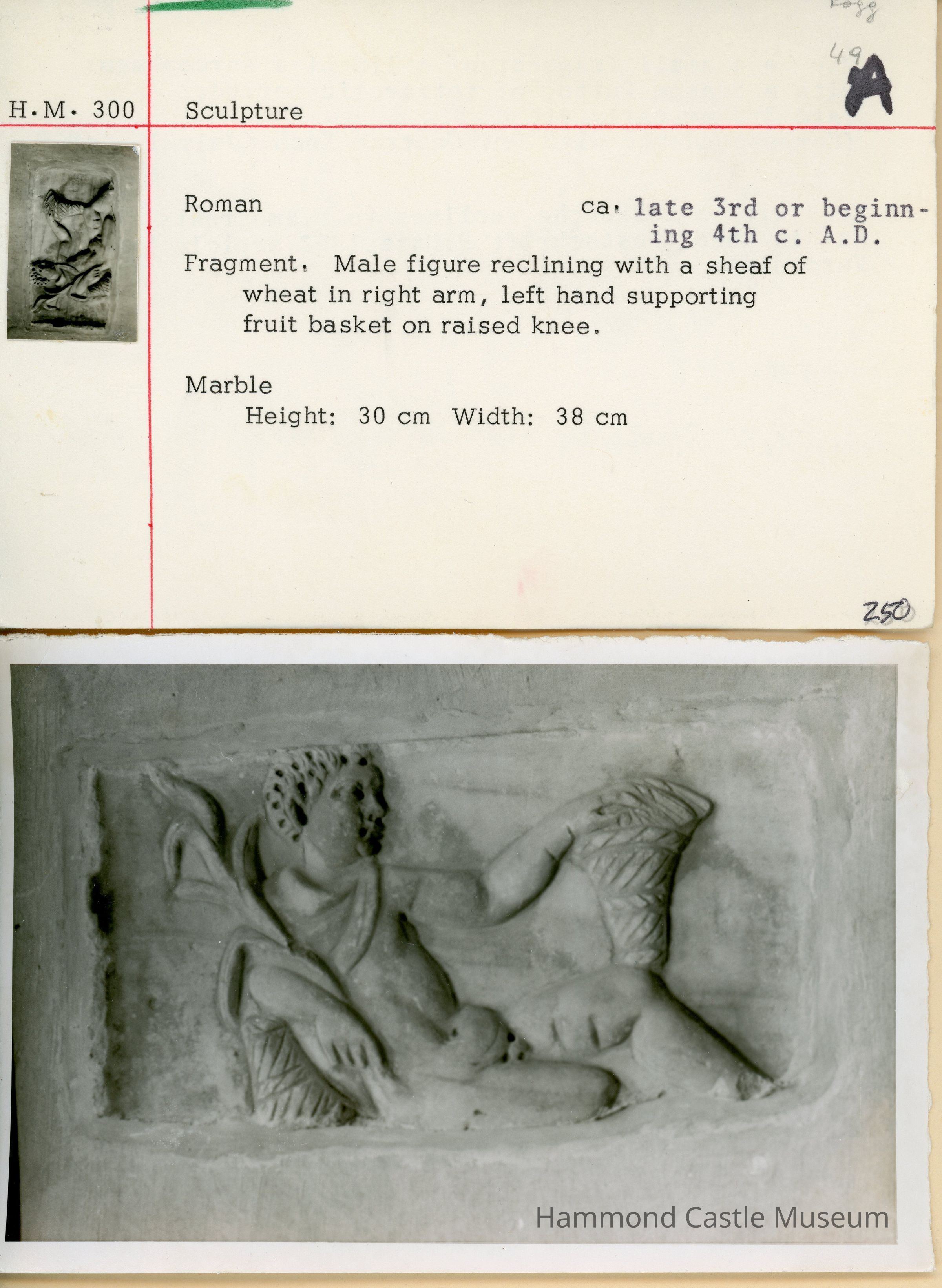
Marble fragment with male figure (Eros) reclining with a sheaf of wheat in right arm, left hand supporting fruit basket on raised knee. (Festschrift F. Matz, 1962, article by Vermeule)
May be a small fragment of a sarcophagus with a Season Putto, of the Tetrarchic period, late 3rd or early 4th c. (from correspondence with Dr. Guntram Koch, July 11, 1978)Collection
SculptureMade/Created
Notes
Date: ca. late 3rd-early 4th c. A.D.Lexicon
Nomenclature 4.0
Nomenclature Secondary Object Term
ReliefNomenclature Primary Object Term
SculptureNomenclature Class
ArtNomenclature Category
Category 08: Communication ObjectsGeneral Notes
Note Type
HM300 - Fragment w Personification of Winter (Cohon-JRA-Forgery-Gloucester-Gen-Winter)