Name/Title
Fragment of Sarcophagus Lid with Nebuchadnezzar, Idol, Acroterial HeadEntry/Object ID
NN030Description
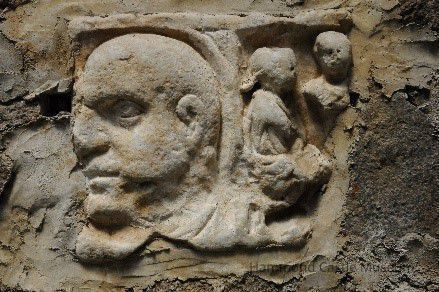
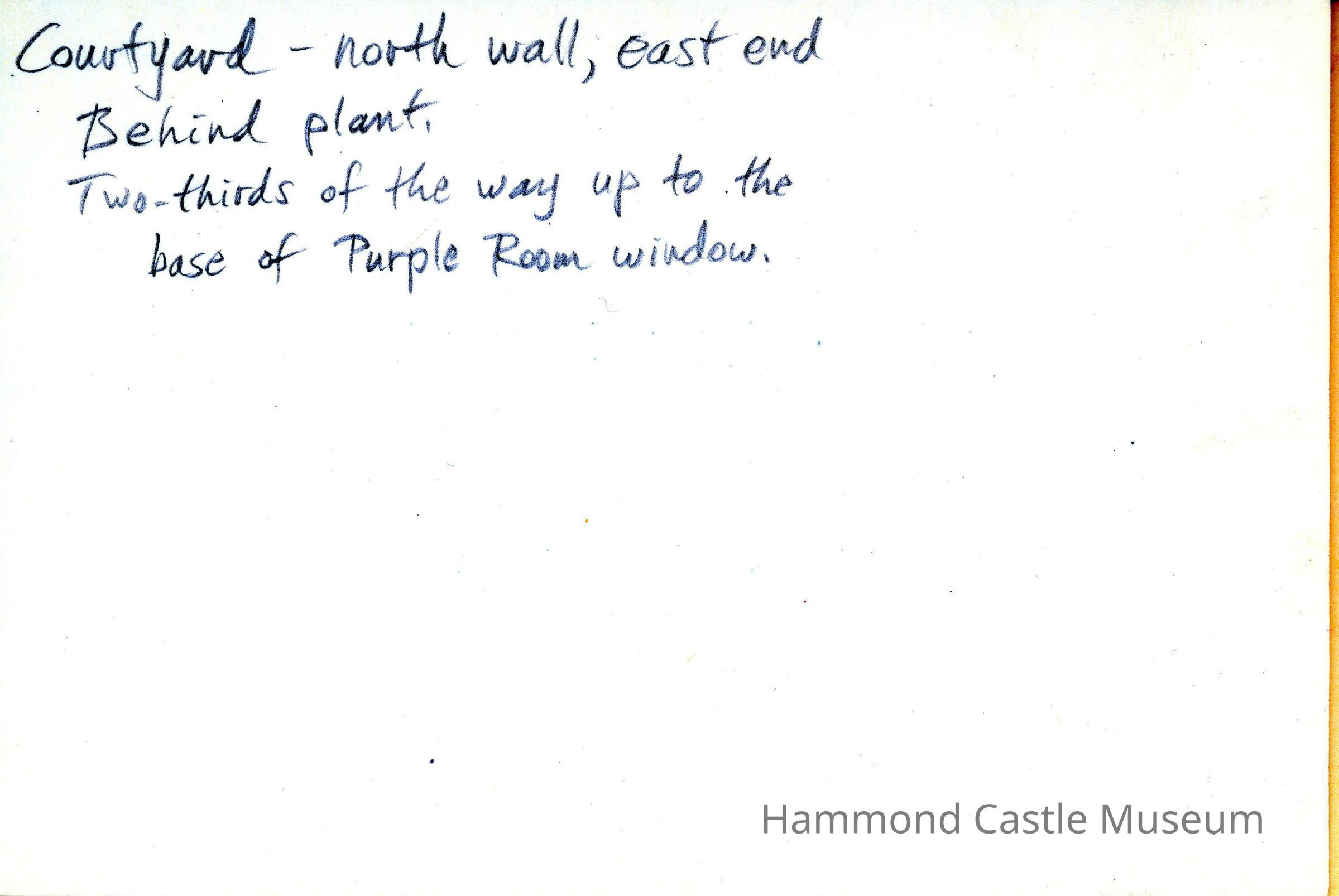
Roman marble fragment w Nebuchadnezzar & Youth in Furnace under Guest Room Courtyard Window
Fragment of Sarcophagus Lid with Nebuchadnezzar, Idol, Acroterial Head
Roman
Late Antique
Fourth century CE
Material
Marble
Dimensions
30 cm (high) x 36 cm (long)
Condition
Poor. The left corner of the sarcophagus lid is extant; the surface has been badly weathered and much of it battered. Nebuchadnezzar’s legs and right arm are missing. Of his folding chair, only the back leg is preserved. Most of the idol’s pillar is missing; so too the idol’s left shoulder. Much of the jaw of the acroterial head is damaged; the hair and ear thoroughly weathered.
Description
Nebuchadnezzar is shown here facing our right and sitting on a folding chair whose curved back leg ends in what appears to be a lion paw. He is bearded with a band around the top of his head and holds in his left hand a staff; he has apparently extended his right hand. He appears to wear a tunic; a mantle lies over his back; and the lower part curves over his right thigh and lies on his lap. Beside him to our right, on a pillar, and facing outward is the bust of the bearded idol. The rest of the scene is missing.
The acroterial head to the left has large facial features: a heavy nose and a wide, mostly frontally oriented eye whose iris and pupil are clearly marked. His rounded cranium is relatively small with little space behind his ear. The hair was apparently short-cropped; his smooth chin indicates that he was clean-shaven. The frame behind the head is semicircular.
Discussion
In the Old Testament, Daniel 3, King Nebuchadnezzar set up an idol that he commanded all to worship. Three Hebrews refused to worship it; whereupon the king condemned them to die in a fiery furnace, from which they emerged miraculously unhurt.
In accord with other representations, on this sarcophagus lid the three Hebrews probably appeared in court opposite the idol rather than in the fiery furnace. What may have been on the opposite side of the lid is speculative: a scene of the Three Wisemen and Virgin Mary has some precedence.
Anticipating the resurrection of Christ and hoped-for resurrection of the deceased, the scenes from Daniel 3, including the Three Hebrews in the Fire, were popular on fourth-century sarcophagi. They may also reflect the memory of the earlier pagan persecutions of Christians in the Roman Empire.
Dressed in the clothes of the Roman period, Nebuchadnezzar is portrayed on the chair of a Roman magistrate, the sella curulis, thus making clear to Roman audiences his authority. The degree to which his garb and chair would reinforce the memory of the persecutions of Christians by Roman emperors is unclear.
With its distinctive, strong facial features, the acroterial head would seem to portray a specific character, but it lacks any complete, defining parallel.
Provenance
This may very well be one of the seven marble fragments obtained by Armando Pacifici in March 1927 from Siniscalchib and Arturo Dolcetti, both of Rome. Pacifici subsequently sold it to Hammond.
Bibliography
Unpublished
Notes
The fragment’s poor condition allows only for a broad dating, the fourth century CE. The scene with Nebuchadnezzar, the idol, and the recalcitrant Hebrews appears on Roman sarcophagi of the fourth century, not before. The scene appears often on sarcophagi in the age of Constantine, 312/313–ca. 340 CE, and far less frequently later, suggesting the fragment’s most likely date, but not conclusively. (See Guntram Koch, Frühchristliche Sarkophage (Munich: C.H. Beck, 2000), 149). The acroterial head is essentially unique, but a few limited parallels can be found in the head identified as an Apostle on a Constantinian fragment from the Cimitero di Pretestato, Rome (Koch (2000), 150; Giuseppe Bovini, Hugo Brandenburg, Repertorium der christlich-antiken Sarkophage 1. Rom und Ostia (Wiesbaden: Franz Steiner Verlag, 1967), I. 244, cat. 600; II. pl. 91). Nevertheless, the evidence for dating the head specifically to the age of Constantine is too weak to be conclusive.
For the many representations of the three Hebrews in Nebuchadnezzar’s court, refusing to worship the idol: Koch (2000), 149. For the only examples of the Three Hebrews in the Fire appearing directly next to the enthroned Nebuchadnezzar: lost fragment of a sarcophagus from St.-Caprais, Agen, France (Brigitte Christern-Briesenick, Repertorium der christlich-antiken Sarkophage 3. Frankreich, Algerien, Tunesien (Mainz: von Zabern, 2003), 3, cat. no. 9, pl. 2. 3); the lid on a Theodosian sarcophagus, Vatican City, Museo Pio Cristiano, inv. nos. 100, 159A, 199 (Bovini, Brandenburg (1967), I. 24–26, 100-1, cat. nos. 28, 160; II. pls. 9, 35). Note especially Koch (2000), 150.
For the Three Wisemen and Virgin Mary directly juxtaposed to the three Hebrews in Nebuchadnezzar’s court, see, for example: Koch (2000), 149; the late fourth-century “Sarcophagus of Stilicho,” Basilica di Sant’Ambrogio, Milan (Jutta Dresken-Weiland, Repertorium der christlich-antiken Sarkophage 2. Italian mit einem Nachtrag Rom und Ostia, Dalmatien, Museen der Welt (Mainz: von Zabern, 1998), 56–58, cat. 150, pl. 60. 2). The juxtaposition is less clear on the Sarcophagus of Adelfia, Syracuse, Museo Archeologico Regionale (Dresken-Weiland (1998), 8–10, cat. 20, pls. 9–10). On the large fragment of a sarcophagus lid, at the Cimitero di Domitilla, the rendering of the Three Hebrews in the Fire appears between the two scenes (Koch (2000), 150; Bovini, Brandenburg (1967), I. 226, cat. 548; II. pl. 84).
For the sella curulis: Thomas Schäfer, Imperii insignia: Sella curulis und fasces. Zur Repräsentation römischer Magistrate (Mainz: von Zabern, 1989). For the sella curulis with lion paws, see Schäfer (1989), 179.
For the popularity of scenes from Daniel 3, including the fiery furnace: Koch (2000), 148-51.
For the acroterial head’s identity, an Apostle’s head would suit the lid’s Christian character; however, his features are substantially less refined than those of the acroterial heads often named as Apostles. For the closest, see the aforementioned Constantinian fragment from the Cimitero di Pretestato, Rome. For the possible naming of such acroterial heads as Apostles, see, for example: Christern-Briesenick (2003), 70, cat. 113; Wolfgang Wischmeyer, Die Tafeldeckel der christlichen Sarkophage konstantinischer Zeit in Rom (Freiburg: Herder, 1982), 46–51; Traute Brennecke, Kopf und Maske. Untersuchungen zu den Akroteren an Sarkophagdeckeln (Berlin: 1970), 7–21, 194–99, cat. nos. 1–27. Koch (2000, 53) names them young and old men, without specifying them as Apostles.
For provenance documents: Hammond Castle Museum Archives, documents 1929-07-16 ca from Armando Pacifici (List of 13 Cases, copy 2 with more notes) p(1) and p(2).
[2026 Cohon]Lexicon
Nomenclature 4.0
Nomenclature Secondary Object Term
CarvingNomenclature Primary Object Term
SculptureNomenclature Class
ArtNomenclature Category
Category 08: Communication ObjectsGeneral Notes
Note Type
1966 Corinne Witham Guidebook (28)Note Type
1966 Corinne Witham Guidebook (30)Note Type
1929-07-16 ca from Armando Pacifici (List of 13 Cases) p1-2