Name/Title
Sarcophagus Lid Fragment with Hunting Scene and AcroterionEntry/Object ID
HM-320Description
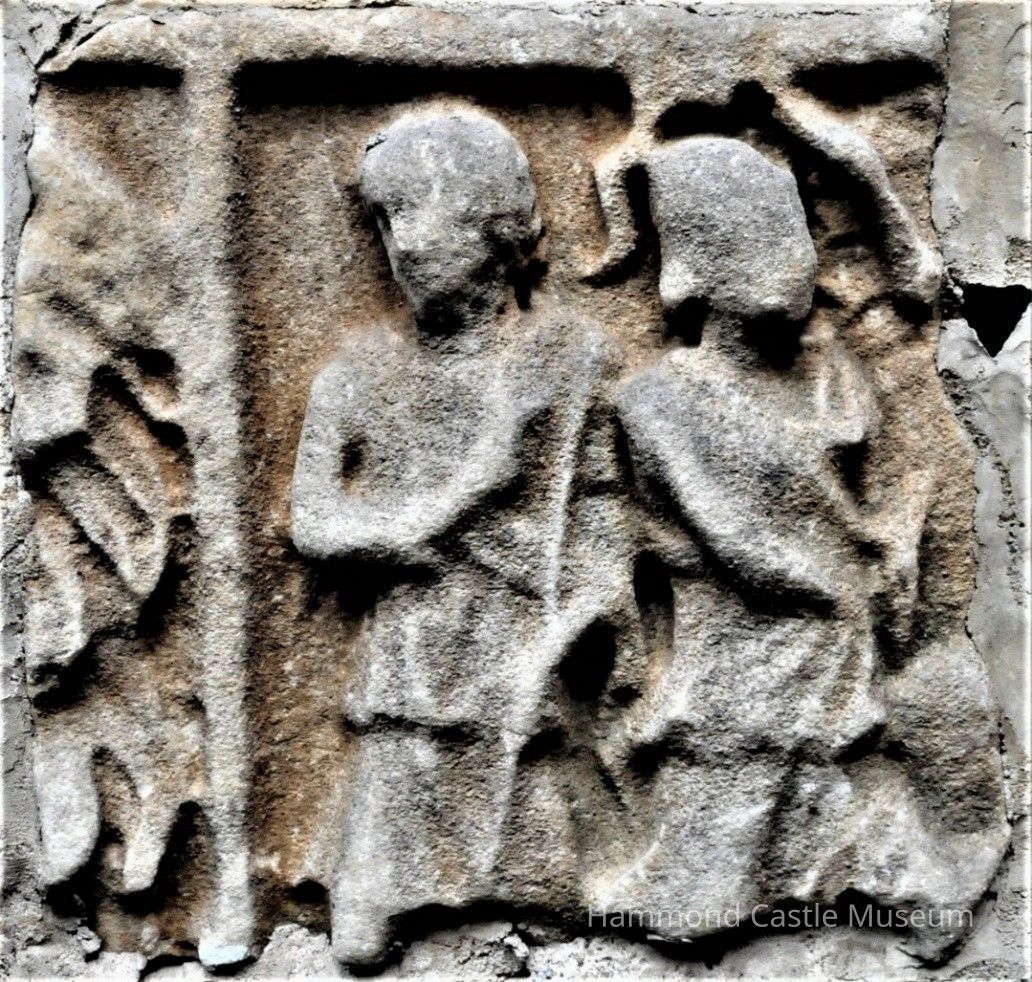
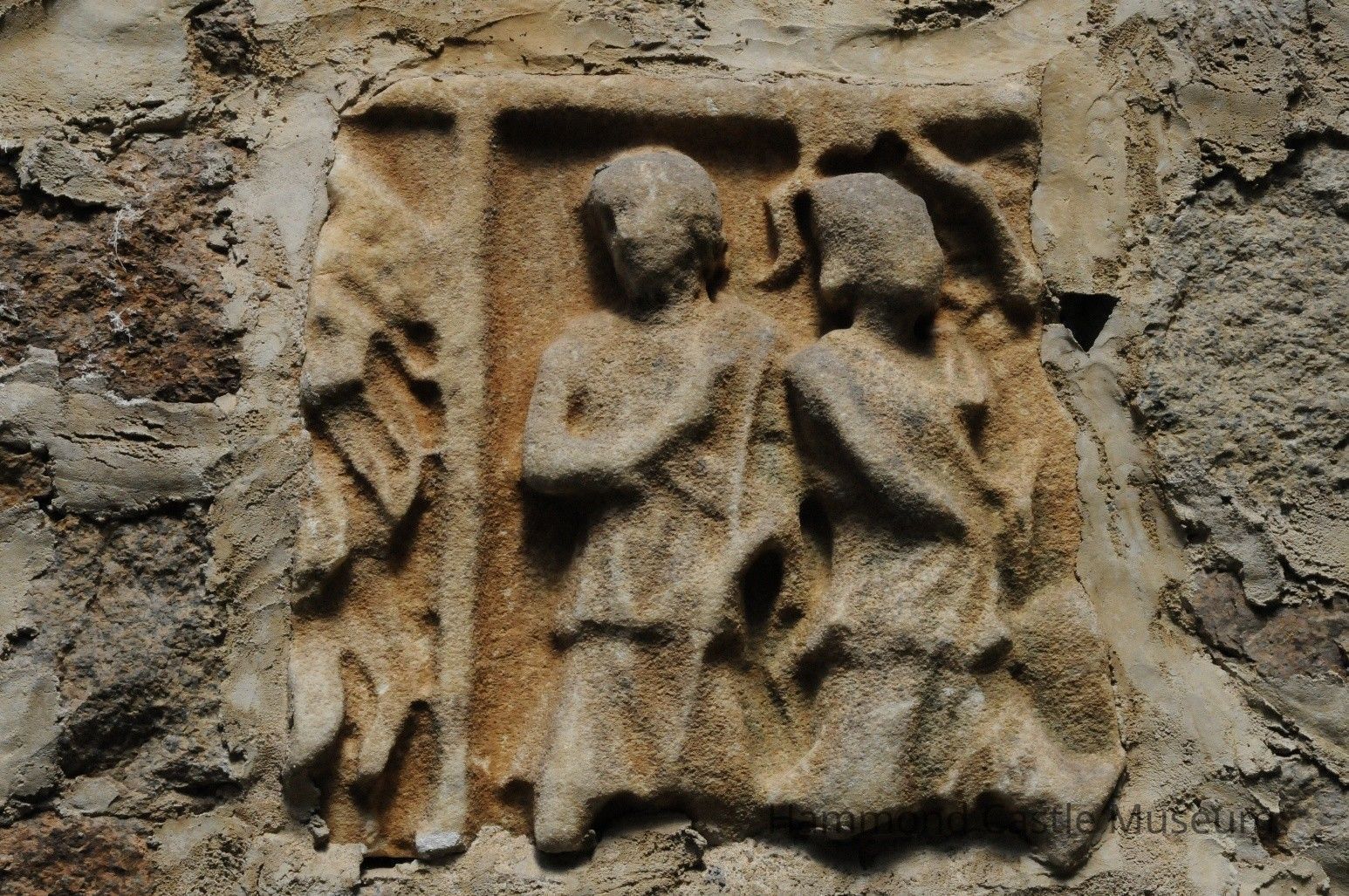
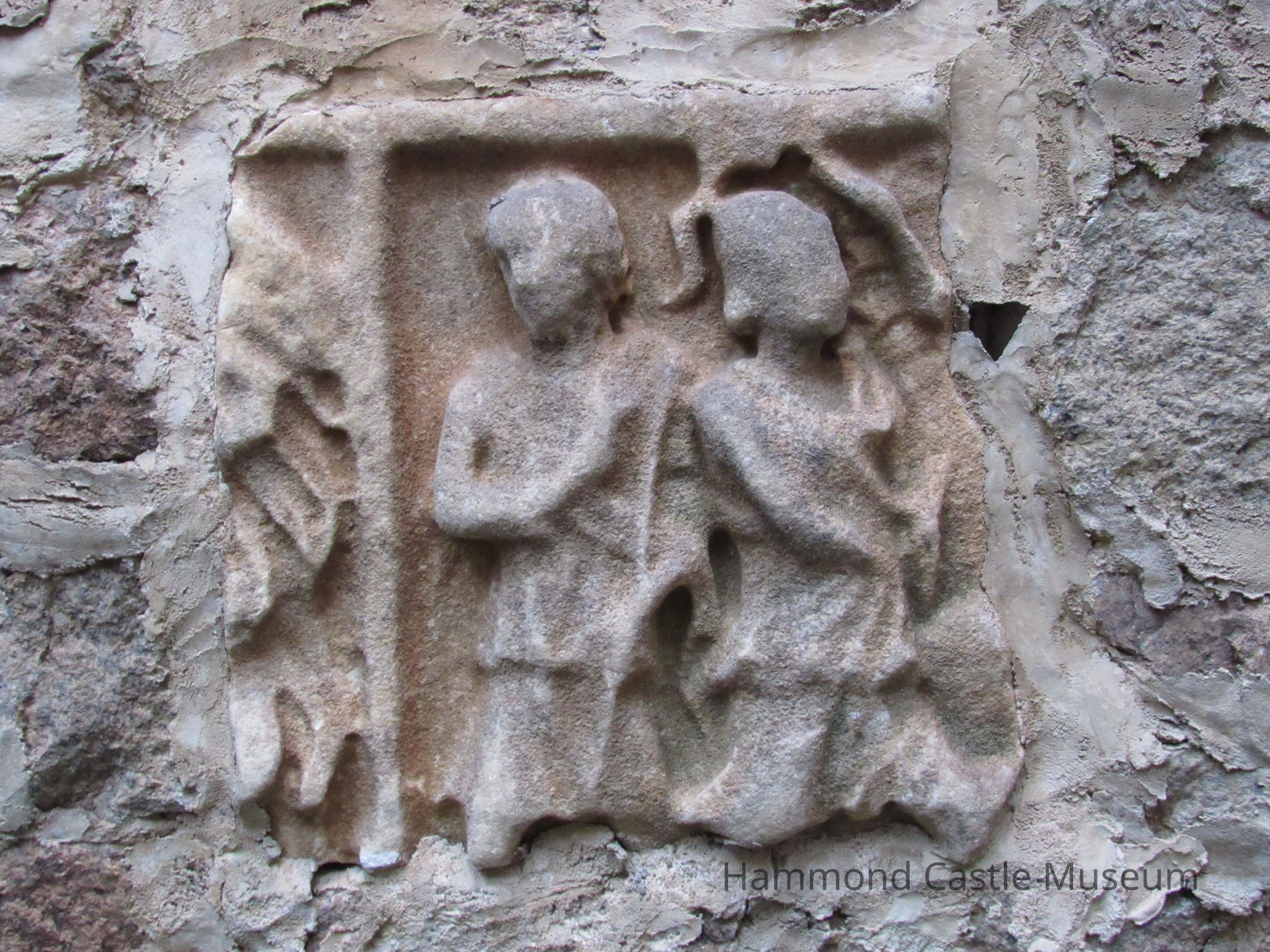
Fragment of the Lid of a Sarcophagus with a Hunt Scene and Acroterion
Inv. no. HM-320
Roman
Roman Imperial Period
Ca. 240 CE (see further below)
Material
Marble, ca. 1 mm average grain size, brownish gold, traces of blue, probably Greek
Dimensions
40.6 cm high (at vertical ridge) x 42 cm long (bottom)
5.7 cm total thickness: 1.7 cm, from relief ground to back + maximum depth of relief, 4 cm (head of attendant)
Condition
This fragment is in poor condition: the face of the acroterion, the lower legs of the attendant and of Virtus and most of the horse and horseman are missing. The surface is badly weathered.
Description and Reconstruction
The thinness of the relief suggests that the fragment was from the upper four-fifths of the façade of a sarcophagus’s lid. (The lower fifth, consisting of the large slab that covered the chest, had been broken away from it.) The partially preserved long locks of hair on the left of the fragment and the vertical band and arc behind them indicate that the hair was from the back of a head of an acroterion at the left corner of the lid.
An attendant, Virtus, and traces of a hunter on horseback appear in that order behind the acroterion. The imagery indicates that the lid belonged to a group known as hunt sarcophagi. Some 250 third- and fourth-century CE Roman sarcophagi depict on the chest or lid the deceased hunting a wild animal, generally a lion; these sarcophagi may sometimes include related scenes: the setting out for and returning from hunts and subsequent feasts. Comparisons to some of these sarcophagi help reconstruct the relief’s missing parts.
Virtus, in her role as goddess of courage, rushes behind the horseman, her head raised up slightly towards him, her left leg before her right, and her torso in three-quarter view. She extends her partially preserved right arm before her, apparently gesturing towards the horseman as in other hunt sarcophagi. Her short, sleeveless, and belted “Amazonian dress” reveals her right shoulder and right breast. Her mantle is bunched up over her left shoulder; a brooch is barely visible there. Images of Virtus on other hunt sarcophagi indicate that the mantle was probably understood to have hung from her left arm. She wears a distinctive two-plumed helmet; a baldric over her right shoulder holds a sword whose handle appears at her left hip.
Little remains of the rider and horse: part of the horse’s haunch and tail; a trace of the rider’s bent back right leg next to Virtus’s right leg; and his raised upper right arm to the right of Virtus’s helmet. Traces of his fluttering mantle lie between his arm and Virtus. Comparisons to complete hunt sarcophagi indicate he was slaying a wild animal before him, most likely a lion but possibly a boar or other beast. It is unclear if his right hand held a spear aimed at the beast or if, having struck the beast, he raised his hand in a gesture of victory.
The hunt attendant seems to address a person on our left who has not been rendered. Turning his slightly inclined head in that direction, he points his right hand to Virtus and the rider. His left hand holds a spear that leans against his left shoulder. The attendant is frontally oriented but his legs turn to our left. He wears a sleeveless belted tunic and a mantle whose end drapes over his left lower arm.
Although little of the acroterion remains, comparisons with acroteria on hunt sarcophagi indicate it probably was of a bearded man, possibly a wind god.
Reconstruction of the entire lid; the chest
As is usual, the acroterion on the left was matched with a similar or identical one on the right. Based on the majority of other lids on hunt sarcophagi, most probably a plaque, or tabula, for a funerary inscription occupied the lid’s center; to the right of the tabula was a hunt or, less likely, a setting out for or returning from a hunt or a resultant feast.
The lid’s current height at 40.6 cm and the absence of its bottom fifth suggest that it originally was about 50 cm high. Few lids with hunt and related scenes are this high (the average, about 20 to 30 cm), and the size indicates that the chest was also very large.
The subject of this lid’s missing chest cannot be determined: very few lids with hunt and/or related scenes still have their original chests, of which about half have hunts, while the rest vary from strigillated to myth (Hippolytus) to marriage to Christian themes.
Discussion
The close similarity of the relief’s three figures to their counterparts on a well-dated hunt sarcophagus in the Ny Carlsberg Glyptotek, Copenhagen dates it to 240 CE.
The lid’s fragmentary state precludes a definitive understanding of the imagery’s significance but at a minimum, it showed the deceased in a hunt and celebrated his courage as exemplified by his actions and embodied in Virtus. The presumed size of the chest indicates the sarcophagus was an important commission commensurate with the deceased’s heroic character.
Provenance
This relief may very well be one of the seven marble fragments obtained by Armando Pacifici in March 1927 from Siniscalchib and Arturo Dolcetti, both of Rome. Pacifici subsequently sold them to Hammond.
Bibliography
Unpublished
Notes
For the thickness of the lids’ facades without the slab at the bottom that covers the chest: S. Walker, Catalogue of Roman Sarcophagi in the British Museum. Corpus Signorum Imperii Romani, Great Britain 2. 2 (London: 1990), nos. 8 (5.7 cm), 9 (5.0 cm), 14 (6.6 cm), 17 (5.0 cm), 25 (4.5 cm bottom; 3.5 cm top). For the thickness of the walls of the chests of sarcophagi for adults: Walker 1990, nos. 2 (8.8 cm), 12 (12.6 cm), 16 (10.6 cm), 19 (8.8 cm), 20 (9.0 cm), 23 (11.2 cm), 24 (10.0 cm).
For acroteria on sarcophagus lids: T. Brennecke, “Kopf und Maske: Untersuchungen zu den Akroteren an Sarkophagdeckeln,” dissertation, Freie Universität, Berlin, 1970.
For a complete catalogue of hunt sarcophagi: B. Andreae, Die Sarkophage mit Darstellungen aus dem Menschleben, Die römischen Jagdsarkophage, Die antiken Sarkophagreliefs 1. 2 (Berlin: 1980). Note further P. Blome, “Der Löwenjagdsarkophag Ludwig im Antikenmuseum Basel,” in Akten des Symposiums “125 Jahre Sarkophag-Corpus,” Marburg, 4.– 7. Oktober 1995, Sarkophag-Studien 1, edited by G. Koch (Mainz am Rhein: 1998), 1-6.
For the image of Virtus in general: M. Milhous, “Honos and Virtus in Roman Art,” dissertation, Boston University, 1992; T. Ganschow, “Virtus,” Lexicon Iconographicum Mythologiae Classicae, VIII (Zurich; 1997), I, 273-81; II, pls. 195-203. For Virtus signifying courage on sarcophagi: Milhous, 1992, 176.
For Virtus’s “Amazonian dress:” Milhous 1992, v, 107–8. For other terms for her garb: tunic (Milhous 1992, 107–8, 130–31, 138, 140, 142); chiton (Andreae 1980, 43). For a mantle over her left arm: Andreae 1980, nos. 75, 126.
For the hands of Virtus, note that although in some hunt sarcophagi she grasps the sword’s handle in her left hand (for example, Andreae 1980, nos. 41, 64, 240), in this case her left hand is not visible. Virtus probably did not carry a spear in her right hand: even a faint trace of it would have remained on her drapery (compare to the nearby attendant). For her gesturing with her right hand, see, for example, Andreae 1980, nos. 240, 245.
For the gesture of victory and the throwing of a spear: Andreae 1980, 51–52.
For an attendant on the left of a hunt sarcophagus looking at two other figures on the far left: Andreae 1980, no. 164.
For the acroterial head, the closest parallel on the lids of sarcophagi with hunt and related scenes are long-haired bearded men: Andreae 1980, nos. 46, 52, 78, 196. Nos. 52 and 196 are of wind gods; the others remain unidentified.
For lids whose hunt and related scenes have a tabula in the center: Andreae 1980, nos. 60, 76, 88, 105, 106, 111, 112, 157, 206. For the few lids with a portrait in the center: Andreae 1980, nos. 29, 183. For lids with hunt scenes on both the left and right: Andreae 1980, nos. 46, 60, 76, 105, 112, 206, 233. For lids with hunt scenes on the left and a banquet or departure or return scene on the right: Andreae 1980, nos. 88, 106, 157. For lids with a portrait of the deceased on the left side and hunt on the right and a return scene on the left and a portrait on the right: Andreae 1980, nos. 78, 240, respectively.
For 20- to 30-cm high lids: Andreae 1980, nos. 2, 3, 29, 46, 55, 60, 76, 81, 94, 150, 183, 206, 233. For lids higher than 45 cm with hunt and related scenes: Andreae 1980, nos. 86, 134, 196. For the only example of a hunt sarcophagus’s large lid and large chest: Andreae 1980, no. 86.
For a hunt scene on the chest and a hunt or return scene on the lid: Andreae 1980, nos. 3, 60, 78, 112, 149, 206, 240. For hunt and/or return scenes on lids but not their chests: Andreae 1980, nos. 105 (strigils), 106 (marriage), 152 (Christian), 233 (Hippolytus), 236, 237 (Christian).
For the Ny Carlsberg Glyptotek sarcophagus inv. no. 786: Andreae, 1980), no. 41; J. Østergaard, Imperial Rome: Catalogue, Ny Carlsberg Glyptotek (Copenhagen: 1996), 67–70; “Metropolitan Roman Sarcophagi in the Ny Carlsberg Glyptotek, Copenhagen,” in Akten des Symposiums “125 Jahre Sarkophag-Corpus,” Marburg, 4.– 7. Oktober 1995, Sarkophag-Studien 1, edited by G. Koch (Mainz am Rhein: 1998), 98-99.
For the heroic character: Milhous 1992, 199.
For the provenance: Hammond Museum Archives, documents 1929-07-16 ca from Armando Pacifici (List of 13 Cases, copy 2 with more notes) p(1) and p(2).
[2026-06-01 R. Cohon]Collection
SculptureMade/Created
Notes
Date: mid to late 3rd centuryLexicon
Nomenclature 4.0
Nomenclature Secondary Object Term
ReliefNomenclature Primary Object Term
SculptureNomenclature Class
ArtNomenclature Category
Category 08: Communication ObjectsGeneral Notes
Note Type
1966 Corinne Witham Guidebook (28)Note Type
1966 Corinne Witham Guidebook (30)