Name/Title
AU Harris, Joseph Hastings - 1933-04-28 - 'Senior Recognition, April 28, 1933'Entry/Object ID
1990.1.196Scope and Content
Orville WrightContext
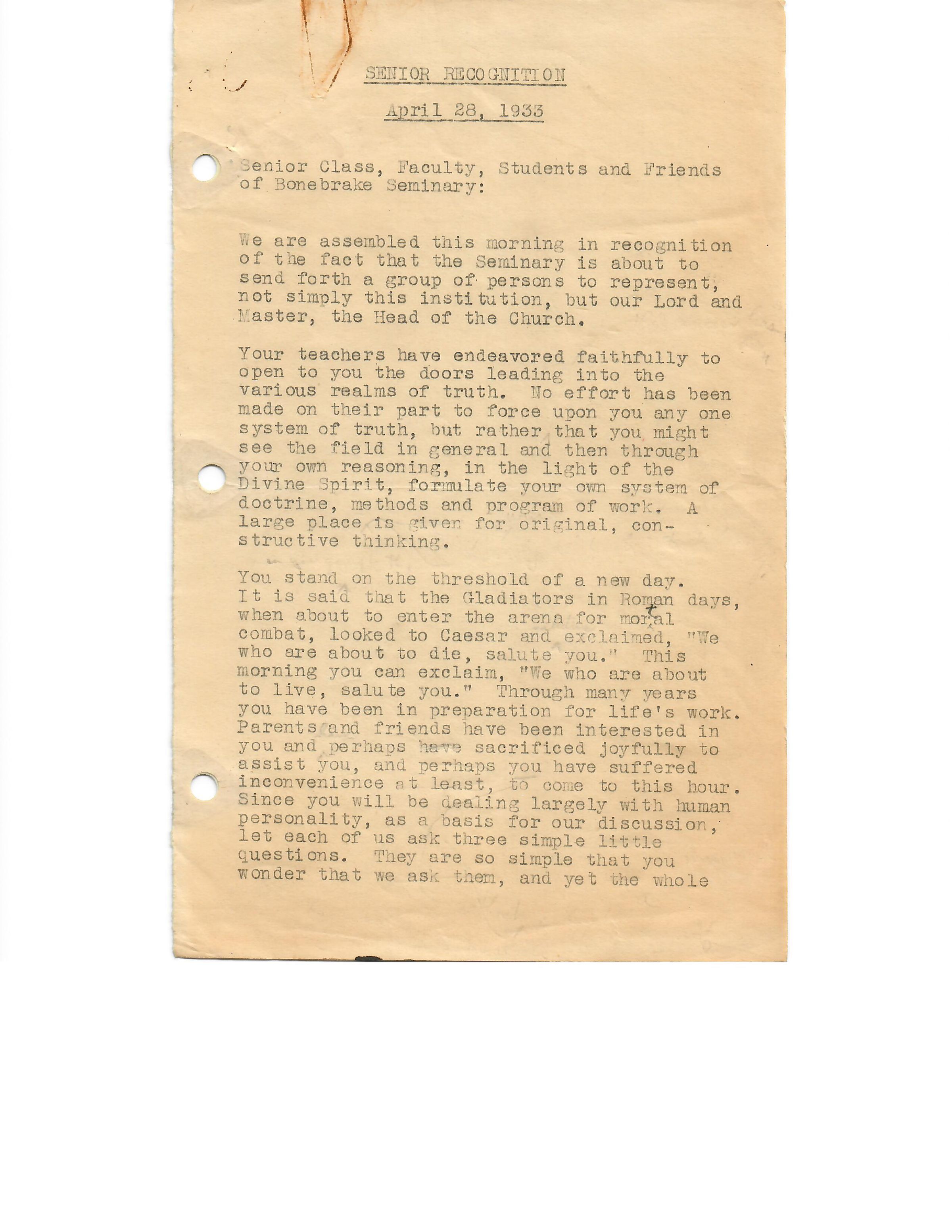
SENIOR RECOGNITION
April 28, 1933
Senior Class, Faculty, Students and Friends of Bonebrake Seminary:
We are assembled this morning in recognition of the fact that the Seminary is about to send forth a group of persons to represent, not simply this institution, but our Lord and Master, the Head of the Church.
Your teachers have endeavored faithfully to open to you the doors leading into the various realms of truth. No effort has been made on their part to force upon you any one system of truth, but rather that you might see the field in general and then through your own reasoning, in the light of the Divine Spirit, formulate your own system of doctrine, methods and program of work. A large place is given for original, constructive thinking.
You stand on the threshold of a new day. It is said that the Gladiators in Roman days, when about to enter the arena for mortal combat, looked to Caesar and exclaimed, "We who are about to die, salute you." This morning you can exclaim, "We who are about to live, salute you." Through many years you have been in preparation for life's work. Parents and friends have been interested in you and perhaps have sacrificed joyfully to assist you, and perhaps you have suffered inconvenience at least, to com to this hour. Since you will be dealing largely with human personality, as a basis for our discussion, let each of us ask three simple questions. They are so simple that you wonder why we ask them, and yet the whole
---------- End of Page 1 -----------
philosophy of life is wrapped up in these questions.
1. The first question is, what am I? We used to quote the definition given by Dr. Samuel Harris, of Yale, as follows: "A person is a being conscious of self, subsisting in individuality and identity and endowed with intuitive reason, rational sensibility and free will." This is a difficult definition and for our purpose it is sufficient to say, we have the power to know the right way of life, the power to choose the good way which we know and the power of will to determine whether we shall walk in the good way which we know and have chosen.
2. the second question is, where am I? For our purpose it is sufficient to say that the spirit dwells in a body that is material and the body is dependent upon the material for its sustenance. Two worlds sweep over this immortal spirit, the world of sense, of time, and the material, and also the world of spirit. In the realm of spirit are two forces, the good and the evil. We have power to know , to choose and to will that we shall walk in the good way which we know and have chosen.
3. The third question is, whither am I going? The answer to this question depends upon what we have sought to know, the choices we have made and the determination of will with which we have sought to carry out those choices.
Now such a being, with such powers, is related to himself, to people about him and to God above him. One must live with himself - why not make himself as agreeable as possible? Why have conflict within one's own being? Why not set an ideal before one's own
---------- End of Page 2 -----------
self and then compel the self to rise to that ideal? We must master ourselves, or rather lay hold of superior forces that may master us. One must live with others. He cannot evade this responsibility to others except at his own peril and also the peril of others. One has said, "He is a great man who inhabits a realm of thought into which others climb with difficulty." It is your privilege to inhabit the heights! Your training has been to this end. We shall be disappointed if you do not realize this goal. Your greatest achievement will be that of inspiring others to the larger and nobler conceptions of life.
You are related also to God above you. Created in His image, we are capable of receiving a revelation from God. Bishop Locke has said, "No man can hope to come to his fullest personality who deliberately leaves God out of his life." This fact should spur us, not only to make all that is possible of our own lives, but also to help others realize their highest possibilities. It should be remembered that the greatest scientists are men who acknowledge the sovereignty of God. / Dr. Robert A. Millikan says, "It is unthinkable that a real atheist should exist at all." We need only to name such persons as Dr. Charles D. Wallace, President of the Natural Academy of Science and head of the Smithsonian Institute, of Washington City; Henry Fairfield Osborn, Director of the American Museum of Natural History of New York; Edwin G. Conklin, of Princeton; John C. Merrian, President of the Carnegie Institute, of Washington; Michael Pupin, electrical expert of Columbia; John M. Coulter, Dean of American Botanists; A. A. and W. A. Noyes, chemists; James R. Angell, President of Yale University and an eminent psychologist; James H. Breasted, Archaeologist; Chamberlain, a Geologist; Dr. G. C. Abbott,
---------- End of Page 3 -----------
Natural Academy of Science and an eminent astronomer and church man. James Clerk Maxwell, the brilliant associate of Spencer and Huxley, and a devout Christian, said "There never was a theory of the universe that did not need a God to make it go."
Such a being, with such powers, is surrounded by the physical universe, What we get from the universe depends upon our power of receptivity. With intellect man has the power to delve into the secrets of nature, searching out God's laws. Mr. Edison specialized in the field of electricity. What was he doing? Simply searching out a law which was written in the constitution of the physical realm. He did not dictate to nature, but rather was receptive and obedient to the truth written therein.
All are familiar with the story of the Wright Brothers, who for many years worked in their bicycle shop at 1127 West Third Street, in Dayton. In face to the negations of scientists and the gossip of the ignorant, they toiled on patiently until in November, 1903, they succeeded in their undertaking. About two years ago the Wright Company asked the privilege of using the Seminary grounds in experimenting with their miniature planes. They are on the grounds frequently and I have mingled with them occasionally. A few evenings ago I took the privilege of making some inquiry about their early struggles. With enthusiasm Mr. Orville Wright told me that after they discovered certain principles, they moved rapidly toward the goal. He proceeded to relate how for a long time they tried to use the data gathered by other investigators. Not succeeding, they wrote the head engineer of these investigators and on receiving reply, began to test the validity of the extant findings. "Much of this data," said Mr. Wright,
---------- End of Page 4 -----------
"was 100% error." Having cleared the field of erroneous data, they began an original research and soon discovered the principle which has made them world famous. Now after thirty years, they are continuing enthusiastic research. Mr. Wright said, "I am not part of the company, but am still interested." Thus he was working, not for money, but for the joy of achievement. May such a spirit motivate you in the realm of the Spirit.
The moral universe is pressing upon us. God has written Himself into the moral realm and man is so constituted that he is capable of making research in this realm. The pages of history reveal many who have sat at the feet of God, in the moral realm, and have drawn forth treasures to bless the world. Happy is the individual who is so grounded in those principles of the true, the right, the perfect and the good, that all who know him may say, "There is a real man."
What ails civilization today? One of the newspapers recently stated that there is a financial war among the nations. Why? Lack of confidence in financial leaders in government administration, in the judges upon the bench; and dare we say it - in the leadership of the Church. A moral sag seems to pervade society. Financial prosperity has a moral and spiritual basis, as well as a material basis. The preacher is a specialist in the field of ethics. Happy the people who are shepherded by a pastor in whom the people have implicit confidence! How cheering to hear people speak of their pastor as a good man - people have confidence in him, his word is trusted. In Stationing Committees and in mingling with laymen sometimes we hear these expressions concerning pastors: "His life outside the
---------- End of Page 5 -----------
pulpit does not square with his pulpit utterances." "Dishonest." "Selfish." "Exaggerates." "Do not know when to believe him." "Indiscreet." Why? Because they have failed to square their lives with those ethical principles in which the universe is grounded.
The spiritual realm surround us and man is capable of receiving impressions in that realm. There are given us latent forces, which if opened to the spiritual world, will make our lives dynamic. You are specialists in this field. If not, you have no right to go before the public. Silverster Horne says, "The preacher, who is the messenger of God, is the real master of society, not elected by society to be its ruler, but elect of God to form its ideals." The preacher who can cause the people to aspire to "sublime thoughts, high and holy concepts of life and death and duty, lofty interpretations of nature and experience, the light that reveals God upon the scene, that dignifies and glorifies human nature" - this is the field of the preacher. His office will never be superseded. The preacher has the privilege of releasing the resources of Heaven and setting God free in human society. His specialty is in repeating the life of Christ upon earth. As the scientist sits patiently at the feet of God in the natural realm to release those forces, so the preacher is a specialist waiting on God, and through prayer, the power of God to bless the world. Happy the preacher who will give God first chance at his life and time.
A mighty challenge faces the minister of today. The teaching of a materialistic
---------- End of Page 6 -----------
philosophy has led people to believe that life consists in things. It is your privilege to so live and preach a Christian philosophy of life that people will be constrained to see that they can realize life's highest possibilities only in obedience to Christ's admonition, "Seek ye first the Kingdom of God and His righteousness." (Matt. 6:33) Half the world cannot read or write. Is it anything to you? Half the world is in physical suffering, hungry, - no hospitals. Does that fact draw upon your sympathies? There is strife and bitterness among the nations. You are to dispense the only cure for these ills. The faculty and students in this institution will be interested in you. We shall have sympathy in your trials and unmingled joy in your successes as you go forth to the whitened fields to represent this institution and your Lord and Master.
{J. H. Harris}