Name/Title
AU Harris, Joseph Hastings - 1927-05-30 letter to Dear BoysEntry/Object ID
1990.1.376Context
[Dated by reference to Decoration Day, traditionally celebrated on the thirtieth of May at that time, falling on a Monday. The year could be 1921 or 1927, but 1927 seems more appropriate.]
Dear Boys:-
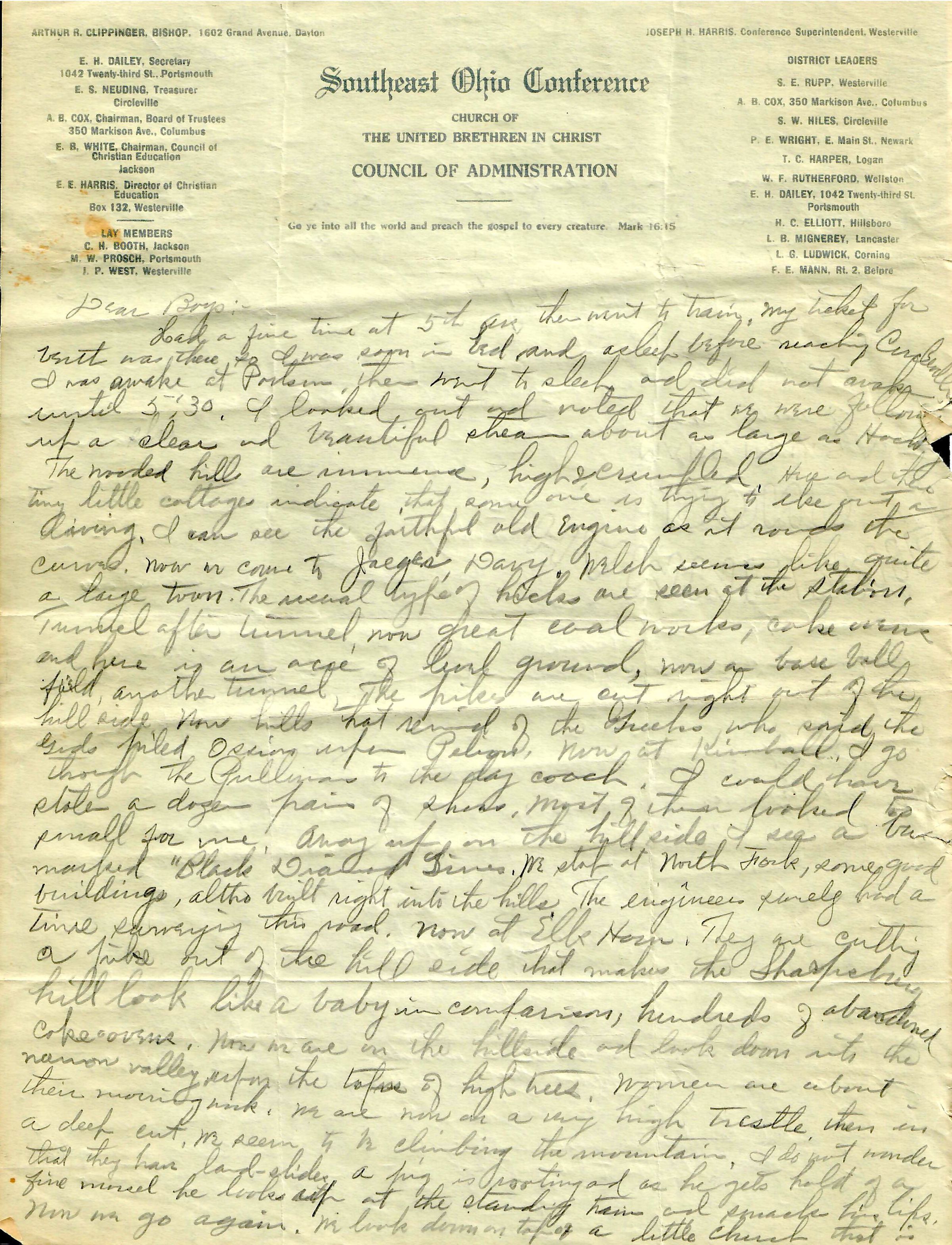
Had a fine time at 5th Ave then went to train. My ticket for berth was there so I was soon in bed and asleep before reaching Circleville. I was awake at Portsm. then went to sleep and did not awake until 5:30. I looked out and noted that we were following up a clear and beautiful stream about as large as Hocking. The wooded hills are immense, high & crumpled. Here and there tiny little cottages indicate that some one is trying to eke out a living. I can see the faithful old engine as it rounds the curves. Now we come to Jaeger, Davy. Welch seems like quite a large town. The usual type of hicks are seen at the station. Tunnel after tunnel, now great coal works, coke ovens and here is an acre of level ground, now a base ball field, another tunnel. The pikes are cut right out of the hill side. Now hills that remind of the Greeks who said the Gods piled Ossion upon Pelion. Now at Kimball. I go through the Pullmans to the day coach. I could have stolen a dozen pairs of shoes. Most of them looked too small for me. Away up on the hillside I see a bus marked "Black Diamond Lines." We stop at North Fork, some good buildings, altho built right into the hills. The engineers surely had a time surveying this road. Now at Elk Horn. They are cutting a pike out of the hill side that makes the Sharpsburg hill look like a baby in comparison, hundreds of abandoned coke ovens. Now we are on the hillside and look down into the narrow valley upon the tops of high trees. Women are about their morning work. We are now on a very high trestle, then in a deep cut. We seem to be climbing the mountain. I do not wonder that they have land-slides. A pig is rooting and as he gets hold of a fine morsel he looks up at the standing train and smacks his lips. Now we go again. We look down on top of a little church that is dear to some one of course. Now in a long tunnel. We are down grade now and the engine chuckles, "Thot I could, thot I could." Now at Bluestone. The name of our Pullman is "Diversey." Here are some stone fences. We now come to the first farm land (rough enough) that I have seen. Now at Bluefield, quite a place. A long train. I get breakfast in diner. Buttered toast, two small slices, Cream of Wheat, and coffee, lots of cream for wheat & coffee. 60c/ then 10c/ tip for a fellow to watch me eat the stuff. It is now 9:15. Wonderful scenery on every hand. Cloudy. Here an old man and a boy planting something midst stones & stumps reminds me of early days when even the sight of such a train would have been a real thrill. Here the strata of the rocks stand almost perpendicular. Now we come into Va. Here a beautiful river (new, I think). Cliffs at my right so high I cannot see the top from the car window. There are 12 cars and frequently the engine is out of view around the curve because of cliffs that jut out. Now at Walton Jc. and some passengers get off. We follow the course of the river about as large as Muskingham. There goes a woman with a washtub over her head and a bucket on one arm, - wash day I presume. The country seems more even but in the distance is the high and long range of hills. Now we are nearing Roanoke where I change. Perhaps I will get home before this does, but it will give a little idea of reality. Some women near me are cackling. Now at Roanoke, a city of considerable size, a center for the N & W. Change for Elkton. I get a sandwich for 15c/. Four trains are standing here. The usual goodbyes and kisses are going on. In front end of coach in large letters is the word "White." Colored folk may not enter, I wonder that they did not challenge me. The news boy is calling, "Cherries, Nabiscos, etc." Train is full. Now we go again. There is quite an expanse of fairly level land with poor looking soil, reddish clay mingled with gravel. Both to right and left are the mountains covered with shrubs and evergreen. They look mighty rough. Here is a large cooper factory at Cloverdale.
Several log houses. This soil is finer than Tick Ridge. Troutville, an old colonial house stands near station. Thousands of Xmas trees. 65 years ago detachments of contending armies were sweeping over this territory. Arcadia is about as big as Plantsville, but O the scenery surrounding it. Now we move along at base of mountains, steep with great rocks jutting out. An old gentleman in front of me has attracted the attention of a little girl with her writing tablet and they are having a great time. Now we are following the course up the James River reminding me of course of King James. Now at Natural Bridge. Here is a range of what appears to be almost solid rocks. Now within a few ft of water's edge of James River. Here a fine field of wheat ripening.
Here is a concrete dam making a beautiful body of water. Still cloudy and fog rising. Now at Buena Vista. Raining some now. Tops of mts in distance are hidden by the fog. This train is about like the N & W in Ohio, the same characteristic whistle. We now come into a beautiful plain with the mts far in the distance. There are some beautiful farms with orchards, splendid houses and great barns. Here is a flock of sheep, the first I have seen. Plenty of Fords here. A wonderful orchard. Now at Waynesboro, quite a little city. Another R.R. crosses overhead, E & W. At Crimora is a firm named Harris. Sells farm implements. Here is Harriston which consists of a little station house. Now we come to the Shenandoah River and soon we reach Elkton. If you can't read this perhaps I can interpret it.
Papa
Pres Maiden met me at Elkton. Now in Harrisonburg.
Arriving at Elkton. Mr. Maiden met me and soon in a neat little machine. We faced Westward. I soon learned that the range of Mts I had viewed for 126 mi was the Blue Ridge. It is about 40 mi west to the Range of the Alleghenies over which I had come early in the day. Between these and just ahead of us is a short range 50 miles long called Massanutten the Southern end of which ends in a beautiful high peak. We face along the base of it. The country is beautiful. It is 18 mi to Harrisonburg where I saw J. W. Wright and then on to Dayton 4 mi. This is a beautiful country. Was entertained splendidly in Pres Maiden's home. Virginia 15 and Jean 5 are the children. Attended a musical program at night. Went to Bridgewater College in afternoon. Spoke to five audiences Sun morning, attended band concert afternoon. In Civil War a general was killed near Dayton and Gen Sheridan ordered Dayton to be burned. Lt. Hayes (afterward Pres) was in immediate charge and said he did not have the heart to burn the homes where there were so many Union people so they destroyed foodstuffs, barns, etc. From this point N. nearly everything was destroyed. The water supply here is a spring with lake furnishing 3,000,000 gal. of water daily. Mr. & Mrs. Wright with Lorene Smith come after me and I go to Harrisonburg to speak in evening. They have a wonderful church and parsonage. I never met finer people than the folks here. We retire 11:30 and at 4:30 Monday are up again and after a nice breakfast I take train for Strasburg. Cloudy. We go along the course of the Shenandoah River. Fields are rolling and green with grass, wheat, etc. It is raining now so I cannot see far. There are only 5 passengers on this car. At this point the river is a little larger than Hocking.
Now at New Market and we come to the scenes of many historical incidents. Over the doors of the station are the words white, colored. Here Gen Early's army camped after Sheridan turned on him at the battle of Cedar Creek in which Uncle Geo Harris participated. Both armies marched up and down the valley. Massanutten was used as a signal station. From just north of Harrisonburg the Lincolns moved to Kentucky. We near Strasburg where Gen Bank's line was cut by the Confederates. The remains of the earth works are still visible. Through this section Lee's army marched on the way to fatal Gettysburg. Now at Woodstock. The station is built of beautiful limestone with which this community abounds. At Strasburg Jc I change to B & O for Harpers Ferry. The train turned on the Y so I seem to be going south. Have not seen the Sun since I left Westerville, but presume He is still there. Now the mts appear in the distance. Now at Cedar Creek. There are monuments here marking the scenes of carnage. The brakeman points out the battle field where Uncle Geo was. He showed me the house of Sheridan's headquarters. The brakeman was reared in this valley. It was the home of Dr. Frankhouser, Fries, Frankhouse, Burtners, etc. I see several stone fences and I can understand why an army liked to get behind a stone fence. Winchester, where Sheridan's army was surprised and routed was Gen Braddock's & Washington's headquarters. There are many orchards here. Kernstown, where a severe little battle was fought. Station at Winchester is built of stone. The limestone soil produces good blue grass. One sees many old colonial homes. Some fields are so stony I presume they never have been plowed. This is a hick train. The engine is attached to this coach so I am pretty close to the engineer.
Here is a flock of turkey buzzards. Now at Summit Point, W.Va. Here is a very old stone barn. A boy comes bounding out to examine the engine. Now at Charlestown where John Brown was in prison, tried and executed. Gen Chas Lee, and Gen Gates lived here. Dolly Madison was married here. Our engine has left us. Here a boy, barefoot, comes leading a little dog with a chain. A greasy looking negro with hands in pockets is bracing up a post of the station. Our engine comes back and on we go. Now at Halltown, now at Millville where we come into full view again of the Shenandoah River. Only 4 mi to Harpers Ferry where John Brown made his raid. The R.R. is right by the river's edge, very stony and the Mts come right down to river. At Harpers Ferry I have a little over an hour so I get ticket then not seeing a guide I walked half mi to the John Brown Ft. & Storer school for colored. Lt. Lee led in battering down the door with ladder. I will describe this trip. I rushed back and went to Jefferson Rock then got some sandwiches and went to train. At the station are tablets concerning John Brown, also a large tablet which shows the site of the U.S. Arsenal which Brown captured. I feel like singing "John Brown's body, he's mouldering in the tomb, etc." Now we start with the bluffs of Harpers Ferry at left and the beautiful Potomac at right. The conductor is jolly and tells me I can go via Pittsburgh or Grafton as I chose and get to Cols on same train. Martinsburg, a city of 18000 and now we come into more level country for a while, but off to the South is a range of mts. I get cup of coffee and eat the two pimento cheese sandwiches. The limestone continues, splendid orchards, cloudy skies. Although it is decoration day I have seen no signs of it except a few tourist machines passing through Harpers Ferry. This is a good train about 45 per hr. Coach about full, but so far since I left Cols I have had seat alone. We go through deep cut. Here we come to Potomac again. Several children with their dollies remind me of old days. Splendid to look out on the river on right, rocky bluffs on left. The strata in rocks are almost perpendicular. Christmas trees by the thousands. I can see our engine quite frequently. A great concrete wall on left to hold the bluffs. For a long way we follow the river's edge. Now at Paw Paw. Some get off, others get on. Now at Green Spring. Now we come to Cumberland, Md. We have crossed the Potomac into Md. This is quite a R.R. center. Now we follow along N. bank of Potomac. Now the mts, like great saddles of the Gods, covered with thick foliage. The cliffs beyond river are much like the Palisades. From Piedmont to Mountain Park Hotel 20 miles the grade 1554 ft. Now at Keyser nestled among the mts. Now at Piedmont 2:30 P.M., quite a place where some Civil War activities took place. We now begin to climb the Alleghenies. And the engine is saying, "Think I can," pretty lively. The river here is rocky and swift and soon we leave it having followed its course about 130 mi. Away ahead on the right side I see the track over which we are to go. The cliff on left is perhaps 100 ft perpendicular. On right we look down upon the trees far below. There are 3 tracks all the way. There is a watchman to note if anything rolls down on the tracks. A great spring gushes out of the mt side. Now we are coasting. Really the Sun is shining about half his strength. Now we are getting away from the mt range and a wonderful agricultural section opens up.
Now we go up grade again to Terra Alta 2500 ft and then begin to coast again. This certainly is wonderful. Looking ahead I can see almost a steep grade with three tracks. We meet a coal train with two great engines pushing to help the third one. I have noted several overhead R.R. crossing our tracks and several of these tunnel right into the mt. They have some powerful engines to climb the mts. Cliffs, cliffs perpendicular and high. Now we dart into a long tunnel. There is another long side of this. Change at Grafton. Train crowded so I give my seat to lady as far as Fairmont. We follow course of Tigert Valley River clear, part of it very stony and swift, wonderful scenery. This river joins with another branch just above Fairmont to form the Monongahela River. At Fairmont we leave the river and dart into the hills, tunnels, bridge, cuts and fills. We go up alongside a little creek where there are mines, some agriculture. Here and there are little huts where it would seem people live in almost degradation. The conductor is jolly and hails me as Rev. A drunk Italian is in seat back of me muttering and smoking. The conductor came along and said, "John, you're on the wrong train you must get off at next stop." As we passed thru Fairmont I thot of Dan and John. Mines, abandoned coke ovens.