Name/Title
AU Harris, Daniel Alfred - XXXX-XX-XX letter to unknown recipient - Naples, ItalyEntry/Object ID
2003.1.8Context
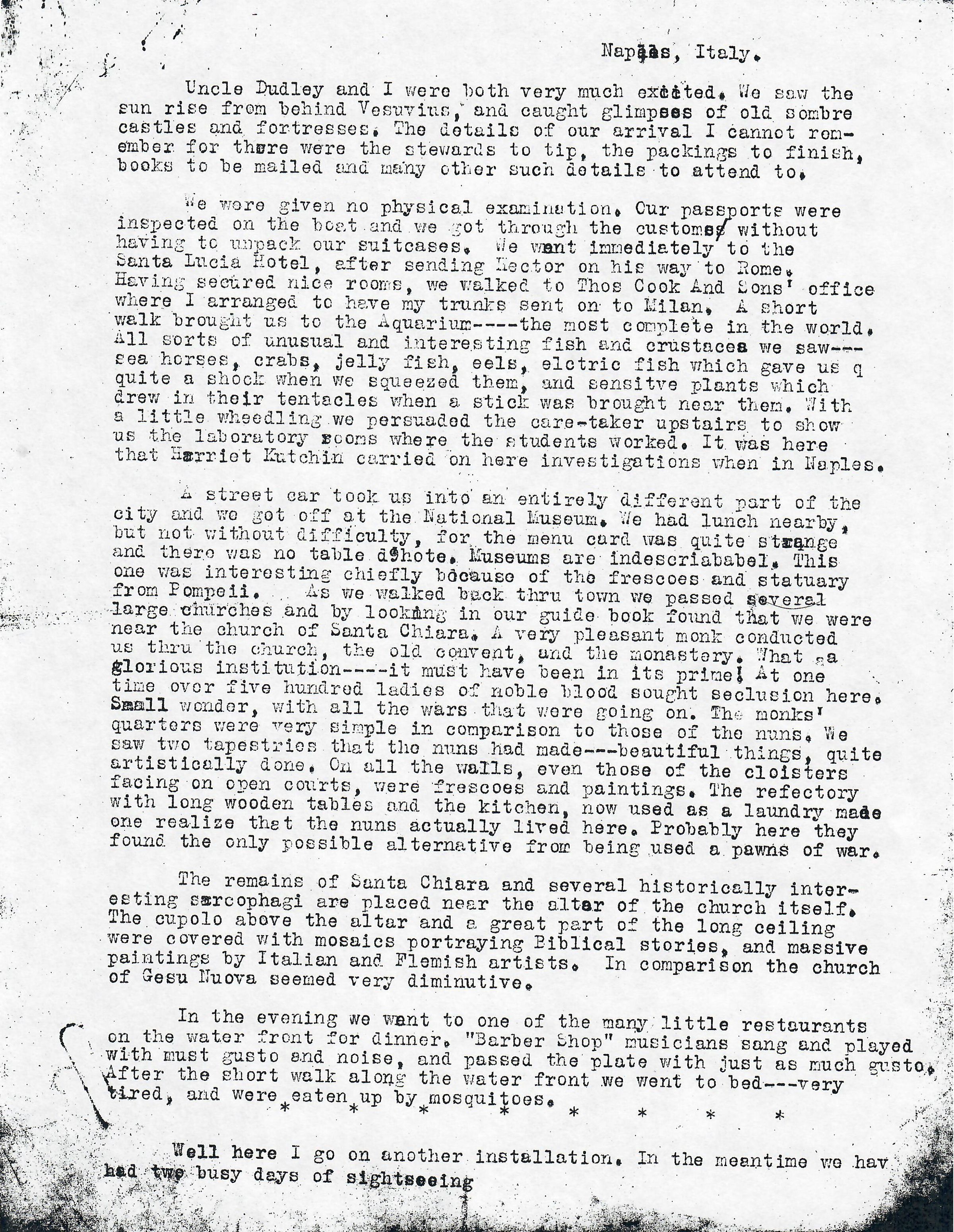
Naples, Italy.
Uncle Dudley and I were both very much excited; We saw the sun rise from behind Vesuvius, and caught glimpses of old sombre castles and fortresses. The details of our arrival I cannot remember for there were the stewards to tip, the packings to finish, books to be mailed and many other such details to attend to.
We were given no physical examination. Our passports were inspected on the boat and we got through the customs without having to unpack our suitcases. We went immediately to the Santa Lucia Hotel, after sending Hector on his way to Rome. Having secured nice rooms, we walked to Thos Cook And Sons’ office where I arranged to have my trunks sent on to Milan. A short walk brought us to the Aquarium----the most complete in the world. All sorts of unusual and interesting fish and crustaces we saw---sea horses, crabs, jelly fish, eels, electric fish which gave us quite a shock when we squeezed them, and sensitive plants which drew in their tentacles when a stick was brought near them. With a little wheedling we persuaded the care-taker upstairs to show us the laboratory rooms where the students worked. It was here that Harriet Kutchin carried on her investigations when in Naples.
A street car took us into an entirely different part of the city and we got off at the National Museum. We had lunch nearby, but not without difficulty, for the menu card was quite strange and there was no table d'hote. Museums are indescribable. This one was interesting chiefly because of the frescoes and statuary from Pompeii. As we walked back thru town we passed several large churches and by looking in our guide book found that we were near the church of Santa Chiara. A very pleasant monk conducted us thru the church, the old convent, and the monastery. What a glorious institution ----it must have been in its prime! At on time over five hundred ladies of noble blood sought seclusion here. Small wonder, with all the wars that were going on. The monks' quarters were very simple in comparison to those of the nuns. We saw two tapestries that the nuns had made---beautiful things, quite artistically done. On all the walls, even those of the cloisters facing on open courts, were frescoes and painting. The refectory with long wooden tables and the kitchen, now used as a laundry made one realize that the nuns actually lived here. Probably here they found the only possible alternative from being used as pawns of war.
The remains of Santa Chiara and several historically interesting sarcophagi are placed near the altar of the church itself. The cupolo above the alter and a great part of the long ceiling were covered with mosaics portraying Biblical stories, and massive paintings by Italian and Flemish artists. In comparison the church of Gesu Nuova seemed very diminutive.
In the evening we want to one of the many little restaurants on the water front for dinner. "Barber Shop" musicians sang and played with much gusto and noise, and passed the plate with just as much gusto. After the short walk along the water front we went to bed---very tired, and were eaten up by mosquitoes.
Well here I go on another installation. In the meantime we have had two busy days of sightseeing in Rome----inexhaustible treasure house. Don't know how successfully I can get back into the atmosphere of Naples and Capri.
Friday morning we got up early and took the smaller (and less expensive) of the two boats for Capri. More "barber shop" musicians furnished entertainment on the way over. Some of it was pretty bad. After touching at Sorento we went to the Blue Grotto where small boats were waiting to take the passengers into the grotto---two or three in a boat. As we approached the opening to the grotto, which was only two or three feet high, it was necessary to almost lie down in the bottom of the boat. Once inside the ceiling arched up and formed a large cavern, flooded with soft blue light, caused by the entrance of the sun light under water. The boat man refused our modest tips as beneath his notice so we let him go with nothing at all.
The motor boat took us to Marina Grande, the main landing place for the island of Capri, and there we had lunch at the Belle-Vue Hotel, left our bags there, and started out in search of adventure. We took the funicular, which is nothing more or less than an inclined cable railway, to the little town of Capri, in a saddle between two hills in the center of the island. Here we bargained with the driver of a "buck-board" as Leo called them, for a drive up to Anacapri a little village much higher up and reached by a winding steep road. I remember the trip chiefly because of the beautiful view of the lower part of the island, and because I left my "Blue Guide of Southern Italy" on a bench when I got out to take a picture. Our drive enticed into taking the drive down to Piccola Marina, on the opposite side of the island from Marina Grande where we had landed. The deep blue of the water, the fantastic shapes of the rocks, and the gleaming white of the houses in the afternoon sun made a picture such as one sees only in imagination— a dream picture made a reality.
Returning again to the town of Capri, we climbed on foot to the ruins of the villa of Tiberius, the wealthy Roman Emperor who retired to Capri to live. The view from the promontory on which the villa is located is one of the most beautiful I have ever seen. Nearby we saw the precipice over which Tiberius is said to have thrown his victims. We returned from our climb, which had taken several hours, thoroughly tired out, took the funicular to Marina Grande and after dinner went to bed, but not before Uncle Dudley and Leo had nearly bought out the hotel supply of beads, scarfs, boxes, etc. Saturday was a memorable day as on that day we took the justly famous Amalfi drive.
At five in the morning we arose breakfasted or tea and rolls, and took the six o’clock boat to Sorrento, where after some complications, we secured a machine and chauffeur for the drive. Sorrento itself is pretty but I do not like it as well as Capri. From a little beyond Sorrento to Amalfi the road is built from twenty five to two hundred feet above the sea, blasted out of the cliffs and built up from below. Each of the hundred odd turns brings a new picture into view, great brown and yellow and white crags and overhanging rocks above, dark caves and mysterious looking grottoes below, the Siren Islands green and white against the vivid blue sea. Here and there we crossed clefts in the rock and from the bridges we could see below the ancient remains left by Saracens pirates who frequented these inaccessible mountainous coasts. At intervals, on high promontories projecting into the sea, stood old Moorish and Saracen watch towers. Who knows what booty and spoils were carried up into these rock bound fastnesses, now inhabited only by fishermen! Beyond Amalfi we left the sea and drove up through the mountains, passing old churches, once mosques, tiny villages and beautiful scenes. As we climbed to the summit of the divide the whole Bay of Naples and the towns around it lay spread out at our feet. About a half hour later we arrived at Pompeii, had lunch at the very nice Swiss restaurant and then spent about two hours walking around through the streets and houses of the once buried city. Certainly people lived then in much the same way as they do now with the exception of a few mechanical improvements. Although many of the utensils and frescoes have been removed to the museum, there are a few houses that have been left almost as excavated. In the museum nearby we saw several petrified bodies in the same position when excavated as when they had died two thousand years ago, fighting the rain of hot ashes.
The remainder of the drive back to Sorrento was of very little interest, for we drove through dirty towns and over roads white with dust most of the way. We arrived in Sorrento in time for the four-thirty boat back to Naples, reached the hotel about seven and after dinner went to bed, tired, but happy.
Sunday morning we took the eight-forty five train to where we changed to the Thos, Cook railway for Vesuvius. We proceeded several miles on a section of track of about 2.5% grade, changing then to a much steeper section of cog and pinion, and after that more of the 2.5%. Finally the funicular itself----55% grade cable railway, We passed large fields of lava, some of it from the 1906 eruption, some of it much older. Here and there the government had built horizontal walls to block the rolling stones loosened by rains. At the top of the funicular we paid our entrance fee, secured our guide and followed a path which led up to the very rim of the large crater. From here we could get a magnificent view of the small crater within the large one—a comparatively small cone, spouting out huge clouds of smoke. As we stood there we were startled by a rumble and a boom and in the tense silence that followed we could hear the ashes and little stones falling on the floor of the large crater, while overhead the smoke poured up thicker than ever. This occurred twice while we were watching.
In the floor of the large crater could be seen the opening caused by the minor eruption of twenty five days before, and the fresh lava which had been thrown out at that time. Here and there through the interior walls of the large crater, steam and Sulphur vapours hissed and sputtered. On the floor of large crater we could distinguish the tiny figures of several men, studying the opening made by the recent eruption. The large crater, on the rim of which we were standing seemed to be composed of red ashes, the material which buried Pompeii.
In response to our inquiries the guide said that modern seismography made it possible to predict the extent of any future eruption with great accuracy so they would have plenty of time to escape in case of a serious eruption. We had lunch about half way down the mountain at the Eremo Hotel operated by Cook's where they gave us the benefit of the rise in the value of the lira in figuring the bill! Back in Naples at 2:15 and we started to carry our luggage to the main station which we thought was just around the corner, but which proved to be about half a mile. We nearly broke our backs. After much inquiring in Italian and some tipping we landed, bag, and baggage, in our compartment together with a pleasant looking priest. You see them everywhere in Italy. The compartment seated eight and was soon filled. The train was hot and there was little ventilation so the five hour trip was a tiresome one, brightened only by the sight of wonderful old castles on every favorably situated hilltop. Part of the time we passed through a valley between high mountains, on the sides of which little villages clustered around the crumbling ruins of old castles.
A woman in our compartment had brought her lunch, --a long loaf of bread which she split open to make a huge cheese sandwich, and some very juicy fruit! By the time we reached Rome night had fallen, and as we entered the city we could see the huge arches of an ancient aqueduct in the moonlight.
To the Quirinal Hotel.
We were very tired, so we slept late Monday morning and then went to see Hector who had gone to a private hospital for some surgical work, more serious than he had supposed. In the afternoon we wrote post cards and I started this letter. No sightseeing for a whole day! Labor day so we laid off for the day. Yesterday and today were packed to the brim with interesting things;---St. Peter's, Vatican, Museum, Forum, Catacombs, etc.
Devotedly,
Dan.